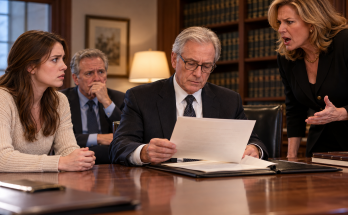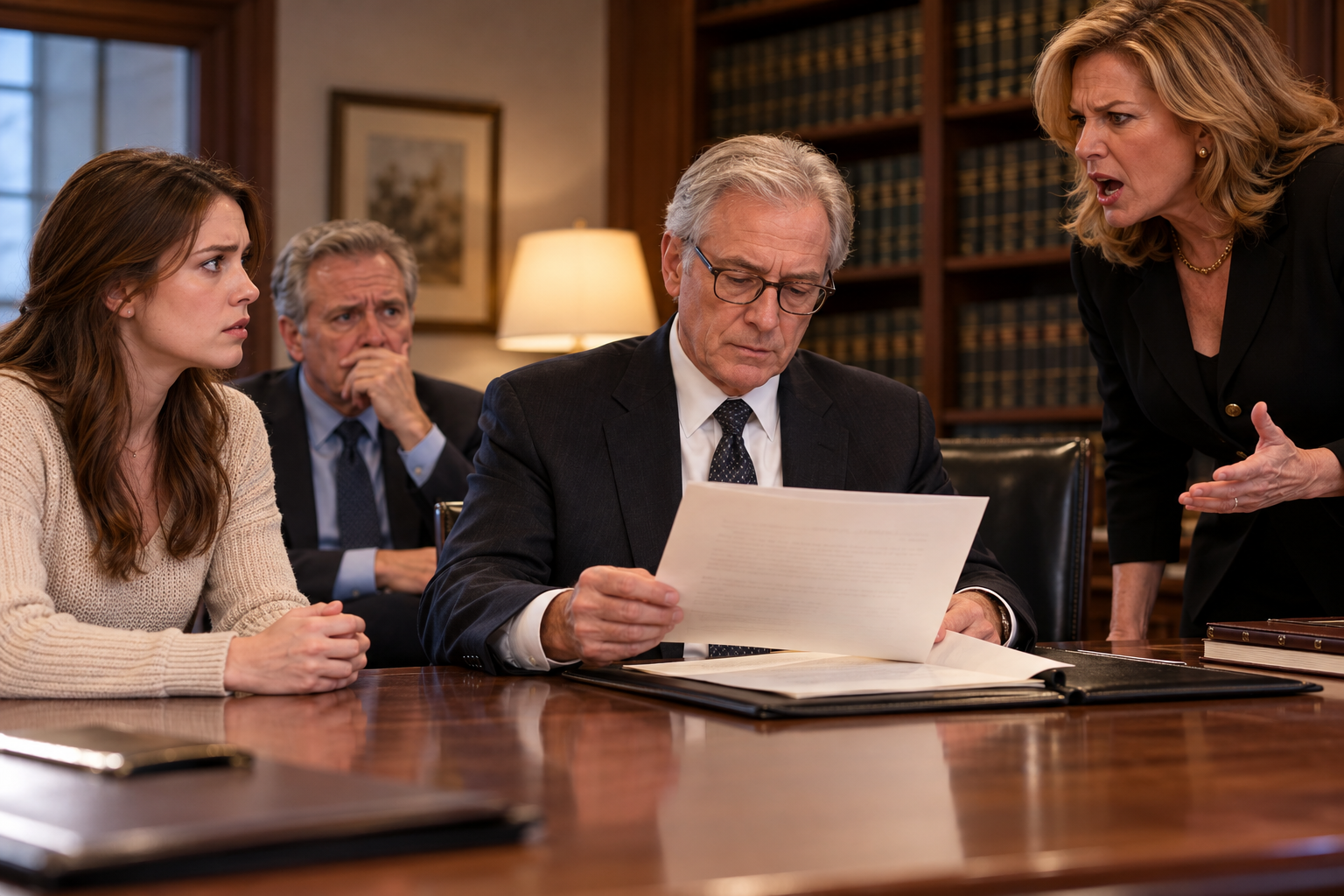
The second page was open.
I kept looking at it.
Mr. Caldwell had unfolded it after I asked him to continue.
My mother had told me to stay out of the conversation.
I had refused.
And now I was waiting to hear the words Nana had left behind.
I wanted an answer so badly that I almost convinced myself I already understood.
My mother was angry.
My father looked frightened.
Surely those reactions meant something.
But I did not know what.
That was the truth I kept coming back to.
Mr. Caldwell had told us Nana signed the amendment three days before she died.
Two independent witnesses had been present.
The document had been notarized.
And her attending physician had confirmed in writing that she was mentally competent.
Those were facts.
They mattered.
But they did not tell me what the amendment contained.
I looked at my father.
His expression had troubled me from the moment the lawyer mentioned the change.
I had expected him to be angry, perhaps.
Instead, he had looked terrified.
I could not forget it.
Yet I could not explain it either.
I wondered whether he had known about the amendment.
I wondered whether he had expected different instructions.
I wondered whether my mother had understood something I had missed.
Then I stopped myself.
I had no answers to those questions.
Only guesses.
And guesses were not enough.
My mother had already shown how quickly an assumption could become an accusation.
She had said Nana was too ill to understand what she signed.
Mr. Caldwell had answered with the physician’s written confirmation.
I did not want to make the same mistake.
Not about Nana.
Not about my father.
Not even about my mother.
I was hurt by the way she treated me.
That much I knew.
She had tried to silence me when I asked the lawyer to continue.
I could remember the sharpness in her voice.
The way she said my name.
Sarah.
As though speaking had been something I should apologize for.
For a moment, I almost had.
I had nearly surrendered the conversation simply to avoid making her angrier.
Looking back, that was the part that embarrassed me.
I had done nothing wrong by asking to hear Nana’s instructions.
I was entitled to listen.
Yet I had needed a moment to remember that.
I looked down at the paper again.
It seemed strange that such an ordinary object could make the room feel so different.
Printed words.
A signature.
An amendment.
Nothing about the paper itself looked frightening.
The fear came from what we thought it might mean.
And I did not want my thoughts to become a substitute for Nana’s words.
I had begun to understand something about myself.
When I was frightened, I wanted to explain everything immediately.
A look.
A silence.
A sudden change in someone’s voice.
I wanted each detail to fit into a complete story.
But real events did not always give me that satisfaction.
Sometimes there was a question.
Then another question.
And no answer yet.
That was where I found myself.
My mother had challenged the amendment.
The lawyer had answered her concerns about its signing and Nana’s competence.
I had refused to remain silent.
Then Mr. Caldwell opened the next page.
I could not go beyond that without the actual contents.
I did not know whether Nana had changed the beneficiaries.
I did not know whether she had revised a particular instruction.
I did not know whether she had addressed my parents directly.
Those details had not been revealed.
And I would not assign them to her.
I thought about the date again.
Three days before her death.
That was not much time.
But according to the physician, Nana had been capable of making her decision.
My mother’s anger did not cancel that assessment.
My father’s fear did not explain the decision.
Only the amendment could.
I wanted to hear it.
I wanted to understand.
And I wanted to be fair when I finally did.
That last part mattered.
Because I knew I might not like what Nana had decided.
I had no guarantee that the amendment would benefit me.
I had no guarantee it would explain my parents’ behavior.
It might have raised questions I had never considered.
I could not know.
But I was determined not to reject it merely because it surprised me.
I had expected that much fairness from my mother.
I needed to expect it from myself.
I looked toward Mr. Caldwell.
He was still the person who could give us the next piece of information.
Not because he understood every private feeling in the room.
But because he had the document.
The written instructions.
The formal record of Nana’s final decision.
I wanted those words to matter more than anyone’s reaction.
Including mine.
I remained in my chair.
I had already chosen not to leave the discussion.
Now I made another choice.
I would not turn uncertainty into a false accusation.
My parents’ reactions deserved attention.
They did not deserve to be treated as proof of things I had not established.
Nana’s amendment deserved the same care.
I could not rewrite its contents to satisfy my suspicion.
I could not give it an ending that had not been provided.
And I could not pretend that the second page had revealed something when its words remained unknown.
For the moment, that was where the truth stopped.
Mr. Caldwell had opened the document.
I had stayed.
And I was ready to hear Nana’s actual instructions.
Click here to continue reading: PART 18: My Mother Wanted Me Out of the Will Reading, but I Had Finally Learned That Staying Silent Would Not Protect Nana’s Wishes
I Thought My Grandmother’s Will Would Finally Bring Us Answers, Until the Lawyer Announced Something My Mother Refused to Accept
Part 17 of 20