The courthouse called two days later.
The clerk told me the related filing had been located and that I could collect a copy.
I thanked her and asked whether I needed to bring anything besides my identification.
She said that would be enough.
I called Mr. Harris's office to ask whether I should wait until our next appointment to read it.
His receptionist took a message.
He returned my call that afternoon.
"Collect the document," he told me. "You can look through it, but don't draw conclusions from a few lines. Bring the full copy when we meet."
I promised I would.
The next morning, I drove to the courthouse.
I had begun to recognize the road, the parking lot, and the hallway that led to the records office.
The familiarity did not make me comfortable.
It simply meant I knew where to go.
The clerk checked my request and brought out a stapled set of pages.
She asked me to confirm the reference number.
I compared it with the number in my notebook.
It matched.
I paid the copying fee and signed the receipt.
Then I stepped away from the counter and looked at the first page.
The paper was ordinary.
The date was not.
It connected the filing to the earlier property entry and showed that the record was part of a longer sequence of documents.
I could not tell what the sequence meant, but I could see that the first document had not stood alone.
I placed the pages in my folder.
I did not try to study them in the hallway.
I wanted a quiet place where I could read each page without someone waiting behind me.
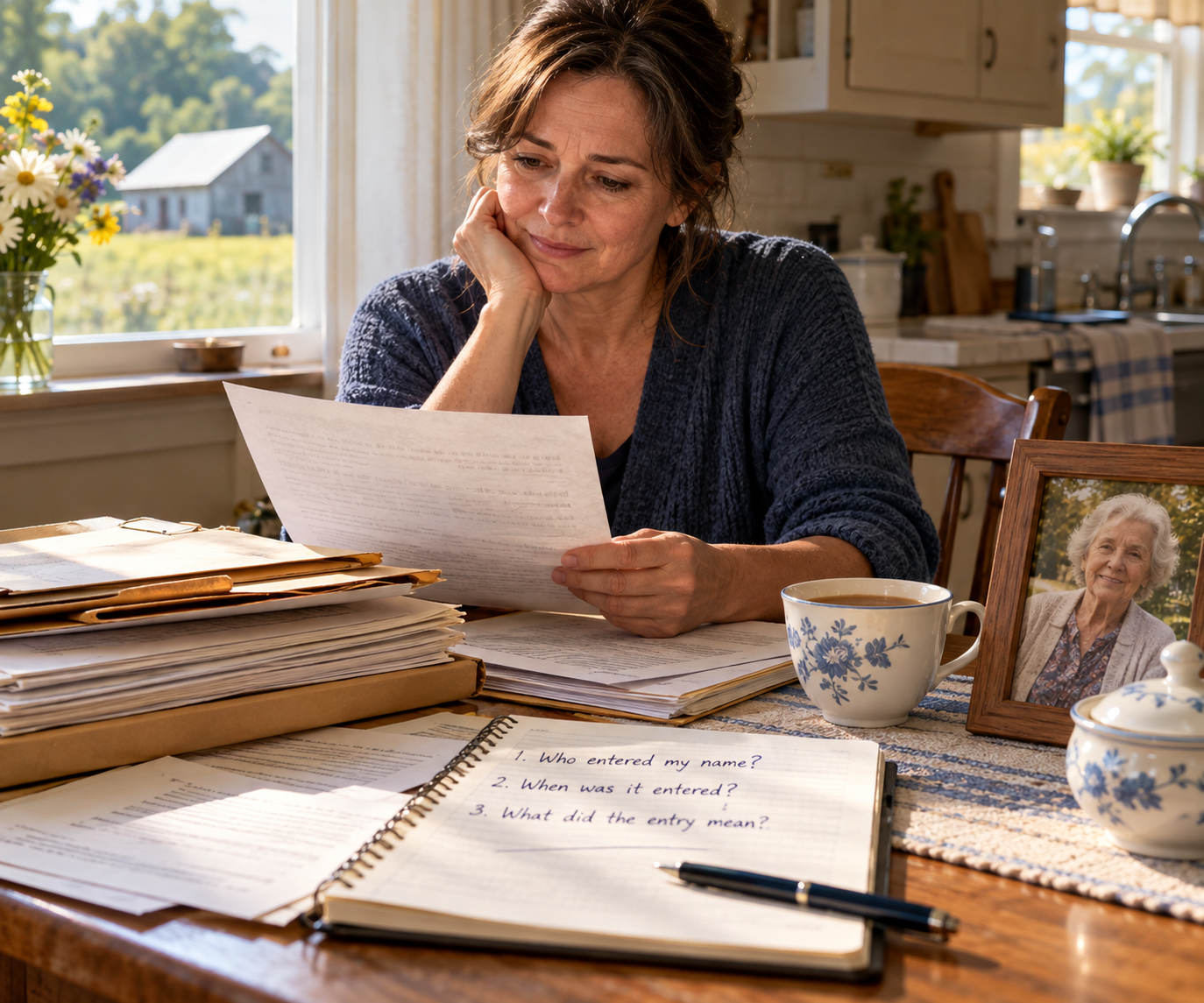
At home, I cleared the kitchen table.
I moved the sugar bowl to the counter and set the documents beside my notebook.
I started with the first page.
The language was formal, and some of the words seemed to have been chosen to make a simple idea difficult to understand.
I read slowly.
When I reached a reference number, I copied it into my notebook.
When I found a date, I checked it against the dates from the first document.
I made no guesses about the meaning of the legal terms.
Instead, I marked the passages I needed Mr. Harris to explain.
The second record did not tell me in plain language why my name had been included.
It did show that the entry belonged to a deliberate series of filings rather than an obvious mistake in copying a name.
That was useful information.
It did not establish what rights, if any, I had.
I read the pages again.
Then I placed them in order and checked the page numbers.
There were no missing pages.
I felt an unexpected sense of relief.
At least I had the whole document the clerk had provided.
I called Rosella's friend.
"I have the second record."
"Does it explain anything?"
"It explains that the first record connects to something else. It doesn't explain enough for me to know what it means."
She was quiet for a moment.
"That sounds frustrating."
"It is."
"But it's still progress."
I looked at the pages spread across the table.
"Yes. I think it is."
I told her I had an appointment to review the documents with Mr. Harris.
She encouraged me to take my time and not let anyone hurry me.
We talked for a few minutes about ordinary things.
She told me the weather was supposed to turn warmer over the weekend.
I told her I needed to buy a new light bulb for the back porch.
The conversation helped me remember that I still had a life outside the papers.
After we hung up, I put the documents into the folder.
I did not call Rosella's sons.
I had nothing definite to tell them, and I did not want another conversation based on assumptions.
The next few days were quieter.
I went to the grocery store.
I attended church.
I helped my neighbor carry a box of canned food from her car to her kitchen.
I did not mention Rosella's property unless someone asked directly.
When a woman from church asked whether I had heard from Rosella's family, I said only that I was still sorting through some records.
She nodded and changed the subject.
I was grateful.
I had no desire to turn Rosella's death into gossip.
The matter was private, even if the records were public.
On the morning of my appointment, I checked the folder twice.
The first document was behind the second.
My notes were in the front pocket.
I had written the questions in a separate column so I could find them quickly.
At Mr. Harris's office, I handed him the folder and explained when I had received the second record.
He read both documents together.
This time, he took longer.
He compared the dates and checked the reference numbers.
He made a few notes on a legal pad.
I sat across from him, keeping my hands folded in my lap.
Finally, he looked up.
"The two records are connected," he said. "That much is clear."
"What does that mean for me?"
"It means we need to understand the arrangement created by the original instrument and determine whether later events affected it."
I felt my shoulders drop.
I had hoped the second document would give us a simple answer.
Instead, it had confirmed that the first record belonged to a larger arrangement.
Mr. Harris continued.
"The language is not something I would want you to interpret alone. There are terms here that have specific legal meanings, and those meanings depend on the whole document."
"Does it say that Rosella gave me the property?"
"I would not describe it that way based on these pages alone."
I looked down at my hands.
"Does it say I have no rights?"
"I would not say that either."
I raised my eyes.
He spoke carefully.
"We need to examine the underlying instrument, the chain of title, and any later documents that may have affected the property. We also need to establish what happened through Rosella's estate."
I had never thought about the land in those terms.
I knew the farmhouse, the grove, the fields, and the creek.
I knew where the driveway narrowed near the old fence.
I knew which part of the yard stayed muddy after heavy rain.
But the legal history of the land was something I had never needed to understand while I was cleaning the house.
Now it mattered.
"Can you help me find those records?" I asked.
"I can help you identify what we need and review the documents you obtain. We may need to request additional records from the county."
I nodded.
I was learning that patience did not mean sitting still.
It meant doing the next necessary thing without pretending it was the last.
Mr. Harris explained that the records could show whether the arrangement remained effective, whether it had been changed, and what part I might have played in it.
He did not promise that I would inherit anything.
He did not tell me that I had no claim.
He told me what needed to be established.
That was enough for me to leave with a clearer plan.
Before I stood, I asked one more question.
"Could Rosella have intended to protect something without giving it to me?"
"Yes," he said. "There are arrangements that serve different purposes. But we should not guess which one applies here."
I thought about Rosella's habit of keeping her papers in separate piles.
She had always wanted things put where they belonged.
If a bill needed to be paid, she put it beneath the brass bird.
If a letter needed a reply, she placed it beside the telephone.
If a document was private, she put it away.
She had not been careless with paper.
I could not believe she had included my name in a property record by accident without some evidence to support that belief.
But I also could not say that she had intended to leave me the land.
Both possibilities remained open.
When I reached home, I put the documents back in the drawer.
I sat at the kitchen table and wrote down the new questions.
What was the original arrangement?
Were there later changes?
What happened through Rosella's estate?
I left a blank line beneath each question.
Then I wrote something else.
Do not confuse hope with proof.
I stared at the sentence for a while.
I was not ashamed of hoping that Rosella had intended to help me.
I had worked hard for most of my life.
I had often wondered whether I would ever own a home without worrying about rent or repairs.
But hope could not tell me what a legal record meant.
I needed to know what Rosella had actually arranged.
I closed the notebook and returned the sugar bowl to the center of the kitchen table.
It had no connection to the property records that I could prove.
Still, it reminded me of the woman whose silence had started all this.
I wondered whether she had ever intended to explain the papers herself.
Perhaps she had planned to tell me when the time was right.
Perhaps she had changed her mind.
Perhaps something had prevented her from finishing what she began.
I did not know.
I washed my cup, dried it, and put it away.
Then I turned off the kitchen light.
I would wait for the next set of records.
Click here to continue reading: PART 15: When I Asked About Rosella’s Estate, I Learned That Her Sons Had Their Own Questions, and Neither Side Had the Whole Story
I Spent Twenty-Six Years Cleaning a Wealthy Woman’s Home Without Knowing Why She Never Let Me Leave It Behind
Part 14 of 20