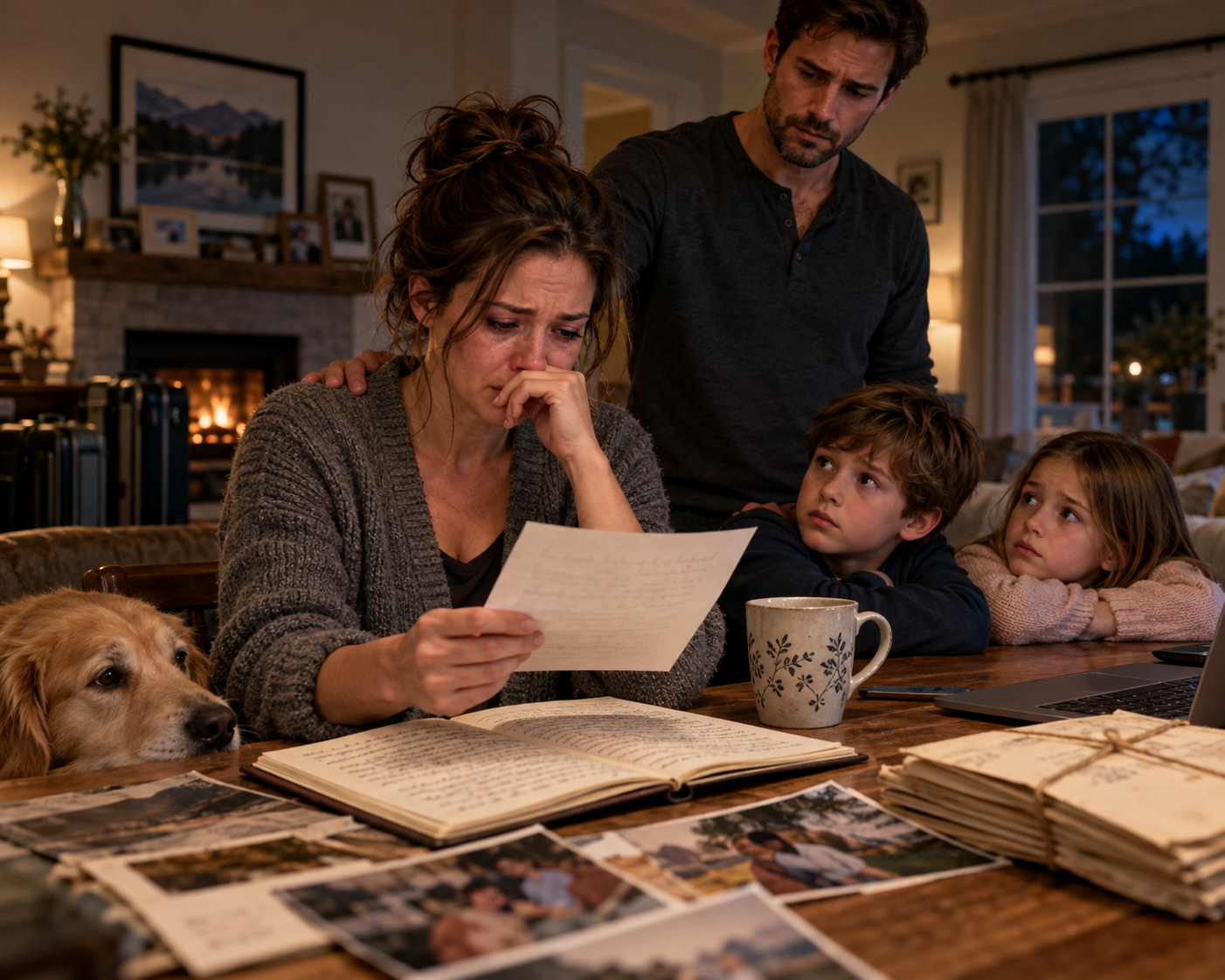
The letter remained in the drawer beside my father's notebook.
I no longer needed to read it every day.
Sometimes I opened the drawer simply to make sure it was still there.
The envelope had become familiar.
The folds in the paper were worn.
My father's handwriting remained clear enough for me to recognize every word.
I had begun to think of the letter differently.
It wasn't a verdict.
It wasn't a list of everything I had done wrong.
It was a final conversation with a man who had known me longer than anyone else in the house.
He had known the child I used to be.
He had known the young man who struggled to find his place in the world.
He had known the husband and father who tried to provide for his family.
He had also known the son who became impatient when caring for him grew difficult.
He had seen all of those versions of me.
And he had written to the man I might become if I was willing to listen.
That thought stayed with me.
One Sunday morning, I took the letter out and read it from beginning to end.
I didn't rush.
I didn't search for the sentences that made me feel better.
I read every line.
When I finished, I sat quietly at the table.
The house was still.
The clock ticked in the hallway.
I could hear Sarah moving around upstairs.
For the first time, I didn't ask myself whether I deserved my father's words.
I asked what I intended to do with them.
I had spent too much time trying to determine whether I was a good son.
The answer wasn't simple.
I had done good things.
I had also hurt him.
I had worked hard to provide for my family.
I had sometimes used that work as a reason to avoid the emotional work waiting at home.
I had loved my father.
I had also made him feel unwelcome at times.
Those truths did not cancel one another.
They belonged to the same story.
I folded the letter and placed it in the envelope.
Then I returned it to the drawer.
I didn't feel as though I had finished grieving.
I didn't expect to.
But I felt ready to stop treating my grief as a punishment I had to endure.
My father was gone.
I could not repair our final years.
I could not give him another quiet evening in the chair beside the window.
I could not ask him to tell me one more story about when I was young.
What I could do was carry the lessons forward.
That afternoon, I asked Sarah whether she wanted to take a walk with me.
She looked surprised.
"Just us?"
I nodded.
"The boys can stay home for a little while."
She smiled.
"All right."
We walked along the quiet street near our house.
At first, we talked about ordinary things.
The weather.
The grocery list.
A repair I needed to finish at work.
Then Sarah asked me how I was feeling.
I thought about giving her the usual answer.
Fine.
Tired.
Nothing to worry about.
Instead, I told her the truth.
"I still miss him."
She took my hand.
"I know."
"Some days I feel like I should have done more."
Sarah walked beside me without answering.
I continued.
"I keep thinking about all the times he asked me to sit with him, and I told him I was busy."
She squeezed my hand.
"You can't change those moments."
"I know."
I looked down at the pavement.
"But I wish I had understood what they meant."
Sarah nodded.
"So do I."
We continued walking.
I realized that I no longer needed her to tell me that everything I had done was understandable.
I could understand my own circumstances without pretending I had handled them well.
I could accept her sadness without demanding that she comfort me.
And I could miss my father without making every conversation about the things I regretted.
When we returned home, the boys were in the living room.
My younger son was sitting in the old chair beside the window.
He looked up when we entered.
"Grandpa's chair is comfortable."
I smiled.
"It was his favorite."
My son shifted in the cushion.
"I think I know why."
"Why?"
He pointed toward the yard.
"You can see everything from here."
I looked out the window.
The yard was small.
There wasn't much to see.
But the view included the side of the house, the grass, and the narrow strip of ground where birds sometimes landed.
My father had spent countless hours looking at that view.
I had assumed he was watching the world because there was nothing else for him to do.
Now I wondered whether he had found peace in the familiar things.
The house.
The yard.
The people moving through the rooms.
The sound of the clock.
My son stood and stretched.
"You can sit here if you want, Dad."
I smiled.
"Thanks."
He walked away.
I sat down in the chair.
For a few minutes, I looked out at the yard.
I didn't check my phone.
I didn't think about the next task.
I simply watched.
A bird landed near the wall.
It moved across the grass, stopped, and flew away.
I imagined my father pointing it out to me.
I imagined him waiting for me to sit beside him.
Then I let the memory rest.
I wasn't going to get that afternoon back.
But I could stay present for the afternoon I had.
That evening, the family gathered around the dinner table.
We talked about the week ahead.
The boys argued about who had left something in the hallway.
Sarah reminded them to clear their plates.
I laughed at a story my oldest son told about a friend at school.
For a moment, I looked at the empty place where my father used to sit.
The ache came back.
It probably always would.
But it no longer felt as though the only honest response was to withdraw into regret.
I could remember him and remain part of the conversation.
I could miss him while helping my sons with their homework.
I could feel sad and still laugh when something was funny.
Grief did not require me to stop living.
If anything, the letter had made that clearer.
My father had noticed the way I worked.
He had noticed the sacrifices Sarah made.
He had noticed the boys sharing their space.
He had seen the life we were trying to build, even when we were struggling to build it well.
I wanted to become someone who noticed those things, too.
After dinner, I helped clean the kitchen.
I wiped the counter.
I put the dishes away.
Then I checked that the drawer I had repaired was closing properly.
It slid smoothly into place.
I smiled at the small success.
The drawer was such an ordinary thing.
But it reminded me that change didn't always announce itself.
Sometimes it appeared in the way a person answered a question.
Sometimes it appeared in the willingness to sit down and listen.
Sometimes it appeared in a task that had been postponed too long.
And sometimes it appeared when a man finally admitted that he had not been as patient as he wanted to believe.
I turned off the kitchen light and walked into the living room.
Sarah was sitting on the sofa.
The boys were upstairs.
The photograph of my father and his grandchildren stood on the shelf.
I stopped in front of it.
My father looked happy in that picture.
So did the boys.
I couldn't know whether he had been happy every day he lived with us.
I couldn't erase the days when I made him feel like a burden.
But I could preserve the moments when we had loved one another well.
I could tell the boys the stories they hadn't heard.
I could remember the man he had been before illness changed his life.
And I could make sure that the people around me knew they mattered while they were still here to hear it.
I sat beside Sarah.
She leaned against my shoulder.
For a while, we listened to the clock.
I thought about the letter in the drawer.
My father had left me something I would never have known how to ask for while he was alive.
Not an excuse.
Not a way to pretend I had done nothing wrong.
A chance to see him clearly.
And, through him, to see myself.
I had been a son who loved his father but struggled to show that love when it became difficult.
I had been a husband who worked hard but sometimes forgot that his wife needed more than a paycheck.
I had been a father who wanted his children to be strong but had not always shown them how to be gentle.
Those were hard things to admit.
They were also things I could change.
I rested my hand over Sarah's.
The house was quiet.
The chair stood beside the window.
The clock continued ticking.
And for once, I didn't feel the need to prove that I had everything under control.
I was still learning.
I was still grieving.
I was still the man who had made mistakes he could never take back.
But I was no longer determined to defend every one of them.
I could finally listen.
I could finally admit what I had missed.
And I could finally begin living in a way that would have made my father proud.
Click here to continue reading: PART 17: The Morning After My Mother’s Retirement, I Realized Her Greatest Work Had Never Been About Serving Lunch
I Thought My Father Had Taken Too Much From My Family Until One Letter Forced Me to Face What I Had Done
Part 16 of 20