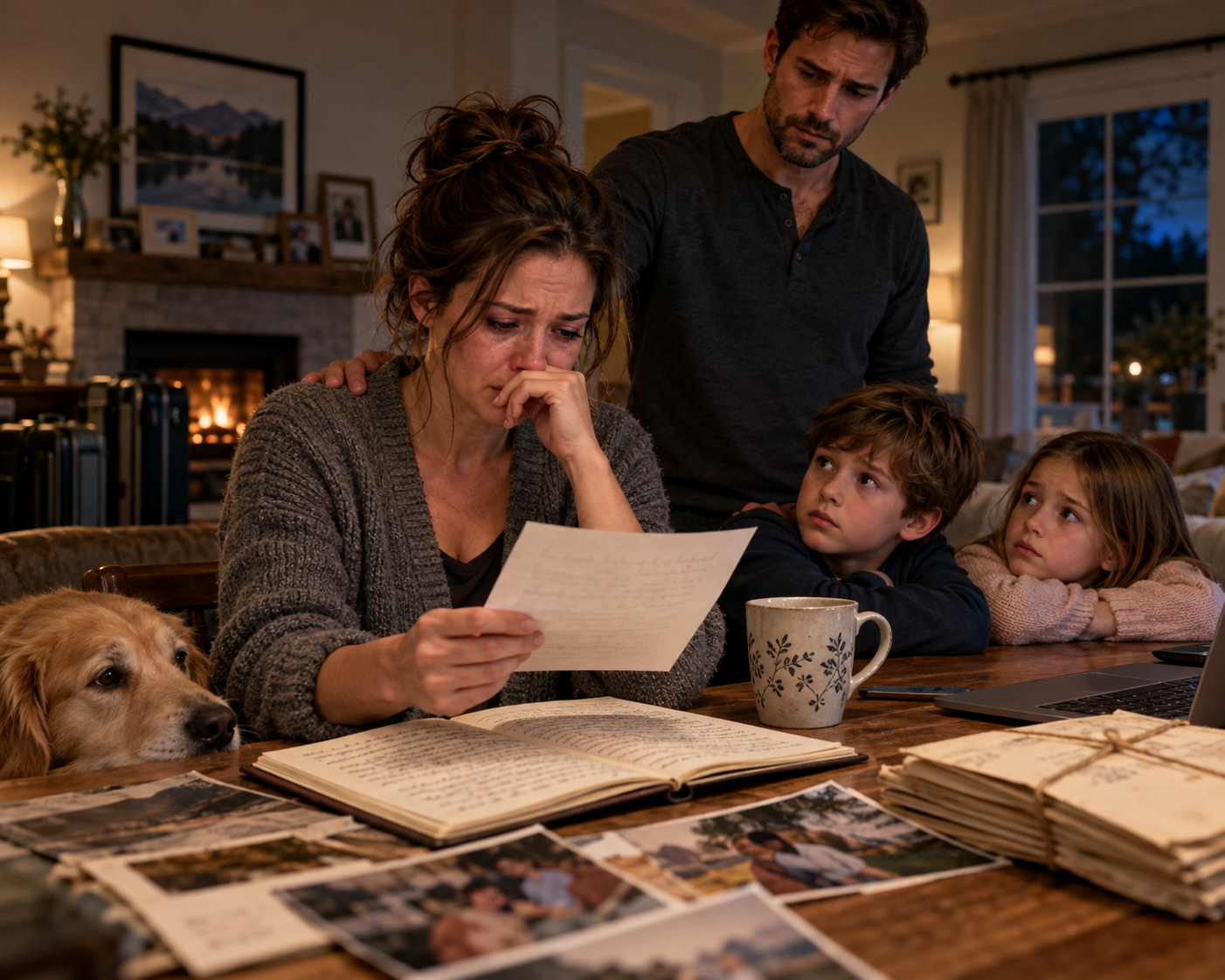
I returned to the letter the following Sunday.
The house was quiet.
Sarah had taken the boys out for a while, leaving me alone with the dining table and the old clock.
I placed the envelope in front of me.
For several minutes, I didn't open it.
I remembered the first time the lawyer had read the words aloud.
I had sat with my hands clenched beneath the table, waiting for my father to tell me what I had done wrong.
I had expected blame.
I had prepared excuses.
I had been ready to explain that I was tired, that money was tight, and that I had never intended to hurt him.
But the letter had not given me the argument I expected.
My father had acknowledged the pressure.
He had recognized the work.
He had understood the fear.
And because he had done those things, I could no longer pretend that my mistakes came from being misunderstood.
I opened the envelope.
The paper had become softer along the folds.
I read the first page slowly.
Then I moved to the next.
I stopped at the passage about the medicine and the appointments.
Those expenses had been real.
I would never deny that.
There had been months when the money seemed to disappear before we had a chance to use it for anything else.
I remembered the frustration of opening a bill after a long shift.
I remembered calculating the cost of a prescription while standing in the kitchen.
I remembered wondering whether we could keep going if another unexpected expense appeared.
Those memories still mattered.
But I could now see another side of them.
My father had never chosen to become ill.
He hadn't asked to lose his strength.
He hadn't planned to spend his final years depending on his son.
He had been a man who once carried his own burdens, until the day came when he needed someone to help carry them.
I had understood that fact in theory.
I hadn't accepted what it required from me emotionally.
I had wanted caring for him to be simple.
I had wanted to help him without feeling tired.
I had wanted to give without worrying about what I might lose.
When those feelings didn't come naturally, I treated them as evidence that something was wrong with him.
I could see now that something was wrong with me, too.
Not because I had struggled.
Because I had allowed my struggle to become a reason to make someone else feel ashamed.
I turned the page.
The next passage described the boys.
I thought about the way my oldest son had wiped his eyes during the reading.
I had seen him cry before.
He was a sensitive boy, though he tried to hide it when he thought someone might tease him.
I had always told him that being strong meant facing difficult things.
I had never considered that he might already have been facing something difficult inside our own home.
He had watched me become impatient with my father.
He had heard me complain about the money.
He had noticed when Sarah looked tired.
And he had learned that the safest response was often to say nothing.
I had wanted my sons to grow into men who could take responsibility.
I had not wanted them to believe that responsibility gave them permission to become unkind.
Yet that was the lesson I had risked teaching them.
I set the letter down.
Then I stood and walked to the living room.
The chair beside the window was empty.
I sat in it.
The cushion gave slightly beneath my weight.
Outside, a bird landed on the grass and pecked at something near the wall.
I watched it for a few seconds.
My father would have noticed that bird.
He might have told me what kind it was.
I might have listened.
Or I might have checked my phone and told him I was busy.
I would never know.
That was one of the hardest parts of regret.
It didn't only remind you of what you had done.
It reminded you of all the ordinary chances you had been given to do something different.
A question you could have answered more gently.
A few minutes you could have spent sitting beside someone.
A meal you could have shared without complaining.
A request you could have treated as an opportunity rather than an interruption.
None of those moments had seemed important at the time.
Together, they had made up a life.
I returned to the table and read the final page again.
My father had written that he was proud of me.
I still found that difficult to accept.
Part of me believed I had forfeited the right to hear it.
But that was another way of making the letter about myself.
My father had chosen those words because he meant them.
He had seen my mistakes.
He had also seen my efforts.
He had not decided that one erased the other.
I had been the one who insisted on treating everything as a test I either passed or failed.
I folded the letter and returned it to the envelope.
When Sarah and the boys came home, I was still sitting at the table.
My younger son entered first.
He dropped his schoolbag near the door and looked at me.
"Are you reading Grandpa's letter again?"
I nodded.
He came closer.
"Does it make you sad?"
I considered the question.
"Yes."
He waited.
"But it also helps me understand him better."
My son pulled out a chair.
"Grandpa used to say that you worried too much."
I looked at him.
"When did he say that?"
"Sometimes when you were working late."
I felt a small smile form.
"That sounds like him."
"He said you always thought you had to fix everything yourself."
I stared at my son.
The words sounded familiar because they were familiar.
My father had told me something similar when I was young.
I had dismissed it as advice from a man who didn't understand the demands of my life.
Now I wondered whether he had understood those demands better than I had understood myself.
My son leaned forward.
"Are you going to be different now?"
I didn't answer immediately.
I could have promised him that I would never lose my temper again.
I could have told him that I would always listen.
But I had learned something about promises.
They were easy to make when the difficult moment had passed.
Keeping them required attention long after the emotion had faded.
"I'm going to try," I said.
He nodded.
"Okay."
He stood and walked toward the kitchen.
I watched him go.
The answer hadn't been dramatic.
It hadn't needed to be.
I couldn't change the father I had been during those years.
I could only decide what I would do with what I now understood.
That evening, Sarah and I prepared dinner together.
We worked side by side, passing plates and setting out the food.
When I reached for something on the top shelf, she moved to help me.
I thanked her.
She smiled.
It was a small exchange.
But I remembered how often my father had thanked us for things we considered ordinary.
I had once thought his gratitude was unnecessary.
Now I understood that he had been acknowledging the effort behind each gesture.
After dinner, the boys cleared the table.
My oldest son carried the plates to the sink.
My younger son wiped the surface with a cloth.
I watched them work together.
Then I picked up the last plate and joined them.
Nobody commented on it.
We finished cleaning the kitchen and sat down for a while.
The clock ticked in the hallway.
The chair beside the window remained in its place.
And the envelope rested safely in the drawer where I had put it.
I knew there would be difficult days ahead.
There would still be bills.
There would still be worries.
There would still be moments when exhaustion made patience difficult.
The letter hadn't removed those things from my life.
It had changed what I understood about them.
I no longer wanted my family to prove that they appreciated everything I did before I offered them kindness.
I wanted to give them that kindness because they were my family.
Because my father had once done the same for me.
And because I finally understood that love could not be measured only by the things we gave up.
Sometimes it was measured by the way we treated the people who needed us when we had very little left to give.
I had not learned that lesson in time to show my father.
But I could still live by it.
For the first time since the lawyer had finished reading, I put the letter away without feeling that I was abandoning the conversation.
I knew what my father had wanted me to hear.
Now the rest was up to me.
Click here to continue reading: PART 9: I Thought Understanding My Father Would Be Enough, Until an Ordinary Evening Showed Me How Much My Family Still Needed Me to Change
I Thought My Father Had Taken Too Much From My Family Until One Letter Forced Me to Face What I Had Done
Part 8 of 20