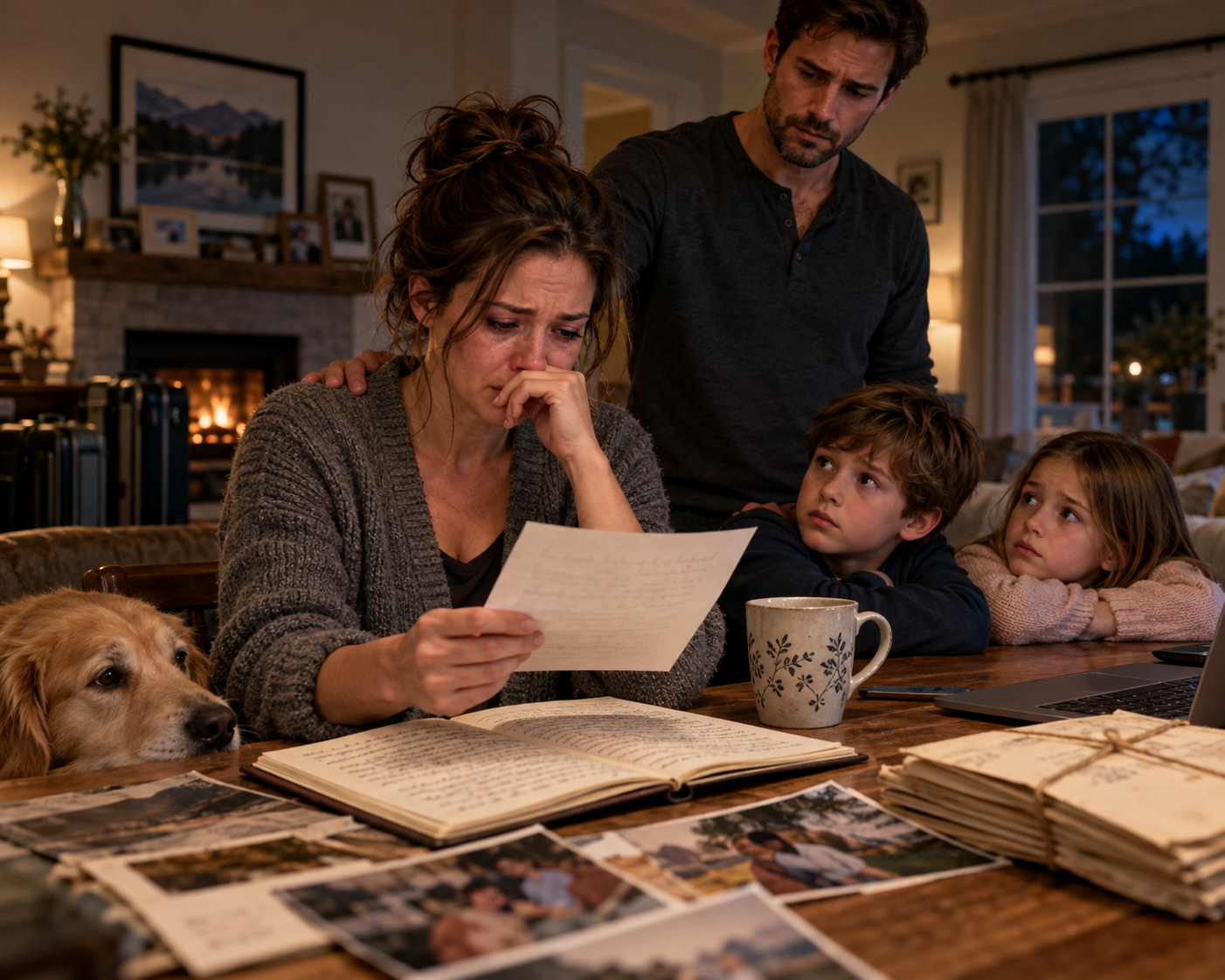
The question came on an ordinary Thursday evening.
I was standing at the kitchen counter, putting away the groceries, when my oldest son walked in.
He opened the refrigerator, stared inside, and closed it without taking anything.
Then he turned toward me.
"Dad, can I ask you something?"
I put the milk on the shelf.
"Sure."
He pulled out a chair and sat down.
I could tell from his face that this wasn't about school or something he needed money for.
He was thinking about something.
Something he had been carrying around for a while.
"Do you think Grandpa was happy living here?"
I stopped moving.
The question seemed simple enough.
I had spent weeks thinking about my father, his letter, and the years he had lived under our roof.
Yet I had never asked myself that question quite so directly.
I set the grocery bag on the counter.
"Why do you ask?"
My son looked toward the living room.
"Sometimes he seemed happy."
He paused.
"Other times, he just sat by the window."
I pulled out the chair across from him.
I knew exactly which window he meant.
The chair was still there.
The cushion still held the shallow impression where my father used to sit.
I had come to think of that chair as a reminder of everything I had failed to notice.
Now my son was asking me to consider something I couldn't answer with certainty.
"I think he had good days and bad days," I said.
My son nodded.
"But was he happy?"
I looked at the table.
I wanted to tell him yes.
I wanted to believe that my father had felt safe and loved in our home.
But I remembered the times he had waited in the doorway before asking for help.
I remembered the conversations he must have heard.
I remembered how often I had allowed my exhaustion to become his problem.
I couldn't honestly say that he had always been happy.
"I hope he was," I said.
My son looked at me.
"Me too."
We sat quietly.
Then I told him something I should have said much earlier.
"I think he knew we loved him. But I also think there were times when we made him feel like he was in the way."
My son lowered his eyes.
I watched him carefully.
I didn't want him to take responsibility for something that had never belonged to him.
"That wasn't your fault," I added.
He looked up again.
"I know."
I wasn't sure he did.
So I continued.
"You and your brother were good to him. You made room for him. You spent time with him. You did things that made him happy."
My son glanced toward the living room.
"Like the cookies?"
I smiled.
"Like the cookies."
He smiled too.
For a moment, the conversation became easier.
Then he asked another question.
"Why didn't you sit with him more?"
There it was.
The question I had been asking myself since the lawyer opened the envelope.
I could have explained my work schedule.
I could have talked about the bills.
I could have reminded my son that I had spent years trying to keep our household running.
All those things were true.
But they weren't the answer he needed.
"Because I thought I had to keep everything going," I said.
He waited.
"I was worried about money. I was tired a lot. Sometimes I thought that if I stopped working or worrying for even a little while, something would go wrong."
My son listened without interrupting.
"And sometimes, instead of telling Grandpa that I was tired, I made him feel like he was the reason I was tired."
The words were difficult to say.
They were also true.
My son rubbed his thumb along the edge of the table.
"Did he know you loved him?"
I thought about the letter.
I thought about the way my father had described my work, Sarah's efforts, and the boys' willingness to share their space.
"Yes," I said. "I believe he did."
Then I took a breath.
"But knowing someone loves you doesn't mean they never get hurt by that person."
My son looked at me for a long moment.
I wondered whether he understood what I meant.
Perhaps he understood more than I realized.
Children notice things long before adults are willing to talk about them.
They notice when a voice changes.
They notice when someone becomes quiet.
They notice when a person who used to sit at the table begins eating alone.
Sometimes they simply don't know what those things mean.
I had made the mistake of believing that because my sons were young, they hadn't noticed my behavior.
They had noticed.
They had simply learned to live around it.
My oldest son stood and opened the refrigerator again.
This time, he took out a bottle of water.
Before leaving the kitchen, he turned back.
"I liked sitting with Grandpa."
I nodded.
"He liked sitting with you."
My son smiled faintly.
Then he went upstairs.
I remained at the table.
The groceries were still scattered across the counter.
I put them away slowly.
That night, I told Sarah about the conversation.
She listened while I sat beside her on the sofa.
When I finished, she looked toward the photograph of my father and the boys.
"He asked me something similar once," she said.
I turned toward her.
"When?"
"Not long before he died."
I waited.
She folded her hands in her lap.
"He asked whether the boys would remember him."
My chest tightened.
"What did you tell him?"
"I told him they would."
She looked at me.
"He seemed relieved."
I stared at the photograph.
My father had been worried about the same thing I was worrying about now.
Not whether his grandchildren would remember every story he told them.
Not whether they would remember every meal or every birthday.
He had wondered whether he would remain part of their lives after he was gone.
And I had spent so much time worrying about the burden of keeping him comfortable that I had overlooked his fear of becoming forgettable.
"Why didn't you tell me?" I asked.
Sarah's expression softened.
"I didn't know what to say to you then. We were both under a lot of pressure."
I nodded.
I understood.
She had been trying to protect the boys.
She had been trying to protect my father.
And sometimes, she had been trying to protect me from another difficult conversation.
She shouldn't have had to do all that.
"I'm sorry," I said.
Sarah took my hand.
"I know."
I looked toward the chair beside the window.
The next morning, I moved the photograph of my father and the boys from the shelf to a place where it was easier to see.
My younger son noticed it while getting ready for school.
"Why did you move that?"
"So we can see it better."
He studied the photograph.
Then he pointed toward his grandfather.
"I remember when he told us to smile."
I laughed.
"He always wanted one more picture."
My son grinned.
"He said the first one didn't count because I was looking at the dog."
I remembered that.
The dog had belonged to a neighbor.
It had wandered into the yard just as Sarah was taking the picture.
My younger son had turned toward it, and my father had laughed so hard that he had to sit down.
We had taken another photograph a few minutes later.
That was the one now sitting on the shelf.
My son walked away, still smiling.
I stayed in the living room for a moment.
I realized that my father had left us more than a letter.
He had left us memories that each of us carried differently.
My job wasn't to decide which memories mattered most.
It was to listen when my family shared theirs.
That evening, I asked both boys whether they wanted to look through the photographs again.
They agreed.
We sat around the coffee table, passing pictures from one person to another.
Sarah told a story about my father helping her prepare dinner.
My oldest son remembered the chair.
My younger son remembered the cookies.
I told them about the time my father carried me to bed after I fell asleep watching television.
Some stories made us laugh.
Others made us quiet.
We didn't try to turn every memory into a lesson.
We simply let them belong to us.
For the first time, the photograph on the shelf didn't feel like a reminder of what I had lost.
It also reminded me of what my father had given us.
And I wanted my sons to remember both.
Click here to continue reading: PART 14: I Had Always Believed a Good Father Was Someone Who Never Showed His Weakness, Until I Realized What That Belief Had Cost Us All
I Thought My Father Had Taken Too Much From My Family Until One Letter Forced Me to Face What I Had Done
Part 13 of 20