I moved slowly, giving myself time to recover from the afternoon.
My body was tired, and my face still hurt.
I wanted to go somewhere quiet and let the day settle around me.
I didn't want another argument.
I didn't want to explain myself to anyone who had already decided that my needs were inconvenient.
And I didn't want to make a decision simply because I was afraid of what Deacon might think.
For once, I wanted to consider what was right for me.
That should not have felt so unfamiliar.
Yet it did.
I had spent most of my adult life making choices around the people who depended on me.
When Deacon was a child, that had been necessary.
When he became a man, I kept doing it because I had grown accustomed to being the person who adjusted first.
I had mistaken the habit for a permanent duty.
Now I was beginning to see the difference.
A mother could care deeply about her child without allowing him to control every conversation.
She could offer help without accepting disrespect.
She could forgive a mistake without pretending that the mistake had never happened.
Those things should have been obvious.
They had taken me seventy-three years to understand in a way I could finally accept.
I stopped and looked at my phone again.
There was still no word from Deacon.
I felt the familiar disappointment rise, but I didn't let it decide what I would do.
Maybe he was angry.
Maybe he believed I had embarrassed him.
Maybe he was waiting for me to call first.
I could imagine a dozen explanations.
None of them changed the fact that he had hit me.
I put the phone away.
I wasn't going to spend another hour trying to guess which explanation might make his behavior easier to accept.
There was nothing wrong with wanting an apology.
There was nothing wrong with hoping that my son would recognize the seriousness of what he had done.
But I could not make my peace depend on whether he gave me the words I wanted to hear.
I had to begin with what I knew.
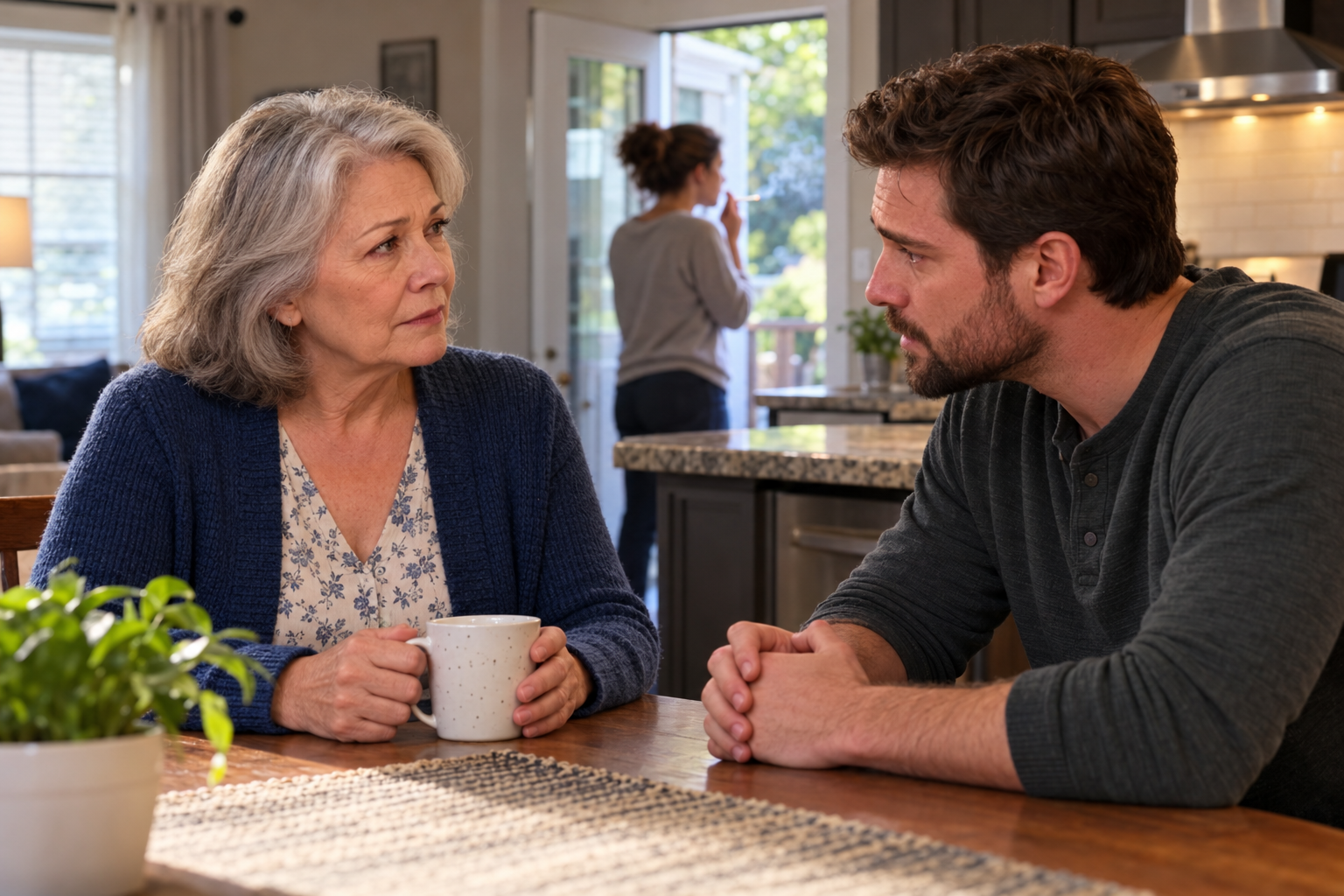
I knew I had asked Sloan to smoke somewhere else because the cigarette smoke made breathing difficult.
I knew Deacon had become angry.
I knew he had struck me.
I knew he had shown no immediate concern for my pain.
Those facts were enough to guide my next decision.
I would not return to his house that afternoon.
I would not enter another conversation while I was still shaken.
And I would not apologize for asking to breathe clean air.
The decision brought sadness with it.
I had always imagined that my relationship with Deacon would become easier as we grew older.
I thought that once he had established his own life, we would have more time to enjoy each other.
I pictured quiet visits, ordinary conversations, and the comfort of knowing that the hardest years were behind us.
I hadn't expected to feel unwelcome in his home.
I hadn't expected to wonder whether I was safe around him.
And I certainly hadn't expected that a simple request about cigarette smoke would reveal how far apart we had become.
I sat down once more and rested my hands on my purse.
The small mirror inside it pressed against my fingers.
I thought about taking it out again, but I didn't.
I knew what my face looked like.
I didn't need to keep checking.
The more difficult thing to examine was the relationship itself.
I had to ask myself whether I had been holding on to an old version of Deacon because accepting the truth about the present felt too painful.
I remembered the boy who used to sit beside me at the kitchen table.
I remembered his questions, his laughter, and the way he used to trust me with things he was afraid to tell anyone else.
Those memories were real.
They deserved a place in my heart.
But they could not erase the man who had stood in front of me that afternoon.
Both versions belonged to the same person.
I had to stop treating the good memories as evidence that the hurtful moments didn't count.
They counted.
I could love the child I had raised and still be disappointed in the adult he had become.
I could remember the sacrifices I made for him without using them to demand gratitude.
And I could recognize that those sacrifices had never purchased a guarantee that he would treat me kindly.
I had given because I loved him.
That love was real.
So was the harm he had caused.
I didn't need to deny either one.
The thought made me feel older in a way that had nothing to do with my body.
I was grieving something I had not expected to lose.
Not necessarily my son himself.
I still hoped we could find a way forward.
But I was grieving the certainty I once had that being his mother would always mean being safe with him.
That certainty was gone.
It might never return in the same form.
If our relationship improved, it would have to be built on something more honest than my willingness to overlook whatever hurt me.
I needed to see that Deacon understood what had happened.
I needed to know that he could take responsibility without blaming me for asking a reasonable question.
And I needed to see that his behavior would change, not merely hear that he wished the argument had never occurred.
I didn't know whether he was capable of doing those things.
I hoped he was.
But hope was not a plan.
I had to make decisions based on what I could see, not only what I wanted to believe.
I took a careful breath.
The air felt easier on my lungs than it had inside the kitchen.
I was grateful for that small comfort.
I had spent years trying to make myself comfortable in situations that were bad for me.
I had stayed quiet around smoke.
I had swallowed hurtful words.
I had accepted impatience because I didn't want to seem demanding.
I had told myself that these were small sacrifices.
But small sacrifices could become a way of life when they were always made by the same person.
I didn't want to live that way anymore.
I wanted to be able to say what I needed without rehearsing an apology first.
I wanted to be able to leave a room when I felt unsafe.
I wanted to know that I could protect my health without being accused of creating trouble.
Those were ordinary expectations.
I had no reason to feel guilty for wanting them.
I looked down at my hands.
They had done a great deal of work over the years.
They had cooked meals, washed clothes, filled out forms, paid bills, and held my son when he needed comfort.
They had worked through pain and exhaustion because there had been no other choice.
I had never expected those hands to remain strong forever.
I had never expected my body to stay healthy.
But I had hoped that age would bring a little more kindness into my life.
I had hoped that the child I raised would understand that his mother was no longer able to endure everything she once could.
Perhaps he had never truly understood.
Perhaps I had made it too easy for him not to.
Whatever the reason, I could not keep waiting for him to discover my limits on his own.
I had to state them.
And then I had to respect them myself.
That meant not returning to the kitchen simply because I felt guilty about leaving.
It meant not calling to reassure him before he had even asked whether I was all right.
It meant allowing the consequences of his behavior to remain his responsibility.
I knew those choices might be difficult.
I also knew that the old choices had become unbearable.
I stood up again.
This time, I didn't look back toward the direction of Deacon's house.
I didn't need to.
I knew what had happened there.
I knew what I had asked for.
And I knew what I would no longer accept.
The phone remained quiet in my purse.
I was still waiting for the conversation that might come next, but I wasn't waiting for it to tell me whether I had done the right thing.
I had made the call because I needed help.
I had spoken because the truth mattered.
I had left because I deserved to feel safe.
Those decisions did not become wrong simply because my son might be upset by them.
I had spent years trying to protect his world from discomfort.
Now I was allowing him to face the consequences of his own actions.
I hoped he would learn from them.
I hoped we might eventually speak honestly.
I hoped that one day I could look at him without remembering the sound of his hand striking my face.
But I would not make promises about a future I could not control.
For the first time, I understood that loving my son did not require me to abandon myself.
I could leave the door open to reconciliation without pretending nothing had happened.
I could care about his future without taking responsibility for his choices.
And I could remain his mother without allowing him to treat me as though I had no right to say no.
The afternoon had changed something between us.
I could not yet know what that change would cost.
But I knew I could not return to the way things had been.
I had finally stopped waiting for Deacon to decide whether my pain mattered.
It mattered already.
And that was where I would begin.
Click here to continue reading: PART 9: The Morning After the Slap, I Realized That My Son’s Silence Was Not the Only Thing I Needed to Pay Attention To
I Thought My Son Would Protect Me, Until I Asked His Wife for One Small Favor in Their Kitchen
Part 8 of 20