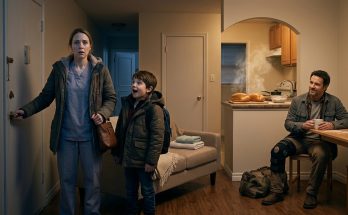
Maya arrived at four fifty-two the next afternoon carrying a backpack, a science workbook, and a paper bag that smelled like french fries.
Austin parked at the curb instead of pulling into the driveway.
That was new.
He got out, walked Maya to the porch, and handed me the bag.
“Dinner.”
I looked inside.
A burger.
Fries.
Apple slices.
“And?”
He frowned.
“And what?”
“What are you eating?”
He smiled.
“We’re going out after therapy.”
Of course.
I had forgotten.
For one second, the old impulse appeared.
Do you have reservations?
Where?
Is Chloe eating enough?
Do you need money?
Should I pack something for later?
I let every question pass.
“Have a good time.”
Austin looked almost surprised.
“Thanks.”
Maya stepped inside.
Then Austin remained on the porch.
“Mom.”
“Yes?”
“Nine.”
I smiled.
“Nine.”
“If we’re delayed, I call.”
“Exactly.”
He nodded.
The exchange took perhaps six seconds.
A year earlier it would have required no exchange because we would both have assumed I was available until whenever he returned.
Change often looked disappointingly ordinary.
No trumpets.
No dramatic confrontation.
Just a clock time spoken aloud.
Maya dropped her backpack beside the sofa.
“Can I see your cabin pictures?”
“You have homework.”
She groaned.
“You sound exactly the same.”
“That is reassuring.”
She flopped dramatically into Ernest’s chair.
I stopped.
Not because she had done anything wrong.
Because no one had sat there since I came home.
The chair had become sacred in my mind without my consciously deciding it.
Maya noticed my face.
She jumped up immediately.
“Sorry.”
“No.”
I surprised myself.
“You can sit there.”
“Grandpa’s chair.”
“Yes.”
She looked uncertain.
“Are you sure?”
I looked at the worn armrest where Ernest’s fingers used to tap while he watched television.
A chair was not a grave.
And Ernest had never tolerated furniture nobody could use.
“He would complain if we turned it into a museum.”
Maya smiled.
“Grandpa complained about everything.”
“Correct.”
She sat again.
I made tea.
She drank lemonade.
For twenty minutes she did homework while I read at the dining table.
No one spoke.
I loved it.
Not because I had missed quiet.
Because this quiet did not ask anything of me.
At six, Maya closed the workbook.
“Done.”
“Show me.”
She passed it over automatically.
I nearly corrected three answers before remembering it was not my assignment to manage.
“Did your teacher ask adults to check it?”
“No.”
“Then I am not checking it.”
She stared at me.
“You used to.”
“I know.”
“Why not now?”
“Because then your teacher learns whether you understand it.”
“That sounds suspiciously reasonable.”
I laughed.
She was becoming more like Chloe.
We ate at the kitchen table.
Maya asked about the sea turtle.
Then about Ruth.
Then whether people on the ship ever became sick of each other.
“Yes.”
“Did you?”
“Sometimes.”
“Who?”
“That is classified cruise information.”
She grinned.
Then she asked, “Did you miss us?”
The question was simple.
The answer was not.
“Yes.”
“All the time?”
I thought.
“No.”
Maya looked genuinely shocked.
“No?”
“I thought about you often. But sometimes I was busy.”
“With what?”
“Living.”
She considered that.
“Dad missed you all the time.”
I smiled faintly.
“Your dad had a difficult year.”
“He says it was his best bad year.”
That sounded like Austin.
“What does that mean?”
“He says everything got worse and then better.”
I understood.
Maya ate an apple slice.
Then said casually, “Mom says the baby might be a boy.”
My heart jumped.
“They found out?”
“She says maybe.”
“Maya.”
“What?”
“Did they tell you not to tell me?”
She froze.
That was enough.
I laughed.
“Oh no.”
“I forgot.”
“It’s fine.”
“Don’t tell them.”
“I will not lie for you.”
She groaned.
“Grandma.”
“But I do not need to volunteer the information.”
She brightened.
“That works.”
At seven thirty, she asked to see my travel souvenirs.
We opened the second suitcase.
I had barely unpacked it.
Fabric, postcards, magnets, receipts, photographs.
Maya held each item as if it were evidence from another planet.
Then she found the postcard from the gallery in Nassau.
The woman by the water.
She studied it.
“Who is she?”
“Nobody specific.”
“Why did you buy it?”
I sat beside her.
“Because she looked like she had somewhere she could go.”
Maya looked at the picture again.
“She looks lonely.”
I had never seen that.
“Maybe.”
“Did you feel lonely?”
“Sometimes.”
“Were you sad?”
“Yes.”
“Then why stay gone?”
The question had no accusation in it.
Only curiosity.
I considered how to explain adulthood without burdening her.
“Because being sad somewhere does not always mean you are in the wrong place.”
She frowned.
“That makes no sense.”
“It might when you’re older.”
“I hate when adults say that.”
“So did I.”
She smiled.
Then carefully returned the postcard.
At eight twenty, my phone buzzed.
Austin.
My first thought was: They are leaving early.
Instead the message read:
Therapy running ten minutes late. Dinner reservation moved. We can be there by 9:20. Is that okay? If not we’ll skip dinner.
I stared at the words.
A request.
Not an assumption.
I looked at Maya, who was drawing something in the notebook I had given Austin until she remembered it belonged to him and stole paper from my printer instead.
I wanted the extra twenty minutes.
I replied:
9:20 is fine.
Austin:
Thank you.
No drama.
I almost laughed at how much emotional significance could fit inside three ordinary messages.
At eight forty-five, Maya brushed her teeth because Chloe had packed a toothbrush.
Then she appeared in my bedroom doorway wearing pajamas.
“Can I ask something?”
“Yes.”
“Are you going away again?”
“Eventually.”
“For a year?”
“I don’t know.”
She leaned against the frame.
“Dad says you might travel more.”
“I might.”
“Can I come?”
“Sometimes.”
Her face brightened.
“When?”
“We have to ask your parents.”
The words felt important.
Not because Austin and Chloe controlled me.
Because they were Maya’s parents.
I had spent years stepping in before anyone asked.
This time I would not make promises that belonged to their authority.
Maya nodded.
“Maybe summer.”
“Maybe.”
She climbed onto the bed beside me.
Then touched Ernest’s pillow.
“Did Grandpa die here?”
My chest tightened.
“Yes.”
“Were you scared?”
I looked at the pillow.
“Yes.”
“Was he?”
“I think so.”
“He told Dad not to be afraid.”
“That does not mean he never was.”
Maya absorbed that.
Then asked, “Did he know you were going on the cruise?”
“I think part of him did.”
That was the truth.
He knew I wanted it.
He did not know I would actually go.
Maya curled one leg beneath herself.
“Dad says Grandpa made mistakes.”
I looked at her carefully.
“What did your dad tell you?”
“Not the grown-up stuff.”
Good.
“He said Grandpa helped too much sometimes.”
“That is one way to say it.”
“And you did too.”
I laughed softly.
“Your father has become very brave while I was away.”
She smiled.
“He says he got it from you.”
That sentence landed deeper than she could know.
I looked toward Ernest’s side of the bed.
“Maybe we both learned.”
At nine seventeen, headlights swept across the front windows.
Austin and Chloe arrived three minutes early.
Maya ran outside.
I followed more slowly.
Chloe stood beside the car.
She looked tired but lighter than before.
Austin took Maya’s backpack.
“Everything good?”
“Yes.”
“Homework?”
“Done,” Maya said.
I did not mention whether it was correct.
That was not my job.
Austin looked at me.
“Thanks, Mom.”
“You’re welcome.”
Then he checked his watch.
“Nine eighteen.”
“I noticed.”
He grinned.
“I wanted credit.”
“There he is.”
Chloe laughed.
Before they left, she touched my arm.
“Dinner next Sunday?”
I hesitated.
Not because I did not want to.
Because I wanted to notice whether I wanted to.
“Yes.”
“Our place.”
That surprised me.
“You’re cooking?”
“Austin is.”
I looked at him.
“Should I eat beforehand?”
He shook his head.
“Cruise changed you for the worse.”
They drove away.
I went inside.
The house felt quiet.
But not empty.
I washed two glasses.
Folded the blanket Maya had used.
Then stopped myself before reorganizing the backpack she accidentally left beside the sofa.
She would need it.
My old instinct said call immediately.
Drive it over.
Fix the problem before anyone feels inconvenience.
Instead I texted:
Maya left her backpack here.
Austin replied:
We’ll pick it up tomorrow.
I stared at that sentence.
We’ll pick it up.
Not Can you bring it?
Not We need it tonight.
He would handle it.
I set the backpack beside the door.
Then made tea.
The next morning, Austin arrived before work.
He knocked.
I opened the door.
He took the backpack.
“That’s it?”
“That’s it.”
“You don’t need coffee?”
“No time.”
“You don’t need—”
I stopped.
He noticed.
A smile formed.
“What?”
“Nothing.”
“No, say it.”
“I was about to manufacture errands for you.”
He laughed.
“Don’t.”
“I’m trying.”
“I know.”
He kissed my cheek.
Then paused.
“Last night was good.”
“Yes.”
“I kept waiting for you to tell me how to fix something.”
“Was there something to fix?”
“Probably. There always is.”
I smiled.
“Then you’ll find it.”
He nodded.
Before leaving, he looked toward the house.
“You decided about the developer?”
“No.”
“Want my opinion?”
That was another test.
He asked.
He did not give.
“Not yet.”
He nodded.
“Okay.”
No wounded expression.
No persuasion.
He left.
I closed the door.
The offer sat printed on my dining table.
Nearly double the house’s expected market value.
Enough money to buy a smaller home outright and invest the rest.
Enough to change my life again.
A year earlier, Austin’s opinion would have dominated the question.
Now it was one factor among many.
I toured three properties over the next two weeks.
Alone.
One was a condo overlooking Biscayne Bay.
Beautiful.
Too polished.
One was a smaller single-story house closer to Maya’s school.
Practical.
Too practical.
The third was a townhouse with a courtyard full of bougainvillea.
I liked it.
That frightened me.
Because liking it meant the old house might not be necessary forever.
At home that evening, I walked room to room.
The marks on the laundry-room door where we measured Austin’s height.
Ernest’s dent in the kitchen floor from dropping a cast-iron pan.
The patched wall where Maya drove a toy car too hard.
Memory everywhere.
But memory did not demand ownership.
That was new too.
I called Iris.
“Tell the developer I’m considering.”
“Good.”
“Not accepting.”
“I know what considering means.”
“Just making sure.”
She laughed.
Then said, “There is something from Ernest’s estate we need to close.”
My stomach tightened automatically.
She heard it.
“Nothing dramatic.”
“You trained me badly.”
“It concerns the boat proceeds.”
“The money is gone.”
“Yes. But the tax reporting requires an affidavit explaining the transfer.”
“Whose affidavit?”
“Yours.”
“I didn’t know about it.”
“That is what the affidavit says.”
I exhaled.
Simple.
Ordinary.
No fraud.
No secret sibling.
No forged signature.
I almost missed the drama.
Almost.
Two days later, I signed.
Carefully.
My own name.
My own choice.
Then I looked at my signature on the page and remembered the forged one.
For the first time, the memory did not make me angry.
It made me protective of something deeper than handwriting.
Consent.
That had been the lesson running beneath everything.
The apartment.
The loan.
The cruise.
Babysitting.
The house.
Yes mattered only if no was possible.
The following Sunday, I went to Austin and Chloe’s for dinner.
I rang the bell.
I did not use the spare key.
Chloe opened the door.
That detail nearly made me cry.
Not because she had forbidden me before.
Because I realized how often I used to enter without knocking.
Boundaries had not only been something they ignored.
I had too.
Austin stood at the stove.
Tomato sauce everywhere.
Maya was setting plates.
Chloe pointed toward the living room.
“You sit.”
“I can help.”
“I know.”
I sat.
It was surprisingly difficult.
Then Maya brought me water.
Austin burned garlic bread.
Nobody died.
Dinner happened anyway.
Halfway through, Austin asked about the house.
Not the offer.
The house itself.
“How does it feel being back?”
I considered.
“Different.”
“Bad?”
“Not bad.”
“Too big?”
I smiled.
“There’s the original question.”
He winced.
“Yeah.”
We both remembered the cemetery.
Wet grass.
His hand on my shoulder.
What are you going to do with the place?
“I’m sorry I asked you that then.”
“I know.”
“No, I’ve been thinking about it.”
I waited.
“I was already planning what happened next before Dad was even underground.”
The bluntness made Chloe glance at him.
He continued.
“I think I was scared.”
“Of what?”
“Everything changing.”
That softened the memory.
Not erased it.
Context did not erase impact.
But understanding made room around it.
“I thought if I knew what you were doing with the house, I could figure out what everything looked like.”
“You were trying to organize grief.”
“Probably.”
“You chose real estate.”
He laughed.
“Bad timing.”
“Very.”
Then he said, “Whatever you do with it is yours.”
I held his gaze.
“Thank you.”
He nodded.
No claim.
No subtle question about inheritance.
No calculation.
Later, when I stood to leave, Chloe handed me leftovers.
I almost refused automatically.
Then took them.
Receiving was part of the lesson too.
At the door, Maya hugged me.
Austin said, “Need me to drive behind you?”
“No.”
“Okay.”
No argument.
I drove home alone.
At a red light, I realized I was smiling.
The next morning, I called the developer.
Not Iris.
Myself.
“I’m not ready to sell.”
The representative tried to increase the offer slightly.
I listened.
Then said no.
Not forever.
Not from fear.
Just no today.
When I hung up, my heart pounded.
I laughed.
A year ago, saying no to my son had felt like tearing apart the family.
Now I had said no to a number large enough to change my finances and survived.
The house remained mine.
For now.
That afternoon, Mrs. Mary came over.
She brought coffee.
We sat on the porch.
“You staying?”
“For now.”
She nodded.
“Good.”
“Why good?”
“I need somebody around who knows the neighborhood history.”
“That’s selfish.”
“Yes.”
I laughed.
Then she pointed toward Ernest’s old chair visible through the window.
“You going to move that?”
“I don’t know.”
“Ugly chair.”
“He loved it.”
“Still ugly.”
I looked at it.
Maybe one day.
Not today.
The sun lowered over the street.
A car passed.
Somebody’s dog barked.
Normal life.
No emergency.
Then my phone buzzed.
Maya.
Can you come to my school Friday?
I smiled.
For what?
Her reply arrived.
Family day.
I stared at the words.
Family day.
Not rescue day.
Not emergency day.
Not unpaid-labor day.
A choice.
I typed:
Yes. I want to.
Then set the phone down.
Mrs. Mary looked at me.
“What?”
“Nothing.”
I smiled.
“Something I want to do.”
Click here to continue reading: PART 22: At Maya’s School I Heard My Son Describe Our Family Without Excuses, and One Sentence Made Me See How Far He Had Truly Come
Nine Days After I Buried My Husband, My Son Asked a Question That Made Grief Feel Like the Smaller Problem
Part 21 of 25