I used to believe I could tell when my daughter was hiding something.
I was wrong about that.
But I learned something important when Melissa answered the telephone in Mr. Okafor's office.
She didn't begin by asking why I was calling.
She didn't ask whether I needed help.
She sounded frightened.
"Mom, you can't do this to our family."
I stayed quiet for a moment.
I had been preparing myself to explain the problem.
Instead, she was already talking as though she knew it.
That should have told me everything.
But mothers have a remarkable ability to make excuses for their children.
I was no different.
"Melissa, I'm trying to find out what happened to my money."
She didn't answer immediately.
I looked across the desk.
Mr. Okafor was watching me.
Brittany remained near the door.
I was suddenly aware of how personal the conversation had become.
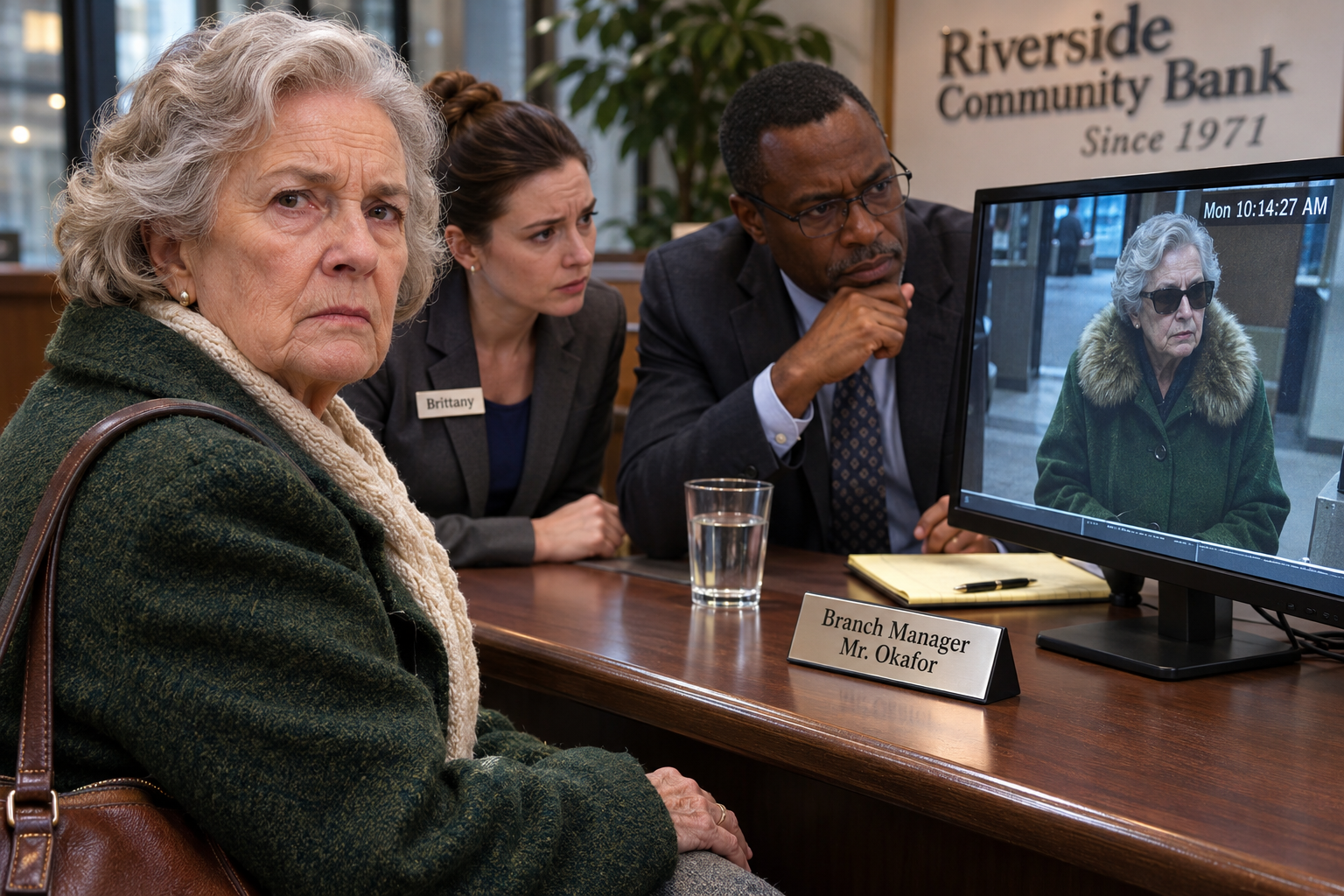
There was a security image on the computer.
There were bank records.
There were two people waiting for answers.
And there was my daughter on the telephone, begging me not to cause trouble.
"I need you to explain something," I told her.
"What?"
"Why did someone come into this bank wearing my green coat and carrying my identification?"
Her breathing changed.
I heard it clearly.
I looked at the photograph again.
Diane's gray hair.
My coat.
My identification.
Nothing about that picture looked accidental.
"Mom, there's more to it than you know."
"Then tell me what I'm missing."
She hesitated.
"It isn't simple."
I looked down at the withdrawal figures.
Sixty-one thousand dollars.
Three transactions.
I had never imagined seeing those numbers attached to somebody else's actions.
"Melissa, somebody removed sixty-one thousand dollars from my account. That part seems clear enough."
"Could you please stop speaking so loudly?"
I glanced around the office.
Nobody was making noise.
I hadn't raised my voice.
The request startled me more than it should have.
My daughter wasn't asking what had happened.
She was worrying about who might hear.
"I'm speaking normally," I said.
There was another pause.
Then she asked, "Are you alone?"
I looked at Mr. Okafor.
"No."
"Who's with you?"
"The man who manages the branch."
The telephone went quiet.
I could hear Melissa breathing.
I waited.
I had learned long ago that if you gave someone enough silence, sometimes they said the thing they were trying to avoid.
I wasn't trying to trap my daughter.
I still wanted her to have an innocent explanation.
But I didn't want to help her invent one.
Then she asked a question I hadn't expected.
"Have you mentioned Brian to him?"
I closed my eyes.
Brian.
My son-in-law.
Melissa's husband.
She had brought his name into the conversation herself.
I had been asking about Diane and the withdrawals.
Now Melissa wanted to know whether the bank manager had heard about Brian.
Something inside me settled.
Not relief.
Something colder.
"Was I supposed to mention him?" I asked.
"Mom, please listen."
"I'm listening."
"Brian did something he shouldn't have done."
I stared at the phone.
Those words were the closest thing to an admission I had heard.
She had not said the money was safe.
She had not said the bank had made a mistake.
She had not said I had misunderstood the photograph.
She had said Brian had done something wrong.
"What exactly did he do?"
"He was dealing with a lot."
I looked at the amount on the desk again.
Sixty-one thousand dollars.
I couldn't make those numbers smaller just because Brian had been struggling.
"Having problems doesn't give him permission to take my savings."
Melissa began to cry.
I knew that sound.
I had heard it when she was a little girl.
I had heard it when she was a young woman, disappointed and frightened.
And I had heard it during the difficult periods of her adult life.
My first instinct was to comfort her.
I could almost hear myself saying that everything would be fine.
I had said those words to her hundreds of times.
Sometimes they were true.
Sometimes I had made them true by fixing what was wrong.
When Melissa was little and fell, I was the one who cleaned her scraped knees.
When she failed her first driving test, I told her she could try again.
I didn't treat either disappointment as the end of the world.
I wanted her to know she could make mistakes and still be loved.
That had always mattered to me.
But looking back, I sometimes confused loving my daughter with removing every difficulty from her life.
When her first marriage fell apart, she needed somewhere to live.
I paid her rent for six months.
I didn't make a fuss about it.
She was my daughter.
I could afford to help.
And I believed that was what a mother should do.
Later, Brian came into her life.
When they decided to marry, I gave them ten thousand dollars to help pay for the wedding.
I remember thinking how much it meant to see Melissa happy again.
I didn't want her beginning that marriage under a cloud of money worries.
So I helped.
And when Melissa and Brian wanted a larger house, they needed more money for the down payment.
I contributed fifteen thousand dollars.
Again, I told myself I was helping them build something lasting.
I didn't think of those gifts as debts.
I didn't expect repayment.
But I did expect honesty.
I had never imagined that the people I helped would become connected to the disappearance of my savings.
And now Melissa was crying because I had discovered what happened.
That was difficult to accept.
I pressed my hand against my forehead.
I wasn't angry in the way people might expect.
I wasn't shouting.
I wasn't threatening anyone.
I felt tired.
The kind of tired that comes when the story you've told yourself about your family no longer agrees with what you can see.
"Melissa, I helped you both when you needed it."
"I know, Mom."
"I helped with your wedding."
"I remember."
"And the house."
"I know."
"Then why wasn't asking me enough?"
She cried harder.
I waited for an answer.
I wanted her to explain why Brian's difficulties had become a reason to touch money that didn't belong to him.
I wanted to know why Diane had been wearing my coat.
I wanted to know how my identification had been used.
Most of all, I wanted to know what Melissa knew.
But the portion of the story I could establish from that conversation gave me only part of the truth.
My daughter knew Brian was involved.
She understood that something serious had happened.
And she was frightened of what I might do after learning about it.
Those were things I could no longer pretend not to see.
I looked toward the computer screen.
The frozen picture hadn't changed.
Neither had the figures beside it.
The evidence was still there.
My daughter continued crying into the telephone.
A younger version of me would have promised to make everything better before asking another question.
I knew that about myself.
I had done it before.
But this wasn't a failed driving test.
It wasn't six months of rent.
It wasn't a wedding expense or a contribution toward a home.
It was sixty-one thousand dollars taken from an account that belonged to me.
I let Melissa cry.
I didn't tell her she was a bad daughter.
I didn't tell her I stopped loving her.
I simply stopped trying to make the conversation comfortable.
"Melissa, I need the truth."
I could hear her breathing.
I looked at Mr. Okafor.
Then I looked at my green coat in the photograph.
Whatever happened next, I knew one thing.
I couldn't keep protecting everyone from a problem they had helped create.
Click here to continue reading: PART 3: I Remembered Every Time I Had Helped Melissa and Brian, but None of Those Gifts Explained My Missing Savings
I Went Into the Bank for My Grandson’s Birthday Money, but a Question About My Account Changed Everything
Part 2 of 10