My daughter had always been able to make me feel needed.
For years, I thought that was a good thing.
I was her mother.
I wanted to be the person she could call when life went wrong.
But sitting in the bank, listening to her cry, I began to wonder whether I had made it too easy for her to expect me to solve everything.
I didn't like that thought.
It felt unkind.
Melissa had been my little girl long before she became Brian's wife.
I still remembered her knees scraped raw after a fall.
I remembered trying to make her smile when she came home disappointed from her driving test.
And I remembered how lost she had seemed after her first marriage ended.
Those memories didn't vanish because of what I had discovered.
They made it harder.
I looked at the telephone in my hand.
She was still on the other end.
I wanted to tell her that I understood.
But I didn't understand.
I understood financial difficulties.
I understood embarrassment.
I understood needing help and being afraid to ask.
What I couldn't understand was how any of those things justified someone entering my bank account without permission.
"Melissa, I want you to hear what I'm saying."
"I'm listening, Mom."
"I'm not asking whether Brian has been having a difficult time."
She sniffed.
"Then what do you want me to say?"
"I want to know why my money was taken."
I waited.
There was no answer that settled the question.
I looked down at my hands.
They were resting together on the edge of the desk.
I had held them that way when Melissa was a child and I was trying not to show her that I was worried.
It was an old habit.
Keep your hands still.
Keep your voice steady.
Deal with the problem.
But there was a difference between helping a child recover from a mistake and accepting that someone had taken your money.
I wished I'd learned that difference earlier.
When Melissa's first marriage ended, I didn't hesitate.
She needed rent.
I paid it for six months.
I remember feeling fortunate that I could help.
I didn't want her depending on a marriage that was already over.
And I didn't want her wondering where she would live.
Giving her that support had seemed obvious.
The money was mine to give.
That was the important part.
I had chosen to give it.
When Brian proposed, I was pleased that Melissa had found someone she wanted to marry.
I contributed ten thousand dollars to their wedding.
I knew weddings could become expensive.
I didn't want money to spoil what should have been a happy occasion.
So I offered what I could.
Again, it was my decision.
I could have declined.
I could have offered less.
But I wanted to give the money, and I did.
The same was true when they decided to buy a larger house.
They needed help with the down payment.
I gave them fifteen thousand dollars.
I didn't write those amounts down in order to hold them over their heads someday.
I gave them because I loved Melissa.
I thought I was helping my daughter and her husband make a stable home.
But there was one thing I hadn't agreed to.
I hadn't agreed to give them access to the rest of my savings.
That line had always existed in my mind.
Now I wondered whether it had existed in theirs.
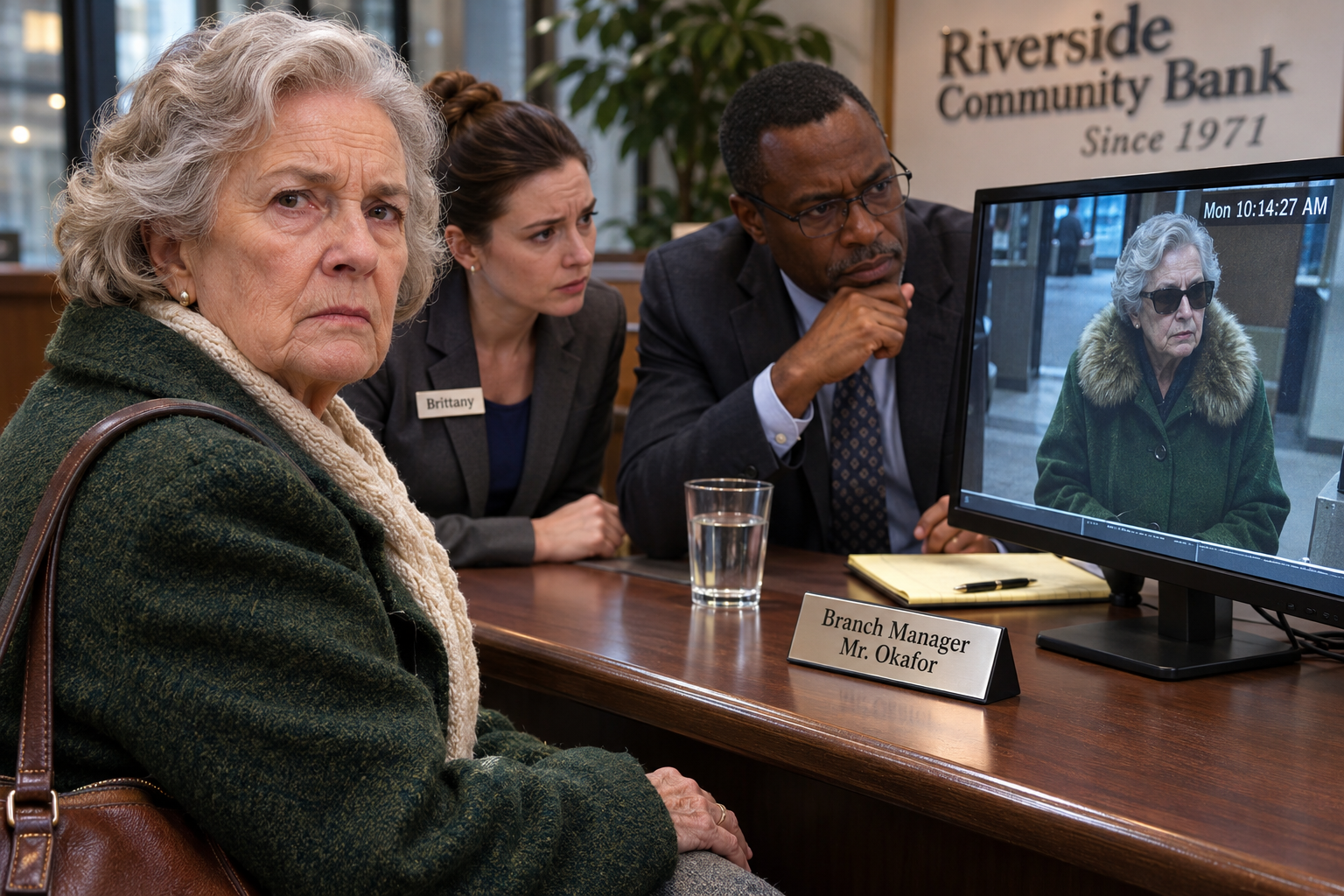
I looked back at the computer.
The image of Diane wearing my coat had become almost unbearable.
There were so many things that photograph could not explain.
It couldn't tell me what Diane had been thinking.
It couldn't tell me how my identification had reached her.
It couldn't tell me what Brian had said to anyone.
And it couldn't tell me exactly what Melissa had known before I called.
I wasn't going to invent answers just to make the picture complete.
But the photograph did establish something.
Someone else had presented herself at the bank using things that belonged to me.
And money had been withdrawn.
Three times.
Sixty-one thousand dollars.
That was enough to make me afraid.
It was also enough to make me stop treating this as an ordinary family disagreement.
"Mom," Melissa said quietly.
"Yes?"
"Brian was under so much pressure."
I felt myself tighten.
There it was again.
Pressure.
As though the difficulty of his circumstances explained the decision.
I knew plenty of people who had faced hardship.
I had faced problems myself.
Hardship could explain why someone needed money.
It couldn't make another person's account theirs to use.
"Melissa, did he have my permission?"
She didn't give me the answer I wanted.
I looked up at Mr. Okafor.
He remained at his desk.
He hadn't tried to interrupt.
I was grateful for that.
This was a conversation between a mother and a daughter.
But it was happening in a room full of evidence that had nothing to do with feelings.
I had spent years speaking to Melissa as though love could solve nearly anything.
Now I needed to speak plainly.
"I didn't agree to these withdrawals."
She was silent.
"And I didn't give Diane permission to use my identification."
The silence continued.
I didn't know what to make of it.
I wanted a denial.
A genuine one.
I wanted Melissa to tell me that the photograph was wrong and Brian had nothing to do with the money.
But she'd already brought him into the conversation.
She'd already admitted he'd done something wrong.
I could not forget that.
I had to be careful not to turn my disappointment into conclusions I couldn't prove.
Being hurt didn't mean I knew everything.
I knew the amount.
I knew the withdrawals.
I knew what the security footage showed.
I knew what my daughter had said about Brian.
The rest still needed explaining.
I asked myself what I would have done if Melissa had simply come to me and said they were in trouble.
I knew the answer.
I would have listened.
I might have helped again.
Perhaps not with sixty-one thousand dollars.
Perhaps not with any money at all.
But I would have heard them out.
I had never made my daughter earn the right to speak to me.
That was why the secrecy hurt.
There had been a way to ask.
There had been a way to tell me the truth.
Instead, I was discovering missing money while trying to buy my grandson a birthday present.
I thought of the three hundred dollars I'd wanted to withdraw.
Such a small amount beside the figure on the bank's records.
I hadn't been thinking about my savings as a fortune.
I thought of them as money that let me live without needing help.
Money that belonged to the years I'd already worked through.
Money I could choose to use for the people I loved.
That choice mattered.
It mattered more than I had realized.
I looked at the photograph once more.
For a second, I imagined myself standing in place of the woman wearing my coat.
The bank records might have said the same thing.
The identification might have looked the same.
But I knew where I had been in all of this.
I had been unaware.
And that made the resemblance cruel.
Someone had used the appearance of being me to remove something that was mine.
"Mom, I wish you would just listen to me," Melissa said.
"I have been listening."
"Then you know it isn't what it looks like."
"I know what the bank has shown me."
Her breathing became uneven again.
I was tempted to ask Mr. Okafor to end the conversation for me.
I wanted someone else to carry the burden.
I had always been the person expected to stay calm.
The person expected to forgive.
The person expected to remember that family came first.
I still believed family mattered.
But I was beginning to understand that being a mother didn't require me to accept every excuse.
I didn't have to turn away from a security photograph.
I didn't have to pretend sixty-one thousand dollars was an insignificant amount.
And I didn't have to comfort Melissa before she'd explained what happened.
I wasn't ready to tell her everything would be fine.
Not because I wanted to punish her.
Because I no longer knew whether it would be.
I sat with that feeling.
Then I told her the only thing I could say with certainty.
"I love you, Melissa. But I can't act as though none of this happened."
She said nothing.
I didn't take the silence as an answer.
I simply looked back at the records.
The numbers were unchanged.
And for the first time, I allowed myself to think about what my own future required, instead of what my daughter wanted me to do.
Click here to continue reading: PART 4: I Finally Understood Why My Daughter Was Afraid of the Truth, but I Still Had to Decide What Belonged to Me
I Went Into the Bank for My Grandson’s Birthday Money, but a Question About My Account Changed Everything
Part 3 of 10