By sunrise, I was sitting in Susan's kitchen.
She had insisted that I stay with her.
I was too tired to argue.
She placed a cup of coffee in front of me.
I wrapped my hands around it.
Across the street, emergency personnel were still examining the garage.
The rain had finally stopped.
Daniel sat opposite me.
He had brought several documents from his office.
“I don't expect you to deal with all of this today,” he said.
I appreciated that.
I couldn't even remember when I had last eaten a proper meal.
He explained the most important details slowly.
James had spent nearly five years developing a communication technology with his engineering team.
The system was designed to help emergency personnel maintain communication when conventional networks failed.
There had been unsuccessful tests.
Financial difficulties.
Long negotiations.
And countless hours of work.
I remembered James sitting at his desk late at night.
Sometimes I would bring him coffee.
He would insist that he was almost finished.
He rarely was.
I had believed the project was important to him.
I hadn't realized how important it had become to other people.
Daniel placed one document in front of me.
It contained details about the acquisition.
I looked at the figures.
Then I looked again.
“Is this correct?”
“Yes.”
The total agreement was worth millions of dollars.
James's share was substantial.
After the required obligations and legal procedures, I would have financial security that neither of us had ever experienced.
I stared at the paper.
There was no excitement.
No desire to celebrate.
I would have exchanged every number on that document for one more breakfast with James.
Daniel seemed to understand.
“He wanted you to be protected.”
I began crying.
“He was supposed to be here.”
“I know.”
Susan quietly placed a tissue beside my coffee.
Daniel explained that James had also made provisions for several charitable contributions connected to emergency response organizations.
That sounded like him.
James had always believed that success meant very little unless it improved somebody else's life.
I remembered the countless conversations we had shared about helping people.
I remembered him repairing a neighbor's broken heater without accepting payment.
I remembered him spending Christmas morning helping a stranded driver.
He had never advertised those things.
He simply did them.
My family had often misunderstood him.
Troy had called his engineering business an expensive hobby.
My mother had occasionally suggested that he should find a more conventional job.
Dad usually remained silent.
James had never responded angrily.
He would smile.
Then he would change the subject.
Now I understood how much he had endured without complaining.
Daniel explained that the estate arrangements were private.
The acquisition itself was public.
I wasn't required to discuss personal financial details with anyone.
I thanked him.
That was when I remembered the family chat.
I took out my phone.
There were several unread notifications.
Most were unrelated.
My mother had posted a photograph of dinner with the Hendersons.
Troy had shared something about a sporting event.
Nobody had asked about my journey home.
I locked the phone again.
Susan looked at me.
“Have you told your family about the fire?”
“No.”
“Are you going to?”
I thought about it.
“Not right now.”
She didn't question me.
Later that morning, a reporter asked whether I would be willing to speak briefly about James.
I initially refused.
I didn't want cameras.
I didn't want strangers asking me how I felt.
But the reporter explained that the company had released a statement about James's work.
Several of his colleagues had expressed their desire to honor him.
I looked toward our house.
Perhaps there was something worth saying.
Not about the money.
Not about my family.
About James.
I agreed to a short interview.
The reporter asked me to stand near the front of Susan's property.
Our damaged garage was visible behind the police barrier.
A camera operator adjusted his equipment.
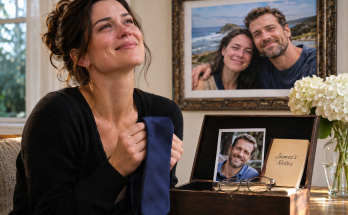
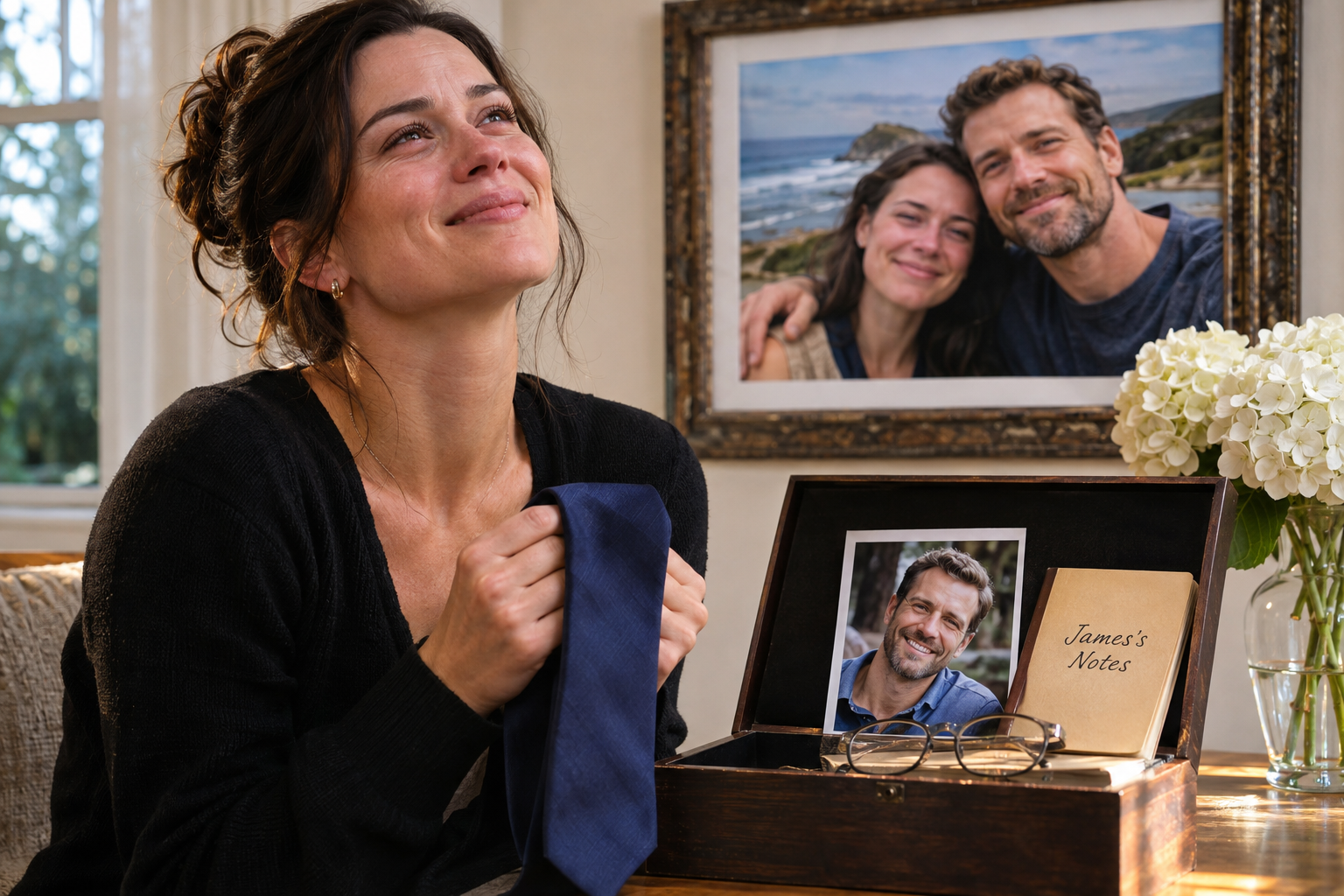
I held James's navy tie.
A firefighter had helped me retrieve my suitcase after the house was declared safe for limited access.
I hadn't let go of the tie since.
The reporter introduced me.
Then she asked about James.
“What would you like people to know about your husband?”
I looked toward the house.
“He was kind.”
My voice broke.
I tried again.
“He worked very hard. He believed that what he was building could help people.”
I explained that he had died unexpectedly overseas.
I had returned to Portland after arranging his burial.
I told her that I had discovered the fire shortly after arriving home.
“Were you alone when it happened?”
“Yes.”
“Did you have anyone supporting you when you returned?”
I hesitated.
I didn't want to attack my family publicly.
That wasn't why I had agreed to the interview.
So I told the simple truth.
“A stranger helped me with my luggage at the airport. My neighbor helped me last night. And James's attorney came when I called.”
The reporter nodded.
She asked whether I had known about the acquisition.
“No. James was planning to tell me when we got home.”
I held the tie a little tighter.
“I wish he could have told me himself.”
The interview ended shortly afterward.
The reporter thanked me.
I returned to Susan's kitchen.
Daniel explained that the news segment would likely air that evening alongside coverage of the fire and the company's announcement.
I didn't think much about it.
I was more concerned about what I would do next.
There were practical arrangements to make.
The garage would need to be assessed.
The house would require cleaning and inspection.
James's estate would need to be settled.
I still had a funeral to grieve.
I couldn't handle everything at once.
Susan offered to let me stay another night.
I accepted.
That afternoon, I finally opened the family group chat.
Nothing had changed.
There was no inquiry about whether I was safe.
No apology.
No offer to visit.
I looked at the last message I had sent.
“No problem.”
Those words seemed to belong to someone else.
Someone who was still willing to pretend that her family hadn't disappointed her.
I closed the application.
At six that evening, Susan turned on the television.
The local news began.
I sat beside her.
The first stories concerned traffic and weather.
Then the presenter introduced a report about the overnight fire and the death of a Portland engineer whose work had recently led to a multimillion-dollar technology agreement.
James's photograph appeared.
I stopped breathing for a moment.
It was a photograph I had taken several years earlier.
He was smiling.
He looked alive.
The report described his work.
His colleagues spoke about his dedication.
They explained that the technology had the potential to help emergency responders.
Then the footage showed our damaged garage.
The emergency vehicles.
The neighbors gathered in the street.
Finally, my interview appeared.
I watched myself holding the navy tie.
“A stranger helped me with my luggage at the airport.”
Susan reached for my hand.
I looked away from the television.
My phone began vibrating.
Once.
Twice.
Then repeatedly.
I recognized my mother's name.
I didn't answer.
Troy called next.
Then Dad.
Messages began appearing.
Mom: Amelia, why didn't you tell us what happened?
Troy: Is that your house on the news?
Dad: Please answer. Are you safe?
Another message arrived from Troy.
“Was that report about James's company true?”
I stared at it.
There it was.
Not a question about how I was coping.
Not an apology for leaving me at the airport.
A question about the money.
Mom called again.
I silenced the telephone.
Then I placed it facedown on the table.
Susan looked at me.
“Do you want to answer?”
I shook my head.
For the first time in my life, I didn't feel responsible for making my family's discomfort disappear.
I had spent years answering their calls.
Years rearranging my plans.
Years forgiving careless remarks because I believed keeping the family together was more important than protecting my own feelings.
The previous evening, I had asked for something simple.
A ride home.
They had refused.
Now they were suddenly desperate to reach me.
I picked up the cream-colored envelope James had left behind.
His handwriting was still clear.
Don't let anyone make you believe that you owe them an explanation for the decisions we made together.
I understood those words differently now.
I didn't know exactly what my family wanted.
But I knew what I needed.
Rest.
Privacy.
Time to mourn my husband.
I switched off my phone.
Then I sat beside Susan and watched the remainder of the news.
For once, I allowed my family to wait.
Click here to continue reading: PART 5: My Mother Arrived at Susan’s Front Door the Following Morning, but Her First Question Told Me Everything I Needed to Know
I Had Just Buried the Man I Loved, and All I Wanted Was to See a Familiar Face Waiting at the Airport
Part 4 of 10