I opened Dad's envelope that evening.
Inside was a handwritten letter.
His handwriting was less tidy than I remembered.
Several words had been crossed out.
Apparently, he had struggled to decide what he wanted to say.
He began by apologizing for not collecting me from the airport.
He didn't blame Mom.
He didn't blame Troy.
He admitted that he had been capable of helping and had chosen not to.
Then he wrote about other occasions when he had remained silent because challenging someone seemed too difficult.
He acknowledged that his silence had often left me feeling unsupported.
I stopped reading.
For years, I had wondered whether Dad recognized those moments.
Apparently, he did.
He wrote that he couldn't change the decisions he had already made.
But he wanted to behave differently in the future.
There was no request for money.
No mention of the acquisition.
No suggestion that I forgive him immediately.
At the bottom, he had written one simple sentence.
I want to be your father in the ways that actually matter.
I folded the letter.
Then I cried.
Not because everything had been repaired.
Because somebody in my family had finally accepted responsibility without asking me to make him feel better about it.
I placed his letter beside James's blue notebook.
There was room in my life for forgiveness, I realized.
But forgiveness didn't require forgetting.
And rebuilding trust would take more than a single conversation.
A few weeks later, the work on our house had progressed enough for me to return permanently.
Susan helped me carry my belongings across the street.
There weren't many.
I had spent much of my time at her house wearing the same few comfortable clothes.
When we reached my front door, she smiled.
“Home again.”
I nodded.
The word still felt complicated.
Home had once meant knowing James would be inside.
Now I needed to discover what it meant without him.
Susan helped me arrange some groceries.
Then she asked whether I wanted company for dinner.
“Yes, please.”
We ate together in the kitchen.
I used the plates James and I had bought when we first moved into the house.
One had a small crack near the edge.
I had always intended to replace it.
That evening, I decided it could remain.
Not everything imperfect needed to be discarded.
After Susan left, I walked through the rooms.
The house was quiet.
I turned on a lamp beside James's armchair.
Then I sat down.
For the first time since returning from overseas, the silence didn't feel entirely threatening.
It was still painful.
But I was learning how to exist inside it.
The garage investigation was eventually completed.
The findings supported an accidental electrical equipment failure.
The older project equipment had suffered a serious malfunction.
There was no evidence that anyone had deliberately started the fire.
I was relieved.
The metallic sounds I had heard that evening had apparently been associated with the developing failure, although their precise origin couldn't be confirmed.
I arranged for the damaged structure and equipment to be dealt with appropriately.
The company's representatives assisted with the relevant technical matters.
The insurance process took time.
There were inspections, estimates, documents, and more telephone calls than I wanted to make.
But eventually, those practical problems became manageable.
When the old garage was finally removed, I stood beside the kitchen window and watched.
I remembered James's notebook.
Replace old garage.
He had already planned to do it.
I wished we could have discussed the replacement together.
He would probably have wanted more space for tools.
I would have insisted on windows.
Instead, I made the decisions myself.
I chose a modest replacement structure that suited my actual needs.
There was no reason to recreate everything exactly as it had been.
James had understood that things could change without losing their purpose.
I tried to remember that.
Meanwhile, Daniel continued helping me through the estate administration.
The process was neither immediate nor effortless.
There were professional fees, financial obligations, tax matters, and necessary legal steps.
I met with independent financial advisers.
I asked questions.
Sometimes I asked the same question twice because I wanted to make certain I understood the answer.
Nobody made me feel foolish.
Eventually, James's share of the acquisition provided the substantial financial security he had intended for me.
I could maintain the house.
I could make sensible plans for my future.
I could take time to grieve without immediately worrying about how every household bill would be paid.
That freedom was an extraordinary gift.
But receiving it didn't feel like winning something.
James had worked for years to create that opportunity.
I had watched him struggle through the difficult periods.
I had seen him fall asleep at his desk.
I had heard him discuss problems that seemed impossible to solve.
Every dollar represented part of that work.
I intended to respect it.
With professional assistance, I made arrangements to preserve my long-term security.
I also supported the completion of James's established charitable commitments.
Those decisions felt right.
They reflected the future he had imagined before his death.
Troy contacted me again after learning that the estate matters were progressing.
This time, he sent a message that sounded almost formal.
He said he had reconsidered his business proposal.
He offered to accept a smaller amount initially.
He suggested that we could discuss repayment arrangements later.
I read the entire message.
Then I answered.
“My decision hasn't changed.”
He replied that he thought I might have become more reasonable with time.
I nearly responded angrily.
Instead, I placed the telephone down.
A few minutes later, I returned to it.
“Please respect my decision. I won't discuss this again.”
I sent the message.
Then I returned to what I had been doing.
I was washing dishes.
It felt almost ridiculous that something which once would have ruined my entire day could now be handled between rinsing two plates.
Troy wasn't pleased.
He sent several more messages.
Eventually, I stopped reading them.
Daniel had reminded me that refusing a request didn't obligate me to participate in an endless argument about it.
I was finally putting that advice into practice.
Mom began contacting me more carefully.
At first, her messages were awkward.
She asked about the repairs.
She asked whether I needed anything.
Sometimes she returned to old habits and suggested that I should reconsider my relationship with Troy.
Whenever that happened, I reminded her that our conversations couldn't continue if they became another attempt to pressure me.
The first few times were difficult.
She accused me of being cold.
She said she hardly recognized me anymore.
I didn't enjoy hearing those things.
But I knew that being recognizable to her wasn't worth returning to the person I had been.
Eventually, she started respecting some of my boundaries.
Not perfectly.
Not immediately.
But there were improvements.
One afternoon, she asked whether she could visit without discussing anything financial.
I agreed.
She arrived carrying a casserole.
We sat together in the kitchen.
For several minutes, she seemed uncertain what to say.
Then she looked toward James's photograph.
“I miss him too, you know.”
I looked at her.
“I know.”
She began describing something James had repaired at their house several years earlier.
I remembered the occasion.
He had spent most of a Saturday afternoon working on it.
Mom had complained afterward that he hadn't finished quickly enough.
Now she remembered how patient he had been.
I listened.
Then she surprised me.
“I wasn't always very fair to him.”
“No,” I said quietly. “You weren't.”
She lowered her eyes.
“I thought Troy needed help.”
“I understand that.”
“He's my son.”
“And I'm your daughter.”
She looked at me.
There was a long silence.
Then she nodded.
“Yes.”
We didn't resolve everything that afternoon.
I didn't expect us to.
But for once, she had listened without insisting that my brother's needs automatically came first.
That was a beginning.
Dad visited more frequently.
Sometimes he helped me with small household tasks.
Other times, we simply drank coffee.
He never asked about my inheritance.
He never suggested that I should fund Troy's business.
When he offered assistance, I began accepting it.
I wanted to give him an opportunity to become the father he had described in his letter.
One Saturday, he helped me hang a photograph in the hallway.
It was the picture James and I had taken beside the ocean.
Dad stood back to check whether it was straight.
“A little higher on the left,” I told him.
He adjusted it.
“Better?”
“Perfect.”
He looked at the photograph for a while.
Then he spoke.
“He really loved you.”
I smiled sadly.
“Yes, he did.”
Dad put down the hammer.
“I wish I'd told him how much I respected him.”
I understood that regret.
There were countless things I wished I had told James.
“You can still respect what he left behind,” I said.
Dad nodded.
And slowly, through his actions, he began doing exactly that.
Several months after the memorial, Michael invited me to a small gathering connected to the engineering project.
The technology was continuing through its next stages of development under the acquisition agreement.
James's former colleagues remained involved in various capacities.
Michael explained how the work was progressing.
Some of the terminology was still beyond me.
James would have understood every word.
I smiled at the thought.
Representatives from organizations associated with the charitable commitments were also present.
They discussed practical efforts to improve emergency preparedness and communication resources.
I was proud to see the work continuing.
James had wanted his success to be useful.
Even though he wasn't there, that intention remained alive.
When Michael thanked me for supporting the arrangements, I shook my head.
“These were James's wishes.”
He smiled.
“And you've honored them.”
I carried those words home with me.
That evening, I opened the blue notebook.
I turned to the list James had written before our trip.
Several entries had now been completed in one form or another.
The legal arrangements.
The charitable commitments.
The old garage.
But there were other entries I couldn't complete for him.
Stop working every Sunday.
Take Amelia somewhere quiet.
I touched those words.
Then I made a decision.
A few weeks later, I booked a short trip to the Oregon coast.
I asked Susan whether she would accompany me.
She accepted.
We stayed somewhere quiet overlooking the water.
There was no complicated itinerary.
No ambitious schedule.
We walked when the weather was pleasant.
We drank coffee when it rained.
One afternoon, I sat alone near the shore.
I had brought James's navy tie with me.
I unfolded it on my lap.
The crease near the narrow end was still visible.
I thought about our anniversary dinner.
His laugh.
His habit of loosening the knot before we even left the restaurant.
For a long time, I had worried that being happy again would somehow diminish my love for him.
Sitting beside the ocean, I understood how unfair that was.
James hadn't spent years planning our future because he wanted me to remain miserable if something happened to him.
His note had been clear.
He wanted me to live without feeling that other people owned my decisions.
I couldn't have the future we had imagined.
But I could still have a future.
When I returned to Portland, I felt rested in a way I hadn't experienced for months.
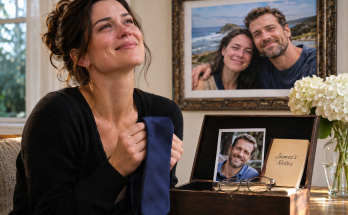
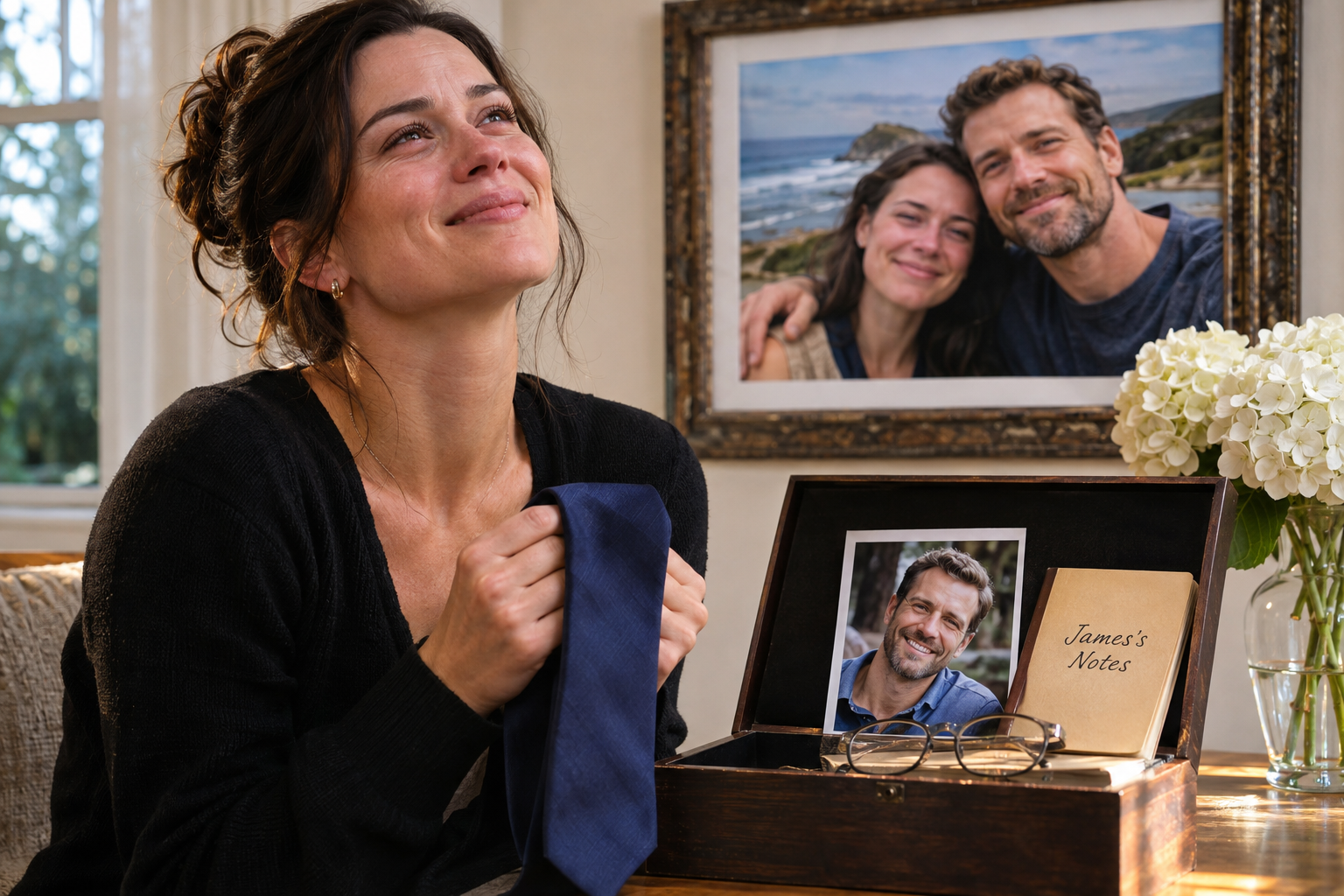
I placed the navy tie inside a small memory box.
James's reading glasses went beside it.
There were photographs, handwritten notes, and a few other personal belongings.
I didn't need to carry them everywhere anymore.
Knowing they were safely at home was enough.
The damaged black suitcases remained in the closet.
One afternoon, I finally emptied them completely.
I washed the clothes I intended to keep.
I donated some of the others after taking the time to decide what mattered most to me.
It was difficult.
But each decision belonged to me.
Nobody rushed me.
Nobody told me what a grieving widow was supposed to do.
I was learning to trust myself again.
One evening, I opened our old family group chat.
The original messages were still there.
I read my request for a ride from Portland International Airport.
Then Troy's reply.
Then Mom's criticism.
Dad's warning about the rain.
Finally, my two words.
No problem.
I remembered believing that those words would protect everyone from an uncomfortable conversation.
They hadn't protected me.
I understood that now.
I didn't delete the messages.
I didn't share screenshots publicly.
I didn't need strangers to condemn my family for what they had done.
The consequences belonged to our relationships.
Troy and I remained distant.
Mom was making an effort, although there were still difficult moments.
Dad had begun showing up in ways I could recognize and trust.
And Susan remained the person I could call without first wondering whether my need would inconvenience her.
Life hadn't become perfect.
It had become more honest.
That was enough.
On a quiet Sunday morning, I made coffee and sat in James's armchair.
Sunlight reached across the living room.
The house was warm.
The repaired backyard looked peaceful.
I opened his blue notebook one final time.
Tell Amelia she doesn't have to worry so much anymore.
I read the sentence slowly.
I wished he were sitting beside me.
I wished I could tell him that his work had continued.
That his charitable intentions had been respected.
That the house had survived.
That I had refused Troy's demands.
And that I was learning not to apologize whenever I needed help.
I closed the notebook.
Then I looked toward our photograph in the hallway.
“Thank you, James.”
My voice was quiet.
There was nobody else in the room.
But for once, being alone didn't mean feeling abandoned.
I thought about the evening news report that had made my family call me repeatedly.
They had seen the damaged garage.
They had seen the emergency vehicles.
They had learned about James's extraordinary professional achievement.
For a moment, the world had shown them the parts of my life they had never bothered to understand.
But the most important thing hadn't appeared on television.
It was something I had discovered afterward.
I didn't need to become wealthy to deserve their kindness.
I had deserved it when I was standing at baggage claim with two heavy suitcases.
I had deserved it when James was alive and working late at his desk.
I had deserved it when I asked for that simple ride home.
And I still deserved it now.
My telephone rang.
It was Dad.
He asked whether I wanted to have lunch together.
I smiled.
“That would be nice.”
“Would you like me to pick you up?”
I looked toward James's photograph.
For a moment, my eyes filled with tears.
“Yes, Dad. I'd appreciate that.”
He told me what time he would arrive.
Then we ended the call.
I finished my coffee and washed the cup.
Outside, the morning was bright.
I knew there would still be difficult days.
There would be anniversaries I wished I could avoid.
There would be moments when reaching for James's hand felt more natural than remembering he was gone.
But I no longer believed I had to face every difficult thing by myself.
I could accept help from people who genuinely offered it.
I could refuse demands that threatened my peace.
I could love my family without surrendering my independence.
And I could remember James without giving up my own life.
When Dad's car eventually stopped outside, I picked up my handbag.
The cream-colored envelope was no longer inside it.
I had placed it safely with James's notebook and other important personal documents.
I didn't need to carry his instructions everywhere.
I knew what they meant now.
I locked the front door.
Dad stepped out of his car and opened the passenger door for me.
“Ready?”
“Yes.”
I climbed inside.
For the first time in a very long while, I didn't feel guilty about accepting a ride.
And as we drove away from the house James and I had built together, I realized something that would remain with me for the rest of my life.
My husband had left me financial security.
But his greatest gift was the courage to stop accepting less love than I deserved.
That was the inheritance nobody could take from me.
The End
Read more original stories on Feel Every Story.
I Had Just Buried the Man I Loved, and All I Wanted Was to See a Familiar Face Waiting at the Airport
Part 10 of 10