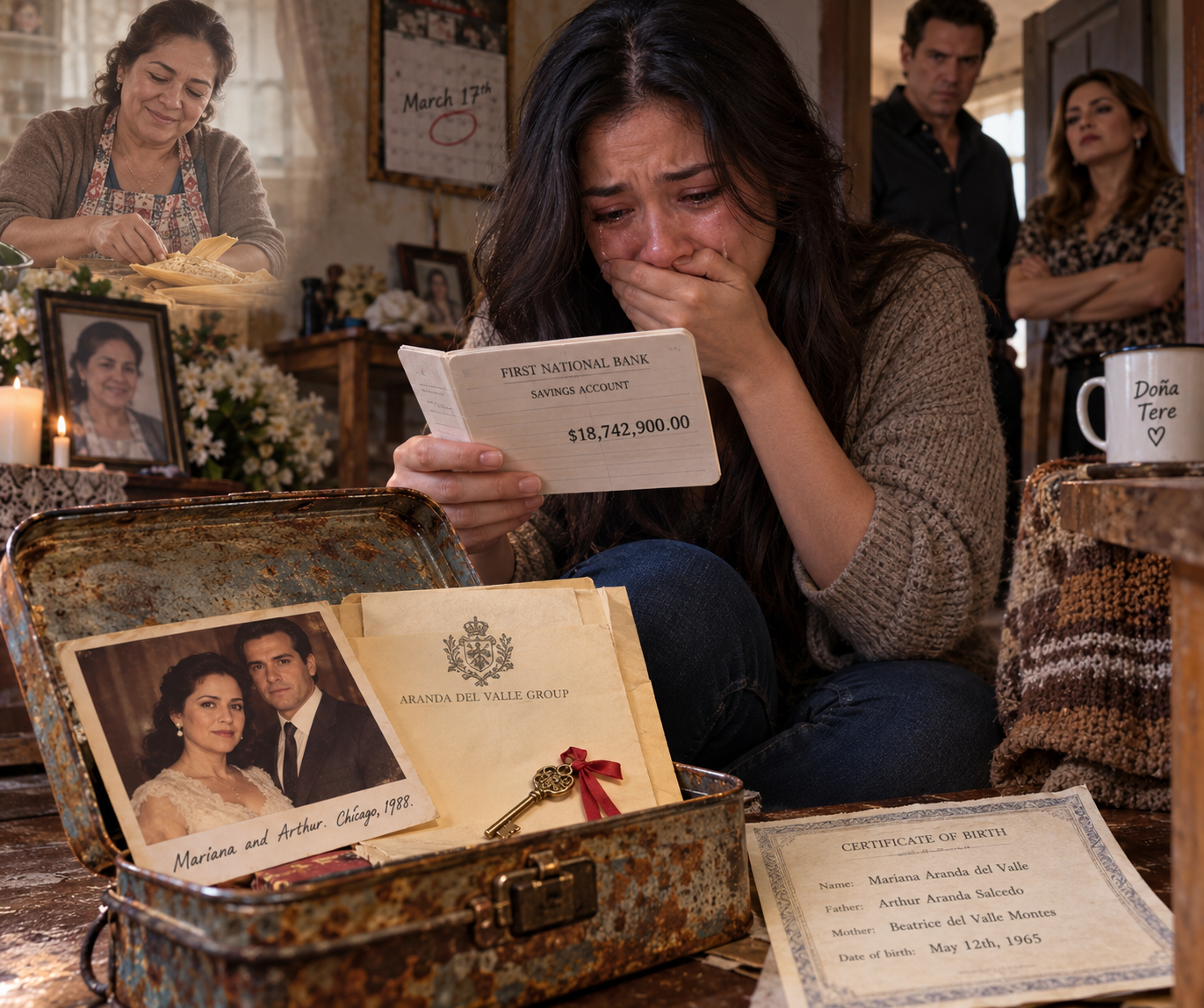
My mother died in a sweater she had been meaning to mend for almost two years.
It was brown, soft from too many washes, with a ragged opening beneath the left sleeve where the seam had separated. I had offered to replace it more times than I could remember. Mom always laughed, pinched the torn fabric between two fingers, and told me there was life left in it.
Three days before her funeral, a nurse at St. Catherine’s called me at 4:17 in the morning. By the time I reached the hospital, Theresa Lopez—the woman everyone in our neighborhood called Doña Tere—was already gone.
She had spent her final months rationing medication because the prescription cost more than she could afford. She had refused rides to appointments when she thought gas money would inconvenience anyone. Two weeks before she died, I had found her eating toast for dinner and discovered she had given half her grocery money to a woman from church whose electricity had been shut off.
That was my mother.
She could be running out of everything and still notice someone who had less.
The funeral reflected the life I believed she had lived. Folding chairs in the parish hall. Grocery-store flowers. Aluminum trays of rice and beans brought by neighbors. Father Castillo waived the church fee after Mrs. Hernandez quietly explained that we were struggling to cover the burial.
Roger arrived twenty minutes late.
My older brother parked his black SUV beside the church steps, stepped out wearing a charcoal suit that probably cost more than Mom had spent on clothing in five years, and checked his phone before walking inside.
His wife, Patricia, followed him in cream heels that clicked sharply against the old tile.
“You could have answered yesterday,” Roger said when he reached me.
I stared at him. “Yesterday I was choosing a coffin.”
His jaw tightened, but Patricia touched his arm before he could respond.
“This isn’t the day,” she murmured.
I almost laughed. Roger and I agreed on very little, but apparently even Patricia understood that criticizing my response time beside our mother’s coffin was poor timing.
We had been drifting apart for years. Roger called it ambition. I called it forgetting where he came from. He had moved into commercial property, married Patricia, started wearing watches he insured separately, and developed the habit of speaking about Mom’s neighborhood as if poverty were contagious.
Yet throughout the service, he kept staring at the coffin.
Not with grief exactly.
With distraction.
I noticed because I was doing almost nothing except noticing things. The wax trembling on the church candles. The smell of lilies turning too sweet in the heat. The scar on Roger’s thumb from when we were children. Patricia whispering twice into his ear. His eyes returning again and again to Mom’s hands.
After the final prayer, Mrs. Hernandez hugged me near the church doors.
“Your mama helped half this street,” she said. “Never wanted anybody talking about it.”
“She couldn’t even afford her prescriptions.”
Mrs. Hernandez’s mouth tightened.
“That woman could keep a secret from God.”
I thought she was trying to make me smile.
Then she slipped ten dollars into my palm.
I tried to give it back.
She closed my fingers around the bill. “For flowers.”
I looked at the people gathering beneath the Texas sun. Mechanics, cashiers, teachers, retirees, families who had bought Mom’s tamales after Sunday Mass for twenty years. None of them had much. Nearly every one of them had brought something.
Roger stood apart near his SUV.
Patricia was beside him, speaking urgently.
I caught only three words.
“Before Elena does.”
They noticed me looking.
Patricia immediately smiled.
Roger turned away.
The moment was so small I might have forgotten it if the rest of the day had been ordinary.
It wasn’t.
That evening I went back to Mom’s house alone.
The place sat at the end of a narrow Austin street where the pavement buckled around mesquite roots and every third mailbox leaned. I had grown up there. The porch railing still bore scratches from the bicycle Roger had thrown during an argument when he was twelve.
Inside, the silence was unbearable.
Her reading glasses rested beside the couch. A half-finished grocery list waited beneath a refrigerator magnet. On the counter sat the ceramic bowl where she dropped loose change after shopping.
For several minutes, I stood in the kitchen with my purse still hanging from my shoulder.
Then I saw the calendar.
Mom had circled one date in red.
March 17.
She had done that every year.
As a child, I assumed it marked someone’s birthday. When I asked, she always changed the subject.
My birthday was in September. Roger’s was in November. Dad’s had been in June.
March 17 belonged to no one I knew.
I pulled the calendar off the refrigerator.
Behind it, taped against the wall, was a small brass key.
I froze.
Mom hid spare money in coffee cans and emergency numbers inside cookbooks. She did not tape keys behind calendars.
I peeled it loose.
The key was old and heavier than it looked, with a round head worn smooth by years of handling. There was no label.
I turned it over.
Nothing.
Then headlights swept across the living-room curtains.
A vehicle had stopped outside.
I slipped the key into my pocket and moved toward the window.
Roger’s SUV.
Patricia got out first.
They had not called.
I opened the door before they reached the porch.
Roger stopped.
“You’re here.”
“That usually happens when someone walks into their own mother’s house.”
“Our mother’s house.”
The correction came too quickly.
Patricia gave me the same soothing smile she used when she wanted to disguise an insult.
“We thought we’d help sort things.”
“At nine at night?”
Roger looked over my shoulder.
“There are documents we need.”
I felt the key against my thigh.
“What documents?”
For half a second, neither answered.
Then Roger shrugged. “Insurance. Deed. Bank statements.”
“Mom didn’t have anything worth fighting over.”
Patricia lowered her eyes.
Roger did not.
“That isn’t the point.”
I studied him.
We had spent the morning burying a woman whose friends had collected money to help pay for flowers. Roger should have been asking about photographs, recipes, Dad’s old tools.
Instead he wanted bank records.
“You can come back tomorrow,” I said.
His expression changed.
“Elena.”
“Tomorrow.”
He took one step toward me. “This has to be handled tonight.”
The pressure in his voice hardened something inside me.
“Why?”
Patricia touched his elbow.
He pulled away from her.
“Because Mom made a mess of things.”
I stared at him.
“Our mother died three days ago.”
“I know when she died.”
“Then watch how you talk about her.”
The muscles along his jaw tightened.
Behind him, Patricia looked less irritated than nervous.
That was what bothered me.
Roger got angry easily.
Patricia rarely got nervous.
I stepped backward and closed the door.
Roger caught it with his palm before it latched.
For one sharp second, neither of us moved.
His face was inches from mine.
“Elena, if you find something you don’t understand, call me before you do anything with it.”
My heartbeat slowed instead of quickening.
“What would I find?”
His grip loosened.
Patricia said from the porch, “Roger.”
He looked back at her.
That was enough.
I pushed the door shut and locked it.
They remained outside for another minute.
I heard them arguing softly.
Then the SUV pulled away.
I stood in darkness until the taillights vanished.
Only then did I take out the brass key.
Under the kitchen light, I noticed a faint line around its round head.
Something had been engraved there and polished almost flat.
I angled it toward the bulb.
Three numbers emerged.
317.
I whispered them aloud.
“Three seventeen.”
My eyes moved toward the calendar lying on the table.
March 17.
My mother had spent years marking the same date.
And she had hidden a key bearing the same numbers directly behind it.
I searched the kitchen first.
Drawers. Cabinets. The flour tin. The shelf above the refrigerator where she kept warranties for appliances she no longer owned.
Nothing.
I moved to her bedroom.
Opening the closet felt worse than the funeral.
Her clothes still carried the faint scent of lavender detergent. Two winter coats hung beside dresses she rarely wore. On the top shelf sat a shoebox of photographs.
Beneath it, pushed all the way against the wall, was a yellow envelope.
My name was written across the front.
ELENA.
I stopped breathing.
The handwriting was Mom’s.
I sat on the edge of her bed and opened it.
Inside was not a letter.
There was a photograph.
My mother looked twenty years old, maybe twenty-two. Her hair was longer, her posture straighter, her smile almost reckless.
She stood outside a mansion.
Not a nice house.
A mansion.
Stone columns rose behind her. A fountain blurred in the distance. Beside her stood an older man in a tailored suit, his hand resting on her shoulder.
On the back, someone had written:
Mariana Aranda del Valle — Chicago.
I read it twice.
Then a third time.
Mariana.
Not Theresa.
I turned the photograph over again as if another name might appear.
It didn’t.
My mother had spent more than thirty years answering to Theresa Lopez.
But the woman in the photograph was unmistakably her.
There was one more item in the envelope.
A bank savings book.
The account holder line read MARIANA A. LOPEZ.
The final recorded balance made no sense.
$18,742,900.
I laughed once.
A frightened, involuntary sound.
Then I stared at the torn brown sweater draped over the chair where I had placed it after bringing Mom’s belongings home from the hospital.
My mother had died wearing a sweater she refused to replace because she said twenty dollars was too much.
And somewhere, somehow, an account carrying her name held nearly nineteen million dollars.
Click here to continue reading: PART 2: The Woman I Buried as Theresa Lopez Had Another Name, and My Brother Already Knew I Was Close to Finding It
My Mother’s Funeral Should Have Ended the Questions, but One Missing Sweater Thread Led Me Back to Everything She Hid
Part 1 of 24