One year after Mom died, I wore her sweater to the restitution center’s opening.
The seam beneath the left sleeve had been repaired.
Not invisibly.
I asked the tailor to leave the stitching visible.
He thought that was strange.
I did not explain.
Some repairs deserve to be seen.
The building had once belonged to an Aranda property company.
Now the name above the entrance read:
MARIA COMMUNITY LEGAL AND RESTITUTION CENTER.
Not Mariana Aranda.
Not Theresa Lopez.
Maria.
Mom’s middle name in both versions of her identity.
Simple enough to belong to neither dynasty nor disguise.
Isabel chose it.
Roger pretended not to cry when the sign went up.
The eighteen million dollars was already moving.
Not dramatically.
Not in oversized checks.
Through settlements.
Debt correction.
Legal fees.
Property-title repairs.
Payments to families whose claims could be verified.
Funding for historians and attorneys to continue investigating old cases.
By the anniversary of Mom’s death, nearly seven million dollars had been distributed or committed.
Eduardo’s estate contribution added substantially more.
He died four months after the press conference.
Quietly.
In his own bed.
No suspicious medication.
No altered records.
No mystery.
That almost felt like justice in itself.
His will surprised everyone.
He left personal letters to each of us.
I read mine once.
Then put it away.
He did not ask forgiveness.
He explained nothing.
He wrote:
Your mother was stronger than I allowed myself to understand.
Below that:
I mistook obedience for love.
It was the most honest sentence he ever gave me.
Isabel received the family archives.
Not ownership.
Custodianship, with instructions that she decide their future.
She donated them.
Every page.
Researchers nearly fainted.
Arthur testified before a grand jury.
He accepted a plea arrangement for obstruction related to historical records and Celeste’s death investigation.
Because of his cooperation and the age of many offenses, he did not receive the punishment some people wanted.
Public debate followed.
Roger refused interviews.
“He did wrong,” he told me. “The court knows. I know. He knows.”
Their relationship continued.
Slowly.
Arthur attended one family dinner.
Mrs. Hernandez made him sit in Dad’s old chair by accident.
Or claimed it was an accident.
Arthur looked at the chair for a long time before sitting.
Roger said nothing.
Later, Arthur helped wash dishes.
That was the first useful thing I ever saw him do without being asked.
Camila eventually pleaded guilty to charges connected to evidence destruction and conspiracy surrounding Celeste’s death.
Her age and health complicated sentencing.
Valeria testified against her.
The two women never spoke directly in court.
According to Miguel, that silence contained its own thirty-year argument.
Valeria returned to Europe afterward.
Before leaving, she visited Mom’s grave.
I did not go with her.
Some conversations belonged to the dead.
Lucía pleaded guilty to obstruction, medical-record falsification and related offenses.
Her cooperation proved critical in the prosecution of Martin.
She did not escape consequence.
Neither did she receive the longest sentence available.
People argued about that too.
Families of victims often live beside legal compromises that feel mathematically incapable of matching loss.
I learned not to use the word closure.
Nothing closed.
Things changed form.
Martin Keene was convicted of Dad’s murder.
The courtroom was full when the verdict came.
Roger sat beside me.
Patricia beside him.
Isabel on my other side.
Martin did not look at us.
He had insisted through trial that Daniel’s death was accidental.
The jury believed the evidence instead.
His financial crimes alone would likely have kept him imprisoned for the rest of his useful years.
The murder conviction made the truth official.
That mattered more than I expected.
Dad’s death certificate was amended.
Cause of death:
Homicide.
It hurt to see.
It also ended eighteen years of a lie.
Mom’s certificate did not change.
Her immediate death remained heart failure.
But the medical review concluded that earlier toxic exposure had likely worsened her condition.
Martin’s attempted poisoning in her final weeks had failed because she stopped taking the pills.
She had died from a damaged heart after surviving the last attempt to harm it.
I hated the poetry people tried to attach to that.
“She died of a broken heart,” one article wrote.
No.
She died of cardiomyopathy after years of stress, inadequate care and likely toxic exposure.
Words matter.
Romance should not erase mechanisms.
Mom had taught me that too, though she probably would have rolled her eyes at the sentence.
The restitution center opening drew more people than we expected.
Former tenants.
Families of contractors.
People whose parents had fought Aranda developments decades earlier.
Some claims were unresolved.
Some probably always would be.
History is not an accounting system where every column eventually balances.
But for once, the burden of uncertainty did not automatically fall on the weaker side.
That was progress.
Harold Benson attended in a wheelchair.
He complained about the ramp.
“It’s too gentle,” he said.
“That’s not a complaint.”
“It takes forever.”
“You are ninety-two.”
“Discrimination.”
Father Castillo pushed him.
Their reconciliation had been complicated.
Harold had known about the priest’s leak.
Father Castillo had admitted everything publicly and to church authorities.
He stepped away from parish leadership during review.
Eventually he returned in a limited role.
Some parishioners forgave quickly.
Others never did.
That was theirs to decide.
Mrs. Hernandez arrived carrying enough food for three times the crowd.
She saw my sweater immediately.
“You fixed it.”
“Yes.”
She touched the visible seam.
“Your mama would complain.”
“I know.”
“She’d say it was still good before.”
“It was.”
Mrs. Hernandez smiled.
“And now?”
“Now it’s good differently.”
She looked at me for a second.
“That sounds expensive.”
I laughed.
Mom would have said the same.
Roger arrived in the used pickup.
He now ran a smaller company.
Much smaller.
He sold several divisions tied to Mercer contracts and paid down the debt instead of fighting to preserve his old scale.
For the first few months, he behaved as if downsizing were a public humiliation.
Then he slept through the night for the first time in years.
Patricia noticed before he did.
“You’re less awful,” she told him.
They stayed married.
Not because surviving catastrophe automatically repaired a relationship.
Because afterward they chose to build a different one.
Patricia took her own consulting work.
Roger stopped pretending financial decisions were too complicated to explain to her.
They fought.
They apologized.
They started over repeatedly.
Ordinary problems.
Mom would have approved.
Isabel arrived last.
Not because of traffic.
Because she had been teaching.
After leaving the foundation, she spent several months doing nothing except traveling, reading and discovering that having an empty calendar frightened her.
Then she accepted a temporary university appointment teaching nonprofit governance.
Roger found this hilarious.
“You escaped a foundation to explain foundations.”
She told him to shut up.
She loved teaching.
That frightened her too.
We considered it promising.
She also changed her name.
Not legally at first.
Professionally.
Isabel Aranda Lopez.
When she showed me the signature, I stared.
“You don’t have to do that.”
“I know.”
“Lopez wasn’t your legal childhood name.”
“I know.”
“Then why?”
She smiled.
“Because Daniel was my father too.”
I cried.
She pretended not to notice.
At the center opening, the three of us stood together beneath the new sign.
Reporters asked for photographs.
We agreed to one.
Only one.
Then Isabel escaped into the crowd.
Roger found food.
I wandered toward a display case containing copies of Mom’s documents.
Not the most private ones.
No letters meant only for us.
Public records.
The settlement.
Trust amendment.
Photographs of the old property cases.
And one enlarged image of Mom in her brown sweater.
She was standing outside the church holding a tray of tamales.
No mansion.
No gala.
No inheritance announcement.
Just Mom.
A little tired.
A little annoyed at whoever took the picture.
Alive.
A young reporter approached.
“Ms. Lopez?”
“Yes?”
“I’m writing about the center.”
I braced myself.
She glanced at the photograph.
“Can I ask why your mother kept wearing that sweater if she had access to so much money?”
The old question.
A year earlier, I might have become angry.
Now I understood why people asked.
The contradiction looked simple from outside.
“It wasn’t really about the sweater.”
The reporter waited.
“My mother grew up around people who treated wealth as proof that they deserved control.”
I touched the repaired seam beneath my arm.
“She rejected that so completely she sometimes rejected comfort she actually deserved.”
The reporter wrote.
“That wasn’t always healthy.”
She looked up.
I continued.
“But the money in the trust wasn’t savings in the ordinary sense.”
“What was it?”
“A debt.”
She glanced toward the center.
“To these families?”
“To people like them.”
I nodded.
“She kept it because she wanted proof. Then she changed the structure so it could be returned.”
The reporter asked, “Did she consider herself poor?”
I thought about it.
Mom counted grocery money.
Worried over utility bills.
Skipped medication she feared.
Worked until her body forced her to stop.
Materially, yes.
But that was not the whole answer.
“She considered herself responsible.”
The reporter wrote that down.
I hoped she used it.
The ceremony began at noon.
There were speeches.
Too many.
Harold exceeded his allotted time by eleven minutes.
Mrs. Hernandez shouted, “Sit down, Harold,” from the second row.
Everybody laughed.
Then Isabel spoke.
She did not talk about the Arandas.
She talked about memory.
“How families tell stories determines what younger generations believe is possible.”
She looked toward Roger and me.
“For years, the story of my mother was that she disappeared.”
Her voice remained steady.
“She did not disappear.”
I felt my throat tighten.
“She was removed from one life and built another.”
Isabel continued.
“The story of Daniel Lopez was that he died young from heart disease.”
Roger lowered his head.
“He was murdered because he found corruption.”
“The story of Roger was that ambition made him successful.”
My brother gave her an offended look.
The audience laughed softly.
“The truth is more complicated.”
Roger nodded.
“The story of Elena was that she was the ordinary daughter.”
Now everyone looked at me.
I mouthed, I hate you.
Isabel smiled.
“The truth is she was the person our mother trusted to open everything.”
My eyes filled.
“And the story of eighteen-point-seven million dollars was that a poor woman secretly died rich.”
She paused.
“That may be the easiest version to remember.”
Silence.
“It is also the least important.”
She looked toward the center doors.
“The money mattered because it showed where harm had traveled.”
Her voice softened.
“And now it travels somewhere else.”
That was the entire story.
Not hidden treasure.
Direction.
After the ceremony, we went to the cemetery.
No cameras.
Just the three of us.
Mom’s grave stood beside Dad’s.
For the first time, the stone had both names.
THERESA MARIANA LOPEZ
born MARIANA ARANDA DEL VALLE
We argued about that inscription for weeks.
In the end, Isabel chose the order.
“She lived as Theresa longer.”
She was right.
Dad’s amended memorial plaque mentioned nothing about murder.
Just:
DANIEL LOPEZ
HUSBAND, FATHER, MECHANIC
HE FIXED WHAT HE COULD
Roger chose that.
I thought it was perfect.
We brought flowers.
Cheap ones from the grocery store.
Mom would have complained if we spent more.
Roger stood with his hands in his pockets.
“So.”
Isabel looked at him.
“So?”
“Do people say things?”
“At graves?”
“Yes.”
“You first.”
“Absolutely not.”
I laughed.
We stood there awkwardly.
Then Isabel crouched.
She touched Mom’s stone.
“Hi.”
Roger whispered, “Strong opening.”
She ignored him.
“I remember the itchy dress now.”
My throat tightened.
“And the cinnamon.”
She smiled through tears.
“And you brushing my hair too hard.”
Roger looked at me.
“Should we leave?”
“No.”
Isabel continued.
“I’m angry with you.”
The honesty felt right.
“I love you.”
Also right.
“I wish you had come back.”
A tear fell onto the stone.
“But I know you wanted to.”
She stood.
Roger crouched next.
He stared at Dad’s stone.
“Apparently you knew everything.”
He shook his head.
“Annoying.”
I laughed.
Then he looked toward Mom.
“I sold the SUV.”
Pause.
“You’d be insufferably happy about that.”
Another pause.
“I’m okay.”
His voice broke.
“I think.”
He stood quickly.
Then it was me.
I crouched between them.
Two stones.
Two parents.
So many years of secrets underneath ordinary names.
I had imagined this moment differently.
A grand statement.
Forgiveness.
Closure.
Instead I said:
“I fixed the sweater.”
Roger laughed behind me.
I smiled.
“You were wrong. It needed fixing.”
The wind moved through the cemetery grass.
Nothing answered.
That was okay.
I touched Mom’s name.
“The money is going back.”
I looked at Dad’s stone.
“Roger knows.”
Then Mom again.
“Isabel knows.”
A long breath.
“And I know.”
That was enough.
When we left the cemetery, Roger drove.
Isabel sat in the passenger seat.
I sat in back.
Five minutes later they began arguing over directions.
“Turn left.”
“The GPS says right.”
“The GPS is wrong.”
“It has satellites.”
“You have missed the exit twice.”
“Elena.”
I looked up.
“What?”
“Tell her.”
I smiled.
“I’m staying out of it.”
Traitors, accusations, inheritance disputes.
Apparently some family traditions could become ordinary.
We drove back toward Mom’s neighborhood.
Her house had been sold to a young family with two children.
I cried the day I handed over the keys.
Then I watched the little boy race down the hallway and realized houses should keep living too.
I kept only a few things.
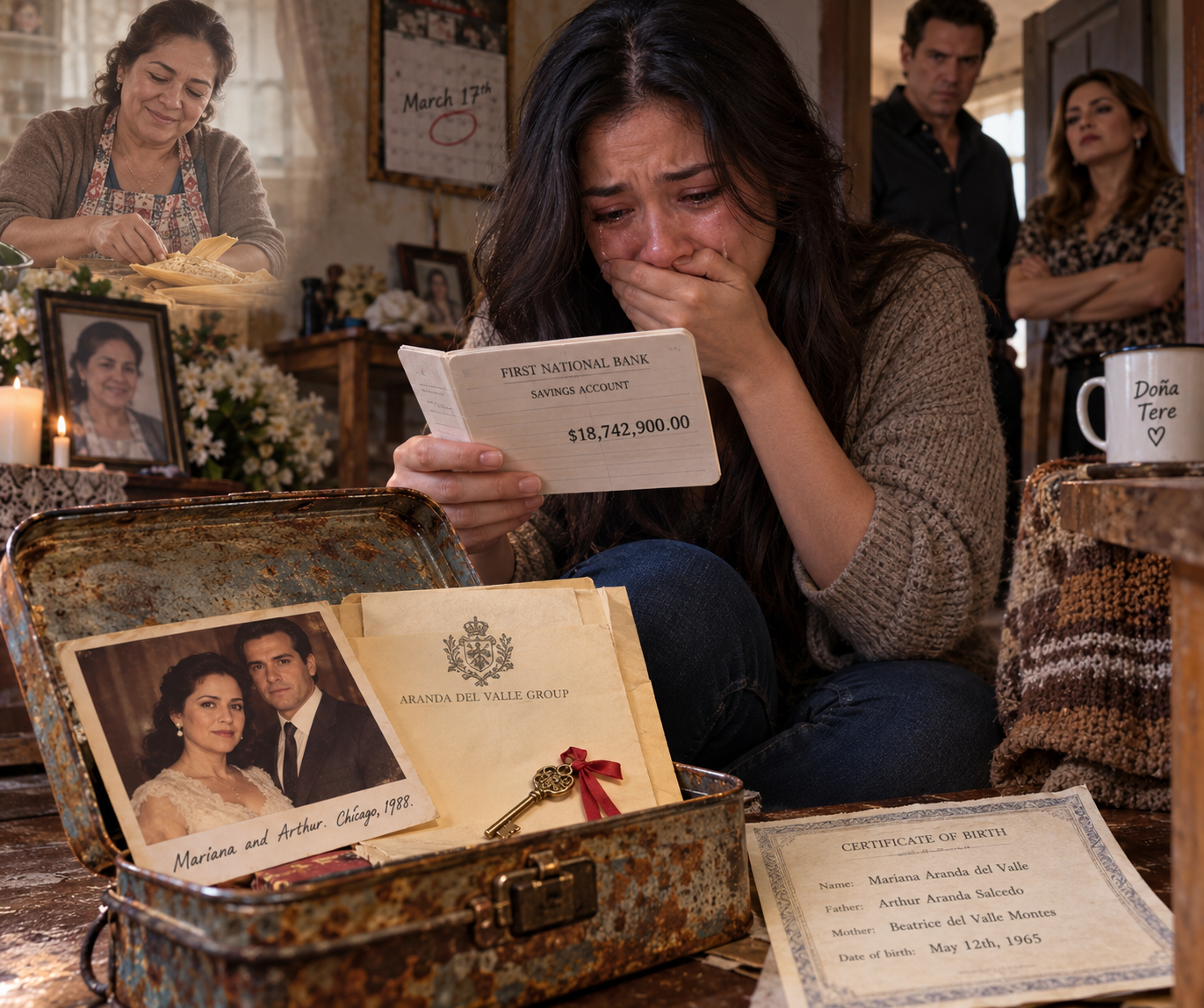
The ceramic bowl.
The recipe card.
The photograph from Chicago.
The brown sweater.
The March 17 calendar page.
And the brass key marked 317.
Not because I needed the secrets.
Because sometimes it helps to remember how small the object was that opened them.
At home that evening, I hung the sweater beside my coat.
The repaired seam caught the light.
A year earlier, I thought the torn fabric proved Mom had died without enough.
Now I knew better.
She had died with unfinished work.
That was different.
Some of it we completed.
Some would continue long after us.
Some harms could never be repaid exactly.
Some relationships would never become simple.
But the central lie was gone.
Mariana Aranda had not vanished.
Theresa Lopez had not secretly hoarded a fortune.
Daniel Lopez had not died naturally.
Roger had not betrayed him.
Isabel had not been abandoned.
And I had not inherited eighteen million dollars.
I inherited the truth about what it was for.
Mom had spent decades believing money could become a leash.
In the end, she made it a road back.
Not perfectly.
Not without damage.
But far enough for her children to find one another.
I touched the visible stitches beneath the sweater’s sleeve.
Then I turned off the light.
For the first time since my mother died, there was nothing left hidden in the room.
The End
Read more original stories on Feel Every Story.
My Mother’s Funeral Should Have Ended the Questions, but One Missing Sweater Thread Led Me Back to Everything She Hid
Part 24 of 24