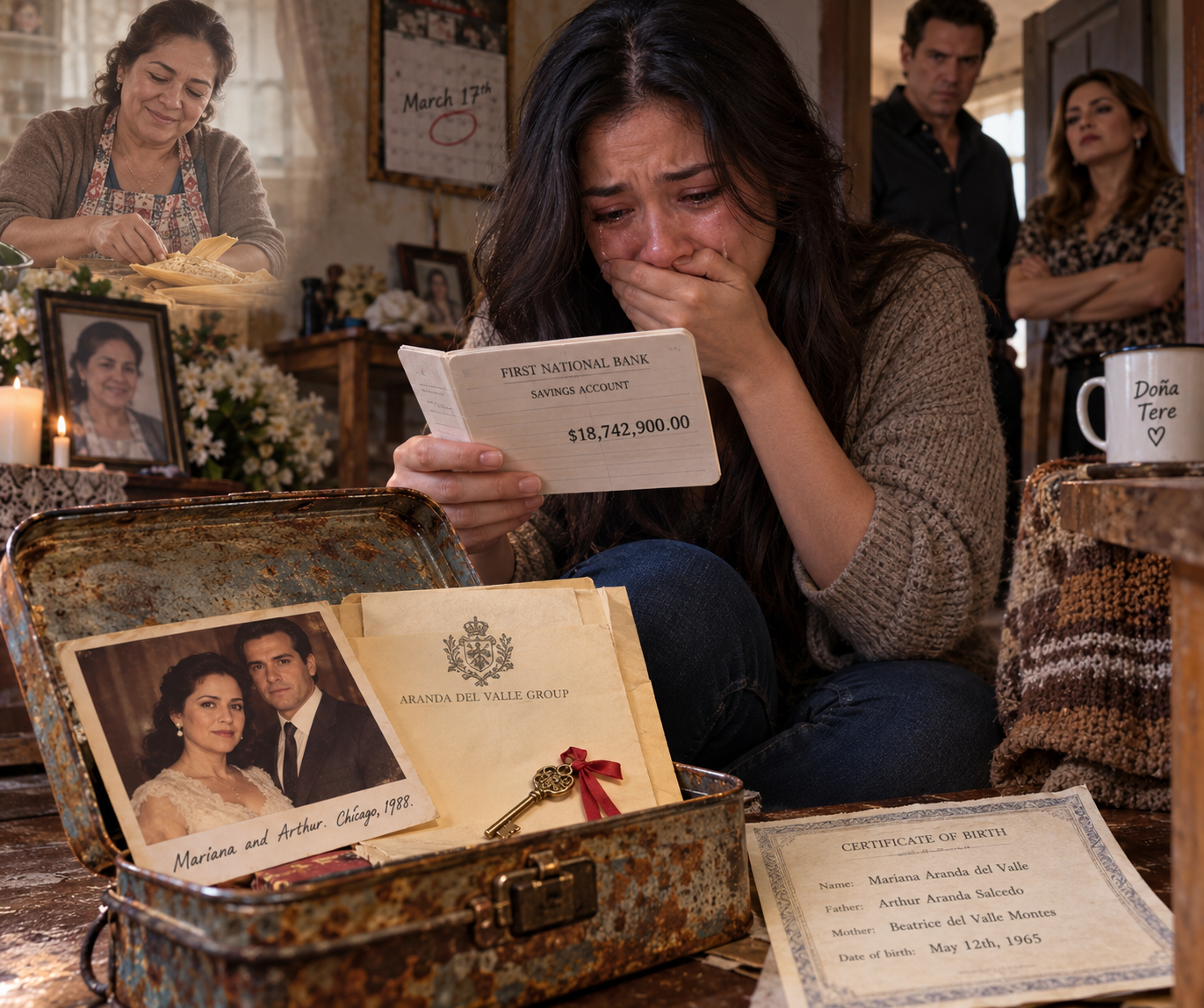
Three months after Mom’s funeral, her house was still not empty.
I had tried.
Every Saturday I arrived with boxes and labels.
KEEP.
DONATE.
TRASH.
Every Saturday I found a reason to stop.
The kitchen remained nearly unchanged.
Her glasses still rested beside the window.
The calendar still hung crookedly.
March 17 was circled in red.
I had removed the key from behind it, but not the tape that once held it.
Some absences become objects.
That strip of yellowed adhesive had become one.
Isabel arrived carrying pastries.
She had learned quickly that you never came to Mom’s neighborhood empty-handed.
Mrs. Hernandez approved.
“That girl has manners,” she told me loudly from across the street.
Isabel called back, “I can hear you.”
“That is why I said it loud.”
We laughed.
The sound still surprised me when it happened there.
Isabel entered the kitchen.
She wore jeans and a plain blue shirt.
No foundation staff.
No driver.
Her old life had not disappeared.
But she had begun learning what she looked like without it.
She placed the pastry box on the counter.
“Roger coming?”
“Supposedly.”
“So no.”
“He’ll arrive forty minutes late and insist traffic has become historically worse.”
Twenty-eight minutes later, Roger walked in.
“I hate this city’s traffic.”
Isabel looked at me.
I held up my hand.
“Twenty-eight minutes.”
Roger frowned.
“What?”
“Nothing.”
Patricia followed him.
They were still together.
Not magically repaired.
Therapy.
Separate accounts for a while.
A forensic accountant reviewing every Mercer-connected business deal.
Patricia had moved out for three weeks, then back into the guest room.
Roger told me this with the solemnity of a diplomatic summit.
I considered it progress.
He carried Dad’s red toolbox.
“Found this in storage.”
I smiled.
“Junk?”
“Apparently.”
He set it near the garage door.
We were meeting for one reason.
Mom’s belongings.
What to keep.
What belonged to Isabel.
What belonged to all of us.
I had dreaded it.
Isabel had insisted.
“I missed thirty years,” she told us. “I don’t want objects to become another thing everybody is afraid to discuss.”
So we discussed them.
The ceramic bowl from the counter went to me.
Roger took Dad’s old coffee mug.
Isabel asked for Mom’s lavender scarf.
Nobody argued.
Then we reached the photographs.
That was harder.
Images of Roger and me growing up.
School.
Christmas.
Dad’s garage.
Birthdays.
Isabel existed only in hidden envelopes.
Her childhood photographs were scarce.
She handled them carefully.
One showed Mom brushing her hair.
Isabel stared for almost a minute.
“I remember that dress.”
I sat beside her.
“You do?”
“It scratched my neck.”
Roger laughed.
“That is your memory?”
“Yes.”
“Not your mother gazing lovingly into your eyes?”
“No. The dress was terrible.”
I smiled.
Mom would have appreciated that.
Isabel turned the photograph over.
Mom had written:
Bel refuses to smile because the collar is itchy.
We laughed harder.
Memory and evidence finally agreed.
Near the bottom of the box, we found a folded piece of construction paper.
A child’s drawing.
Three stick figures.
MAMA.
DANIEL.
BEL.
Isabel stopped.
Her hand shook.
Roger looked away.
I touched her shoulder.
“You okay?”
“No.”
An honest answer.
She kept looking.
“Can I take this?”
“Of course.”
Then she frowned.
There was writing on the back.
Mom’s handwriting.
Found under the old cabin bed, 2004.
She had returned to Bastrop.
Years after losing Isabel.
She had gone back.
Isabel pressed the paper to her chest.
“I spent my whole life thinking she moved on.”
“She didn’t.”
“I know.”
The difference between knowing intellectually and knowing in your body was enormous.
Roger sat on the floor across from us.
“I thought Dad moved on from everything too.”
He had begun visiting Arthur.
Not often.
Not comfortably.
Once every two weeks.
Arthur was cooperating with federal and state investigators.
His lawyers hated how much he talked.
Roger liked that.
“What do you even say to him?” I asked once.
“Mostly I tell him what he did wrong.”
“And he keeps inviting you back?”
“Apparently he is developing character.”
Arthur had never asked Roger to call him Dad.
That mattered.
Roger had told him once:
“I had a father.”
Arthur answered:
“I know.”
For now, that was the relationship.
Not father and son.
Two men connected by biology and damage, trying not to lie.
Isabel had seen Eduardo twice.
The second meeting lasted fourteen minutes.
He gave her Mom’s childhood jewelry.
She accepted one item.
A cheap silver bracelet Mariana wore at seventeen.
She returned everything else.
Eduardo did not argue.
His health was declining.
Prosecutors had not decided which charges age and evidence could realistically support.
Publicly, people debated whether his confession was sincere.
I stopped caring.
Sincerity was not my job to measure.
The records mattered.
His cooperation mattered.
The rest belonged to him.
The restitution process had begun.
It was messier than Mom’s documents made it look.
Families had died out.
Properties changed hands.
Records contradicted one another.
Some claims could be verified.
Others could not.
Interest calculations alone filled spreadsheets large enough to frighten attorneys.
The eighteen million might not cover everything.
Eduardo’s added estate funds would help.
So would asset sales from several Aranda entities.
The important change was not the number.
It was that people once forced to prove harm against a powerful family now had an institution obligated to help prove it with them.
Mom would have liked that.
Roger joined the tracing committee.
He complained constantly.
“He enjoys it,” Patricia told me.
“I heard that,” Roger said.
“You were meant to.”
His company survived.
Barely.
Several Mercer-backed contracts collapsed.
Banks became nervous.
He sold the black SUV.
That amused me more than it should have.
He bought a used pickup.
Dad would have approved.
“Don’t sentimentalize it,” Roger said. “The financing was better.”
“Of course.”
Isabel left the Aranda Foundation completely after the transition board took control.
Her resignation became national business news for almost a week.
She hated the attention.
“What are you doing now?” Roger asked while sorting photographs.
She shrugged.
“I don’t know.”
He stared at her.
“You resigned without another job?”
“Yes.”
“That is horrifying.”
Patricia laughed.
Isabel looked at me.
“What are you doing?”
I had avoided the question.
My life had been suspended since Mom died.
Work.
Bills.
The apartment I barely visited.
Everything had become secondary.
“I’m going back Monday.”
“To work?”
“Yes.”
Roger looked disappointed.
“What?”
“I expected a dramatic transformation.”
“Why?”
“You uncovered a family conspiracy.”
“I still have rent.”
He considered that.
“Fair.”
Mom had told us to have ordinary problems.
I was beginning to understand the mercy in that.
We worked until afternoon.
Then Isabel found the sweater.
The brown one.
I had washed it after police returned it.
The concealed pocket had been opened during the investigation.
The seam now hung loose again.
Isabel held it up.
“This is the famous sweater.”
Roger groaned.
“Please don’t call it that.”
Online articles had turned it into a symbol.
THE $18.7 MILLION SWEATER.
THERESA LOPEZ’S SECRET.
Some people claimed Mom had been an eccentric millionaire pretending to be poor.
Others turned her into a saint.
Both versions irritated me.
She was neither.
She was my mother.
Complicated.
Stubborn.
Often funny.
Sometimes wrong.
Frequently scared.
Very brave in ways that coexisted with being scared.
I took the sweater.
“There’s a tailor near my apartment.”
Roger frowned.
“You’re keeping it?”
“Yes.”
“You’re going to repair it?”
I looked at the torn seam.
Mom had refused for years.
But the tear had not really been a tear.
It had been hiding something.
Now the hiding was over.
“Yes.”
Isabel smiled.
“Good.”
That evening, we made dinner in Mom’s kitchen.
Not anything ceremonial.
Rice.
Beans.
Chicken.
Roger overcooked the onions.
Patricia fixed them.
Isabel admitted she could barely cook.
Mrs. Hernandez came over uninvited and insulted all of us.
It was perfect.
After dinner, we carried chairs onto the porch.
The street settled around us.
Children rode bicycles past.
A dog barked at a delivery truck.
Someone played music too loudly.
Ordinary life.
Isabel sat beside me.
“Do you think she imagined this?”
“What?”
“Us.”
Roger was arguing with Patricia about dish soap inside.
I smiled.
“Probably.”
“She left such specific instructions.”
“Yes.”
“But not about this.”
“No.”
Mom had given us truth.
Not a script.
Isabel watched the street.
“I don’t know how to be your sister.”
“Neither do I.”
“That’s reassuring.”
“We can be bad at it.”
She smiled.
“I’m excellent at overachieving.”
“There you go.”
She became quiet.
“Sometimes I’m angry she didn’t contact me.”
“I know.”
“Then I feel guilty because of what she was facing.”
“Don’t.”
She looked at me.
“You’re allowed to be angry.”
Those words had helped Roger too.
Maybe they were the most useful thing I had learned.
Understanding somebody’s reasons did not require surrendering your own pain.
“I loved her,” Isabel said.
“You remembered her.”
“Not enough.”
“Enough.”
She looked toward the kitchen.
Roger appeared in the doorway.
“Why are you two being emotional without me?”
“We weren’t.”
“Good.”
He dragged out another chair.
We sat in a row.
Three siblings who had spent most of our lives not knowing what we were.
Isabel biological daughter of Mariana and Daniel.
Roger biological son of Mariana and Arthur, raised by Daniel.
Me biological daughter of Mariana and Daniel.
The categories mattered legally.
Emotionally, they mattered less every week.
Roger nudged my chair.
“What happens tomorrow?”
“Why?”
“We finished the boxes.”
“Mostly.”
“The investigations are moving.”
“Yes.”
“The trust is operating.”
“Yes.”
He looked uncomfortable.
“So what do we do?”
I understood.
For months, every morning had contained a crisis.
A document.
A threat.
A revelation.
Now nothing urgent waited.
Mom had warned us about this.
Finish the truth.
Then live.
I looked down the street.
“Tomorrow?”
“Yes.”
“Laundry.”
Roger stared.
“That’s depressing.”
Isabel laughed.
Patricia opened the door.
“Your laundry has been depressing for years.”
Roger turned.
“Why is everyone attacking me?”
Because we could.
Because nobody was chasing us.
Because no one was hiding a cassette.
Because ordinary teasing had returned.
Later, after everyone left, I remained alone in Mom’s kitchen.
The house sounded different.
Not empty.
Finished.
On the table sat one final envelope we had almost missed.
No legal papers.
No secret records.
Just Mom’s recipe for tamales.
At the bottom she had written:
Roger uses too much salt.
I laughed until I cried.
Click here to continue reading: PART 24: One Year After Mom Died in Her Torn Sweater, the Fortune Was Gone Where She Wanted and Her Children Finally Came Home
My Mother’s Funeral Should Have Ended the Questions, but One Missing Sweater Thread Led Me Back to Everything She Hid
Part 23 of 24