Thunder shook the windows before I reached Mom’s house.
I carried the safe-deposit box records inside beneath my jacket, locked the front door, checked the back entrance, and turned off every light except the one above the kitchen table.
Then I saved Roger’s voicemail in three places.
I sent one copy to my email.
One to cloud storage.
One to my best friend Sofia.
My message said only: Keep this. Don’t delete it, no matter what I tell you later.
She called immediately.
I silenced the phone.
I was not ready to explain something I barely understood myself.
The storm settled over Austin while I laid everything across Mom’s table.
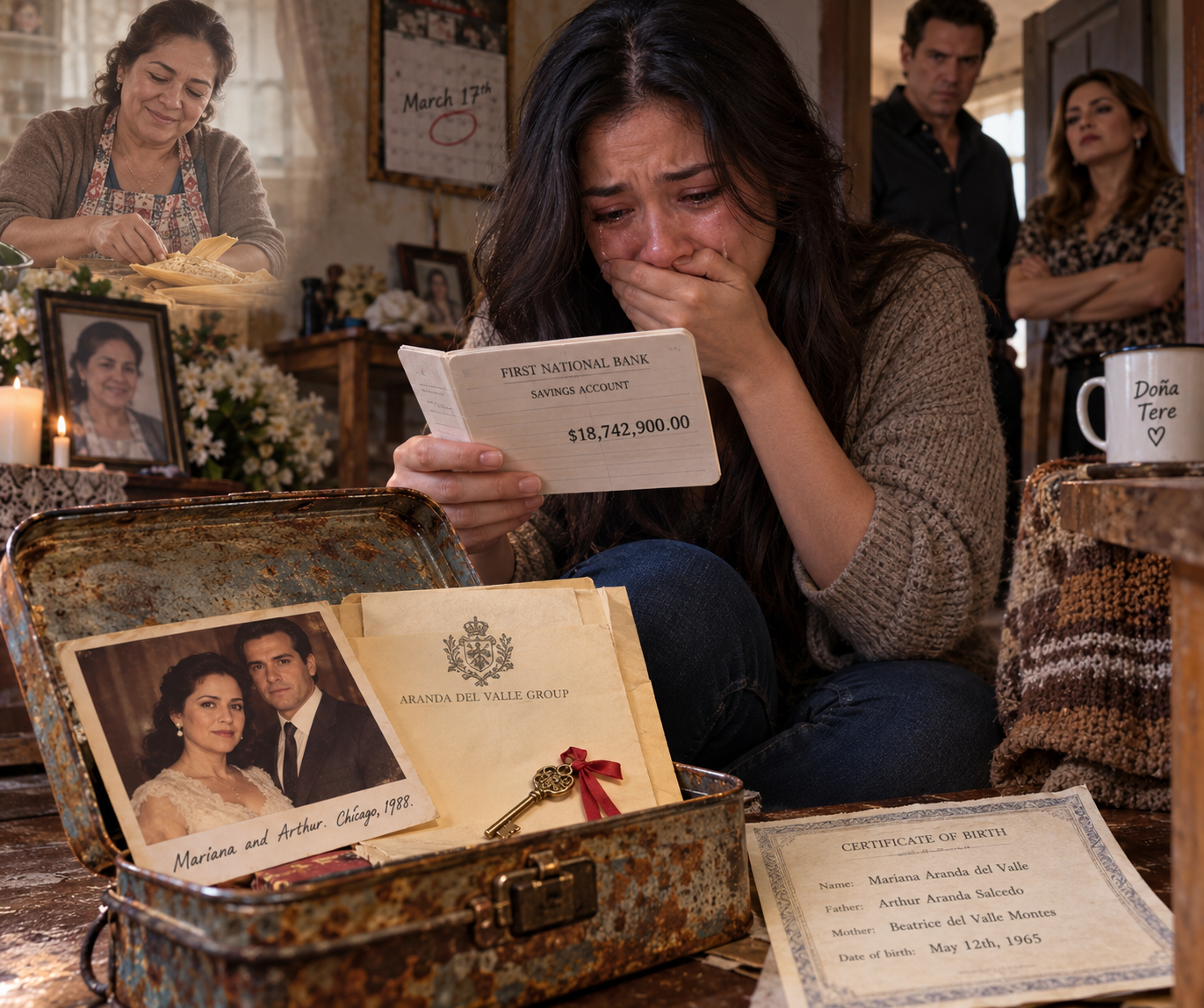
Photographs.
Birth documents.
The savings book.
Newspaper clippings.
The agreement.
The kitchen suddenly felt too small for the life she had hidden inside it.
I started with the settlement.
The legal language became clearer on the second reading.
Mariana Aranda del Valle would permanently surrender her claim to the family’s wealth and public identity. In exchange, a private trust would remain available for her lifetime.
No public use of the Aranda surname.
No contact with designated members of the family.
No legal challenge regarding the child born in 1987.
No disclosure of that child’s parentage.
I pressed my fingers against my temples.
Mom had not walked away from eighteen million dollars.
She had technically possessed access to it.
She had simply refused to live from it.
Why maintain the account but remain poor?
Why keep it untouched?
The answer seemed to be sitting inside the clause concerning Isabella.
I searched the newspaper clippings.
One described Mom as an Aranda heiress who vanished during a period of intense disagreement with her family.
Another referred vaguely to a broken engagement.
The articles contradicted one another in ways that felt deliberate.
One newspaper claimed she had gone to Europe.
Another suggested South America.
None mentioned Daniel Lopez.
None mentioned a child.
It was as if an entire piece of her life had been removed before the public was allowed to see it.
I stared at the photograph of the little girl.
Dark curls.
Brown eyes.
The small mark beside her eyebrow.
I could almost imagine Mom sitting at this same table thirty years earlier, touching that photograph after Roger and I had gone to sleep.
A knock exploded against the front door.
I jumped so violently my chair struck the wall.
“Elena!”
Roger.
I swept the documents into the metal cash tin Mom kept beneath the sink and shoved it behind cleaning supplies.
Another knock came.
Harder.
“Open the door.”
Patricia’s voice followed.
“We can see your car.”
I stayed in the kitchen.
Roger rattled the handle.
“Stop making this difficult.”
I walked into the living room but kept several feet between myself and the door.
“What do you want?”
“To talk.”
“We talked yesterday.”
“No, you locked me outside.”
“That was the useful part.”
Patricia said something too quiet to hear.
Then Roger’s voice softened.
“Elena, please.”
That word unsettled me more than shouting would have.
Roger did not ask me for things politely. Not when we were children. Not as adults.
“What are you afraid I found?” I asked.
Silence.
Rainwater drummed against the metal awning.
Roger said, “You’re turning Mom’s death into something it isn’t.”
“I haven’t told you what I found.”
Another silence.
Patricia whispered, “Tell her Arthur’s attorneys will bury her.”
My hand tightened around the curtain.
Arthur.
I stepped closer to the door.
“I heard that.”
Nothing.
Then Roger swore.
I unlocked neither bolt.
“Who is Arthur?”
“Elena—”
“Who is he?”
Roger’s voice changed.
“You need to leave this alone.”
“Why?”
“Because you have no idea what kind of people you’re dealing with.”
The answer told me more than he intended.
“You do.”
“Elena.”
“You know them.”
Patricia interrupted. “Roger, we’re leaving.”
He struck the door once with the flat of his hand.
Not hard enough to break anything.
Hard enough to warn me.
A minute later the SUV started.
I watched through the curtain until it turned the corner.
Then I retrieved the documents.
Harold Benson’s name appeared on almost every important page.
Attorney.
Witness.
Notary.
The internet found him in less than a minute.
Harold J. Benson, attorney at law.
Ninety-one years old.
Still listed at a small office on West Eleventh Street.
I called.
A receptionist answered.
When I asked for Mr. Benson, she said he no longer accepted clients.
“This isn’t about hiring him.”
“What is it regarding?”
“Mariana Aranda.”
The woman stopped typing.
I heard the silence through the line.
“Could you hold?”
Five minutes later, a man answered.
His voice was thin but steady.
“Who is this?”
“Elena Lopez.”
Nothing.
Then he asked, “Daniel’s Elena?”
My throat closed.
“You knew my father?”
“Come before dark.”
The call ended.
I drove across the city in heavy rain.
Benson’s office occupied the second story of an aging brick building between a bakery and a laundromat. The stairwell smelled of wet coats and old plaster.
The receptionist looked at me as if she had been expecting a ghost.
An elderly man appeared from the hallway.
White hair.
Wooden cane.
Dark vest buttoned neatly over a pale shirt.
His eyes dropped to the photograph in my hand.
He stopped walking.
“Mariana.”
I had heard only two people call my mother that.
Both within a single day.
“I’m Elena.”
His gaze lifted.
Something in his face gave way.
“You have her expression when she’s trying not to cry.”
I hated how close that came to breaking me.
He invited me into his office.
Books covered the walls. A peppermint tea bag rested beside a chipped cup on his desk. Rain crawled down the window behind him.
I laid out the documents.
Benson did not touch them.
“I wondered who she would trust with these.”
“She didn’t trust me. She lied to me my whole life.”
His eyes remained on the photograph.
“She lied because other people taught her the cost of truth.”
I sat forward.
“Then tell me what it cost.”
He removed his glasses.
“Your mother was born into a family with enough money to purchase silence. People often misunderstand that kind of wealth. They think its greatest advantage is comfort.”
“What is it?”
“Control.”
He opened a locked drawer.
From it he removed a thick folder wrapped in cloth.
“I kept these because Mariana made me promise somebody would remember correctly.”
Inside were photographs I had never seen.
Dad repairing a motorcycle.
Mom sitting on the seat behind him, laughing.
Dad holding a newborn child.
The little girl again.
Isabella.
“Who was she?”
Benson looked at me.
“Your sister.”
The answer seemed to bend the room.
I shook my head.
“I have one brother.”
“You had a sister before either of you.”
“Had?”
“She’s alive.”
My chair scraped the floor.
“Where?”
Benson did not answer immediately.
He selected an old newspaper photograph.
A younger Arthur Aranda stood at a charity event beside an elegant woman.
Between them was a four-year-old girl.
Dark curls.
A small birthmark beside her left eyebrow.
I held the safe-deposit photograph beside it.
Same child.
My fingers went cold.
“Why is she with him?”
“Because Arthur raised her.”
“As what?”
“His daughter.”
The rain seemed suddenly louder.
I looked at Benson.
“My mother gave him her baby?”
His expression hardened.
“Never say that where Mariana can hear you, wherever she is.”
“Then what happened?”
“They took Isabella.”
I stared at him.
Benson continued slowly.
“Your grandfather Eduardo believed Mariana’s first child belonged to the Aranda legacy. Arthur helped enforce that belief. Your mother had chosen Daniel. The family intended to punish both of them.”
I pushed the photograph away.
“No.”
“She fought.”
“Then why didn’t she go to the police?”
“Because people with ordinary lives believe authorities stand outside wealth. Mariana learned that some authorities answered the phone when her family called.”
My mouth tasted metallic.
Benson leaned closer.
“She and Daniel tried to get Isabella back.”
“What stopped them?”
“Arthur showed them surveillance photographs.”
“Of what?”
“Their home. Daniel’s garage. Your mother buying groceries.”
He paused.
“Then Mariana discovered she was pregnant again.”
I looked down.
“With Roger?”
Benson shook his head.
“With you.”
The air left my lungs.
The timeline felt wrong. Roger was older than me.
Benson saw my confusion.
“Roger’s history is another matter, and one you will eventually need to understand. But the threat Arthur made was specifically about you.”
“What threat?”
Benson’s knuckles whitened around his cane.
“If Mariana challenged the family again, Daniel would die.”
He swallowed.
“And the child she was carrying would never be born.”
I pressed a hand against my chest.
Mom had surrendered her name.
Her fortune.
Her first daughter.
Not because she stopped fighting.
Because she had been forced to choose which child she could keep alive.
A sudden click came from the hallway.
The lights went out.
Benson stood faster than I thought a ninety-one-year-old man could move.
Downstairs, the receptionist cried out.
Headlights flooded through the office blinds.
One vehicle.
Then another.
Then a third.
Black SUVs stopped along the curb.
Benson pulled me away from the window.
I whispered, “Who are they?”
He looked at the photographs spread across his desk.
Then at me.
“They found you.”
Click here to continue reading: PART 4: Harold Benson Had Protected My Mother’s Secret for Thirty-Eight Years, and the Men Outside Came to Erase Every Page of It
My Mother’s Funeral Should Have Ended the Questions, but One Missing Sweater Thread Led Me Back to Everything She Hid
Part 3 of 24