The office remained dark.
Three sets of headlights shone through the blinds, laying white bars across Harold Benson’s desk, the photographs, and my hands.
Downstairs, his receptionist spoke to someone.
Her voice had the careful politeness people use when they already understand politeness may not help them.
“Mr. Benson isn’t seeing anyone tonight.”
A man answered.
“We won’t take long.”
Benson locked his office door.
The movement was practiced.
That frightened me more than panic would have.
“You expected this someday.”
“I expected many things,” he said. “I hoped I would be dead before most of them.”
Footsteps entered the stairwell.
Benson gathered the documents.
Not only mine.
His.
Photographs. Affidavits. Copies of correspondence. Yellowing records filled with signatures and stamps.
He shoved everything into a leather briefcase and handed it to me.
I nearly dropped it.
“This belongs to you now.”
“No. You’re coming with me.”
“Elena, listen.”
The footsteps climbed.
One floor.
Half a flight.
Benson lowered his voice.
“The greatest mistake your mother’s family ever made was believing evidence disappears when people are frightened.”
Someone knocked.
Three calm taps.
“Mr. Benson?”
He said nothing.
The voice continued.
“We represent Aranda Family Legal Affairs.”
I looked at him.
He raised one finger to his lips.
The man outside tried the handle.
Locked.
“We’d like to discuss Mariana’s estate.”
Hearing Mom’s real name spoken through the door made my skin prickle.
They had followed me.
Or followed the documents.
Maybe both.
Benson moved toward the rear wall and pulled two books from a shelf.
A narrow panel shifted.
Behind it was a metal stairway.
“You have a hidden exit?”
“I represented unpopular people.”
The man outside knocked again.
“Mr. Benson, cooperation would be better for everyone.”
I whispered, “Call the police.”
Benson gave me a look that answered without words.
Then the voice in the hallway changed.
“Open it.”
A second man said, “He won’t.”
The first replied, “Then break it.”
The receptionist screamed downstairs.
Benson pushed the briefcase against my chest.
“Go.”
“What about you?”
“I’m ninety-one.”
“That doesn’t answer me.”
“It answers enough.”
I shook my head.
He put one hand on my shoulder.
His eyes were wet.
“I failed Mariana when she needed the law to be stronger than her family. I have lived with that longer than you have been alive.”
Wood cracked behind us.
The office door shuddered.
“I am not failing her daughter tonight.”
Another impact.
The lock plate splintered.
Benson opened the hidden door.
Cold damp air climbed from below.
“Run.”
I descended three steps.
Then stopped.
“Harold.”
He gave me a tired smile.
“Your mother never liked people wasting time arguing with her either.”
The door crashed inward.
Men entered the office.
I forced myself down the stairs.
Above me, voices filled the room.
“Where is she?”
“Check the back.”
“Find the file.”
I moved faster.
Then one sentence stopped me halfway down.
“Arthur wants the younger daughter alive.”
Younger daughter.
The words followed me into the alley.
I ran.
Rain had stopped, but water dripped from balconies and fire escapes. My shoes struck shallow puddles. The briefcase slammed against my hip.
Behind me, a door banged open.
I turned the corner without looking back.
My phone vibrated.
Sofia.
I answered while moving.
“Elena, where are you?”
“How do you know something’s wrong?”
“You sent me a voicemail and told me to save it like evidence in a murder trial.”
Fair point.
Another SUV passed the end of the alley.
I crouched behind a stack of restaurant bins.
“They followed me.”
“Who?”
“The Arandas.”
Silence.
Then: “I need an explanation with more nouns.”
“I don’t have time.”
“Are you hurt?”
“No.”
“Police?”
“I don’t know who I can trust.”
I regretted saying it until Sofia answered immediately.
“Then come to Channel Eight.”
“What?”
“My uncle Miguel works investigations there.”
“Sofia—”
“You said you have evidence. Newsrooms make copies. Powerful people hate copies.”
Even terrified, I almost smiled.
She gave me the rear entrance address.
Twenty minutes later I reached the television station.
Sofia was waiting beside a security door in jeans and an old university sweatshirt.
The moment she saw me, anger replaced fear.
“You look terrible.”
“Thank you.”
“I mean hunted.”
“That’s closer.”
She hugged me.
The contact nearly undid me.
Until then, I had been moving from problem to problem without allowing myself to feel anything. Against Sofia’s shoulder, my hands began trembling.
She pulled back.
“Who died now?”
“Maybe Harold Benson.”
Her face changed.
Inside, she took me upstairs.
The newsroom was brighter than daylight. Monitors glowed over rows of desks. Phones rang. Producers moved between stations carrying paper cups and headsets.
Miguel Ortega met us in a small conference room.
He had rolled sleeves, gray hair, and the unimpressed expression of a man accustomed to people arriving with stories they considered historic.
Sofia said, “She needs help.”
Miguel looked at the briefcase.
“Everybody who carries one of those thinks they need help.”
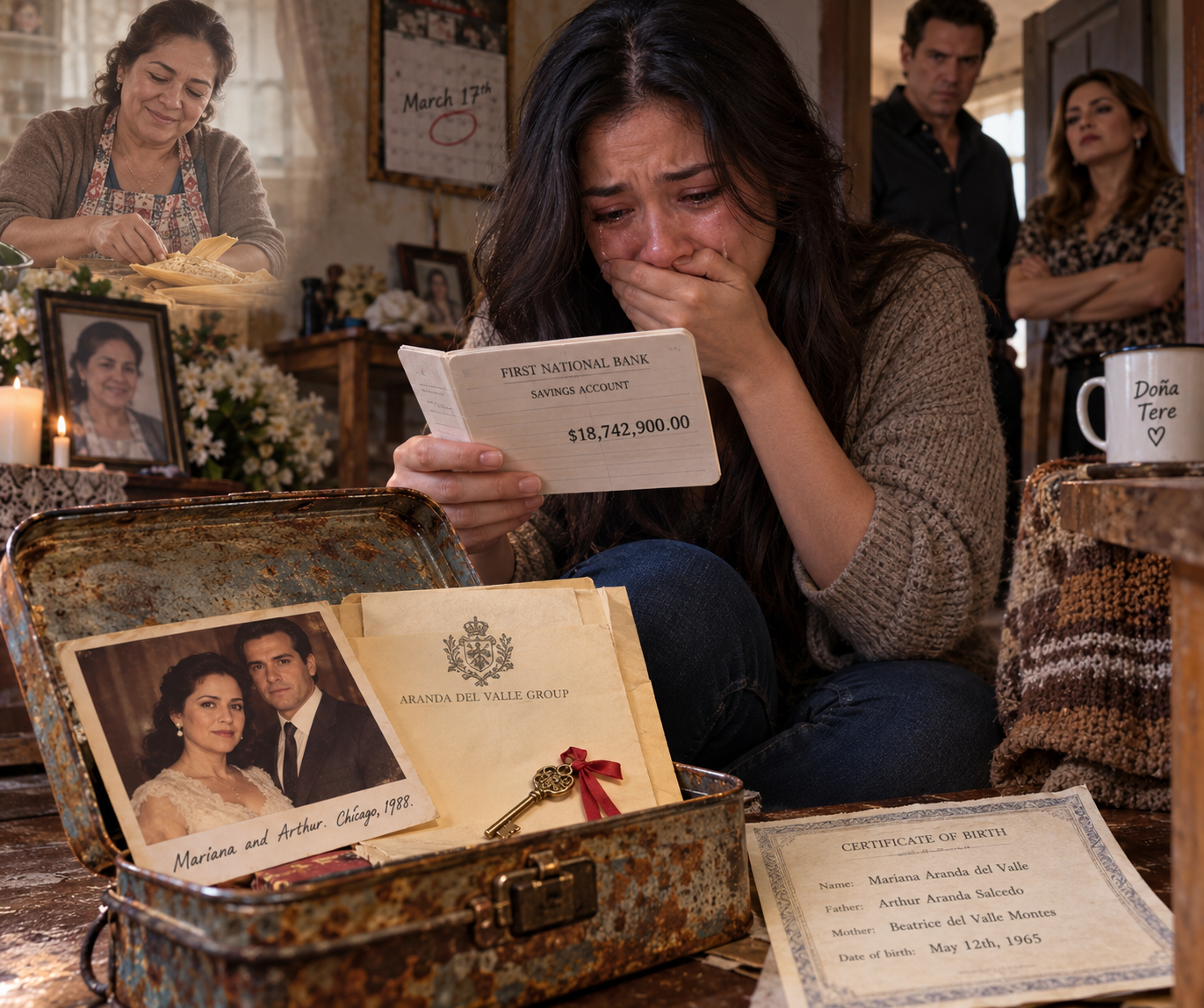
I placed Mom’s birth records on the table.
Then the photographs.
Then the agreement.
Then the savings book.
His expression changed.
“Where did you get these?”
“My mother.”
“Name?”
“Theresa Lopez.”
I put the photograph of young Mom beside it.
“Before that, Mariana Aranda del Valle.”
Miguel sat.
For the first time, he looked directly at me.
“Start at the beginning.”
I told him about the hospital.
The funeral.
Roger.
The key.
Box 317.
The eighteen million dollars.
Isabella.
Harold.
The men at the office.
Miguel interrupted only to clarify dates.
When I finished, I played Roger’s voicemail.
He listened once.
Then again.
When Roger mentioned Dad and the old secret, Miguel asked me to send the audio to the station’s secure server.
“You believe me?”
“I believe recordings, documents and frightened ninety-one-year-old lawyers more than I believe anybody’s family story.”
He picked up the settlement.
For several minutes, he read silently.
Then he frowned.
“This signature.”
“Arthur?”
“No.”
He turned the last page toward me.
I leaned closer.
Beneath several initials was a signature I had treated as another legal witness.
Eduardo Aranda del Valle.
My grandfather.
Miguel tapped it.
“This settlement wasn’t merely approved by Arthur.”
“What does that mean?”
“It means the authority behind it went higher.”
He crossed the newsroom to a cabinet and returned with an old archive binder.
ARANDA GROUP.
The file contained years of reporting.
Land disputes.
Campaign contributions.
Worksite deaths.
Settlements.
Investigations that vanished before charges were filed.
Miguel pointed to a photograph.
Eduardo Aranda stood at a hospital opening, old but unmistakable.
“Ninety-three and still alive.”
I felt something twist inside me.
“So my grandfather knows Isabella was taken.”
“If these records are accurate, he signed the arrangement surrounding it.”
Sofia sat beside me.
“Can we find Isabella?”
Miguel did not answer.
A producer outside suddenly turned up the newsroom television.
A breaking-news banner appeared.
ARANDA FOUNDATION TO NAME NEW CHIEF EXECUTIVE.
The screen switched to a hotel ballroom.
White flowers.
Gold lights.
A stage prepared for a morning announcement.
Then a woman stepped in front of the cameras.
I stopped breathing.
She was older than me.
Elegant.
Composed.
Dark curls framed her face.
Beside her left eyebrow was a small birthmark.
I lifted the old photograph from Harold’s briefcase.
The same eyes looked back at me from a four-year-old child.
Miguel lowered the television volume.
The caption identified her.
ISABEL ARANDA.
Sofia whispered, “Elena.”
I could not answer.
My sister was alive.
Not hidden.
Not missing.
She was standing on television preparing to inherit the public leadership of the family that had taken her from our mother.
My phone rang.
Unknown number.
Miguel motioned for everyone to be quiet.
I answered.
“Hello?”
A man spoke in a calm, cultivated voice.
“Elena Lopez.”
Not a question.
“Who is this?”
“I think you know.”
My fingers tightened around the phone.
He continued.
“My name is Arthur Aranda.”
Across the table, Miguel began recording.
Arthur sounded almost warm.
“I understand you have acquired documents belonging to my family.”
“They belonged to my mother.”
“A distinction we can discuss.”
“What did you do to Harold Benson?”
A pause.
“You should be more concerned with what happens next.”
I looked at Isabel on the television.
“What do you want?”
“Bring the documents to the Aranda Grand Hotel tomorrow morning. Before nine.”
“And if I don’t?”
Another measured pause.
Then his voice lost the last trace of warmth.
“Ask your journalist friend whether Mr. Benson survived the fire.”
The line went dead.
I looked at Miguel.
“What fire?”
He was already moving toward the newsroom.
One of the screens changed.
An alert appeared beneath the anchor.
ELDERLY ATTORNEY CRITICALLY INJURED IN OFFICE FIRE.
Harold Benson.
Sofia covered her mouth.
I stared from the breaking-news report to Isabel’s face on the neighboring screen.
Mom had spent decades silent.
She had surrendered the Aranda name.
She had left a fortune untouched.
She had lived in a small house, worn repaired clothes, sold food outside a church, and watched one daughter grow up from a distance so the other could remain safe.
Now Arthur knew I had the proof.
Harold was fighting for his life.
Roger was tangled in whatever had been hidden.
And at nine the next morning, Isabella would step onto a stage believing Arthur Aranda was the man who had given her a future.
I closed the briefcase.
For the first time since finding the key, I knew what I had to do next.
I was going to that hotel.
Click here to continue reading: PART 5: I Entered the Aranda Hotel Expecting Arthur’s Threat, but the First Person Waiting for Me Was the Sister I Had Never Met
My Mother’s Funeral Should Have Ended the Questions, but One Missing Sweater Thread Led Me Back to Everything She Hid
Part 4 of 24