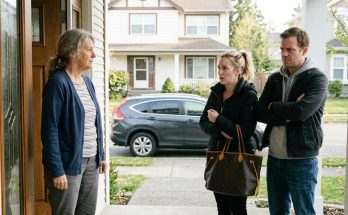
Elaine Porter agreed to meet us the following morning.
Not at Mercy.
She refused to enter the building.
“I spent thirty years avoiding that place,” she told Chen. “I’m not starting now.”
We met at a county interview office.
Elaine was small, silver-haired, and carried a canvas purse against her body as if someone might take it.
When Sarah entered, Elaine stood.
Then froze.
“Oh.”
Sarah stopped.
“You recognize me.”
Elaine nodded.
“I wondered whether I would.”
“Do I look very different?”
“Yes.”
Sarah smiled faintly.
“Good.”
Elaine laughed once.
Nervous.
Then cried.
“I’m sorry.”
Sarah’s smile disappeared.
“For what?”
“I should have done something.”
“You kept the note.”
“That isn’t enough.”
“No.”
Elaine blinked.
Sarah sat.
“But it’s something.”
That answer seemed to steady her.
Lily joined them.
Elaine looked at her left foot before she looked at her face.
Lily noticed.
“The birthmark?”
“Yes.”
Lily slipped off one shoe.
The pale crescent remained.
Elaine covered her mouth.
“I put your first identification band around that ankle.”
Lily looked down.
“Do you remember my birth?”
“Afterward.”
“Who delivered me?”
Elaine hesitated.
“Dr. Vale.”
Nathan.
Sarah went still.
“He delivered Lily?”
“Yes.”
Nathan had never said that.
Of course he had not.
“Was Victor present?”
“Not for delivery.”
“Margaret?”
“Outside.”
“Patricia?”
“She arrived later.”
“Daniel?”
Elaine shook her head.
“Already gone.”
Sarah looked down.
Elaine continued.
“The birth itself was medically ordinary. What happened afterward was not.”
“Did you know I was part of an experiment?”
“Not at first.”
“When did you realize?”
“When Dr. Hale ordered medication that had no postpartum indication.”
“Did you question it?”
“Yes.”
“What happened?”
“Nathan told me it was for acute trauma.”
Sarah’s jaw tightened.
“Did he know what it really was?”
“I believe so.”
“Did you administer it?”
Elaine’s face folded.
“Once.”
Sarah absorbed that.
“Thank you for telling me.”
“I refused the second time.”
“What happened?”
“Victor threatened my license.”
“And?”
“I administered saline instead.”
Everyone stopped.
Sarah stared.
“You faked a dose?”
“Yes.”
“When?”
“Hour five.”
The period when Sarah had supposedly stopped responding.
Maybe part of why.
Victor thought she was under more drug than she actually was.
Elaine continued.
“That may be why you were able to pretend later.”
Sarah looked at Lily.
A stranger’s quiet act of defiance may have preserved enough clarity for Sarah to protect her daughter.
“Why didn’t Victor notice?”
“He wasn’t watching the syringe.”
“What was he watching?”
“You.”
Of course.
“Did anyone else know?”
“One person.”
“Who?”
Elaine looked at Chen.
“I’ve never told anyone his name.”
“Why?”
“Because he asked me not to.”
Sarah leaned forward.
“Who?”
Elaine’s hands tightened around her purse.
“Dr. Samuel Greene.”
Mara looked up.
The name meant something.
“Neurologist?”
Elaine nodded.
“He consulted on Victor’s early trials.”
“Alive?” Sarah asked.
“I don’t know.”
Chen searched.
Samuel Greene.
Eighty-three.
Retired.
No death record.
Living in New Mexico.
Sarah stared.
“What did he see?”
“Everything.”
“Session records?”
“More.”
“What?”
“Victor’s original protocol.”
Chen became very still.
The master authorization.
The document that could establish intent before later falsifications.
Elaine explained.
Dr. Greene initially believed the research involved consenting adults with trauma disorders.
Then he discovered children were being exposed.
Sarah.
Rebecca.
Others.
He confronted Victor.
Victor threatened him.
Greene copied files.
“He planned to report it.”
“Did he?”
“Yes.”
“To whom?”
“Hospital board.”
“What happened?”
“The complaint disappeared.”
Judith.
Probably.
“Did Greene keep copies?”
Elaine nodded.
“I think so.”
Sarah asked, “Why didn’t he go public?”
“He tried.”
“How?”
“Medical journal.”
“Rejected?”
“Withdrawn.”
“By him?”
“No.”
Victor had influence.
Money.
Professional relationships.
Then something worse.
Greene’s wife was arrested for prescription fraud.
Charges later dismissed.
But his career collapsed.
He left the state.
“Victor framed her.”
Elaine nodded.
“That’s what Samuel believed.”
Chen contacted Greene.
He refused to speak by phone.
Then Elaine took the call.
“Samuel.”
Silence.
“It’s Elaine.”
Longer silence.
“She’s alive.”
Greene asked one question.
“Which one?”
Sarah closed her eyes.
That told us how many children he had worried about.
Elaine answered.
“Sarah Whitmore.”
Greene began crying.
He agreed to video.
An elderly man appeared.
White beard.
Oxygen tubing beneath his nose.
His first words to Sarah were:
“I failed you.”
Sarah looked tired.
“Apparently there’s a club.”
Greene laughed through tears.
“I deserve that.”
“What did you know?”
“Too much.”
“When?”
“By 1989.”
Before Lily.
Before Daniel died.
Before the worst years.
“Did you report Victor?”
“Yes.”
“Can you prove it?”
Greene held up a folder.
“I kept everything.”
Chen arranged secure collection.
Scanned copies arrived first.
Original protocol.
Victor Hale principal investigator.
Nathan Vale assistant.
Judith Trent administrative coordinator.
Adult volunteers only.
Then handwritten amendment.
Never submitted.
Pediatric attachment-response extension.
No ethics approval.
Victor’s signature.
Nathan’s initials.
Sarah stared at Nathan’s initials.
Again.
Greene had also kept laboratory results.
S-4.
Sarah.
Exposure at eight.
Notes documenting acute distress.
Recommendation:
NO FURTHER EXPOSURE.
Victor overrode it.
S-5.
Rebecca.
Age three.
Greene’s handwritten note:
This is not treatment. Stop immediately.
Sarah looked at Rebecca.
Her sister stared at the screen without blinking.
There were letters.
Dates.
Registered mail receipts.
Proof complaints were sent.
Hospital administration received them.
Then board minutes.
No mention.
Someone removed them.
Greene had one more file.
Audio cassette.
Meeting with Victor.
Chen digitized it.
Victor’s younger voice:
You’re confusing ethics with outcomes.
Greene:
She is eight years old.
Victor:
She will not remember.
Greene:
That is not a defense.
Victor:
It is the point.
The room went silent.
There was intent.
Not later reinterpretation.
Not unreliable recovered memory.
Victor saying it himself.
Greene continued on tape:
If you expose another child, I will go to police.
Victor:
And tell them what? That you participated?
Greene:
Yes.
Victor:
Your wife won’t survive the scrutiny.
There.
Threat.
Recorded.
Greene had hidden the recorder in his coat.
“Why didn’t you give this to police?” Sarah asked.
“I did.”
“What?”
“Copy.”
“When?”
“1990.”
“Who took it?”
“Detective Harold Mercer.”
Chen searched.
Mercer.
Deceased.
Retired with commendations.
But his son was alive.
Stored boxes from his father’s career.
A search with family permission found the case.
Unfiled.
Not destroyed.
Mercer had written:
Ordered by chief to close. No probable cause claimed despite recordings. Chief cites hospital counsel.
The chief at the time?
Judith’s brother-in-law.
The network extended beyond medicine.
Not necessarily everyone knowingly involved.
But enough institutional pressure to bury one complaint after another.
Sarah read Greene’s final letter.
He wrote it after leaving the state.
I do not know whether Sarah remembers what was done. If she does not, that may spare her pain, but it does not spare us responsibility.
Sarah sat back.
“Finally.”
“What?” I asked.
“Someone understood that forgetting didn’t make it harmless.”
Greene heard.
He nodded.
“I wish I had understood sooner.”
Sarah looked at him.
“You did more than most.”
“Not enough.”
“No.”
She did not comfort him with absolution.
But she added:
“Your records matter now.”
Greene cried.
“Good.”
The evidence changed the prosecution.
Victor could no longer plausibly describe the childhood exposures as misunderstood treatment.
Nathan’s liability sharpened.
Judith’s administrative role became documented.
Hospital leadership faced historical investigation.
But Greene had another memory.
One that involved Sarah’s father.
Joseph.
“Your father came to me.”
Sarah leaned forward.
“When?”
“After your exposure at eight.”
“What did he know?”
“That something happened.”
“Did you tell him?”
“Not enough.”
“Why?”
“I was afraid.”
Sarah’s expression tightened.
“Everyone was.”
“Yes.”
“What did Dad do?”
“He asked whether Margaret had consented.”
“Had she?”
“Yes.”
Sarah flinched.
Even after everything, that hurt.
Margaret consented to Sarah’s first exposure.
“To make me forget Celia?”
“Partly.”
“And Rebecca?”
“Yes.”
“Did Dad know?”
“Not then.”
“What did he do after?”
“He threatened Victor.”
“Then?”
“Margaret told him Sarah would be taken from them if he caused trouble.”
Same weapon.
Family separation.
Joseph stayed.
But Greene remembered something else.
“He started keeping a journal.”
Sarah frowned.
“We found Dad’s letters.”
“Not letters.”
“A journal.”
“Where?”
“I don’t know.”
“He said if anything happened to him, it would go to Sarah.”
Nothing like that had appeared.
Rebecca shook her head.
“I cleaned Dad’s things after he died.”
“No journal?”
“No.”
Sarah looked at me.
“Another hidden box.”
I almost laughed.
“Apparently our parents believed furniture was safer than people.”
Greene smiled sadly.
“Sometimes they were right.”
Joseph’s old belongings were mostly in Rebecca’s storage unit.
Police searched with permission.
Nothing.
Then Rebecca remembered their father’s habit.
He restored old clocks.
One remained in Sarah’s house.
Tall grandfather clock in the hallway.
Stopped for years.
Sarah looked at me.
“You never threw it away?”
“It weighs two hundred pounds.”
“Romantic.”
“Practical.”
We returned home under escort.
The house still carried smoke damage from the earlier fire attempt, but the hallway survived.
The clock stood against the wall.
Rebecca opened the lower cabinet.
Weights.
Pendulum.
Dust.
No journal.
Sarah ran her hand along the inner panel.
“Dad hated wasted space.”
Rebecca frowned.
“What?”
“He built compartments into everything.”
A removable wooden strip.
Behind it:
A narrow notebook wrapped in plastic.
Joseph Whitmore.
Sarah held it without opening.
For once, no one rushed her.
Then she sat on the floor.
I sat beside her.
Rebecca on the other side.
Lily leaned against the wall.
Sarah opened the first page.
Joseph’s handwriting:
If Sarah ever reads this, it means I was too cowardly to tell her while I was alive.
Sarah breathed out.
“Dad.”
The entries began after her childhood exposure.
Joseph suspected Margaret and Victor.
He documented mood changes.
Nightmares.
Sarah asking about a woman in a yellow scarf.
Rebecca waking screaming for “Mama.”
He confronted Margaret.
She admitted Rebecca was not biologically theirs.
Joseph nearly left.
Then stayed because he feared losing both girls.
Years later, he learned more.
Celia.
Daniel.
Lily.
He tried to intervene in pieces.
Never enough.
The final entries were written shortly before his death.
One sentence made Sarah stop.
Margaret told me Victor has begun watching Ethan Caldwell’s family.
I looked at the page.
“What?”
Date:
Twenty-six years ago.
Before Sarah and I married.
Before we had even met formally.
Sarah looked at me.
“Why your family?”
Joseph’s next entry answered.
Henry knows about the clinic. Victor believes Henry has copies.
My father.
Again.
Then:
Victor asked Margaret whether Sarah could be encouraged toward Henry’s son. Margaret refused. She said Ethan is outside the study and must remain outside.
Sarah stared at me.
“Our meeting.”
My stomach tightened.
“Was it arranged?”
The next pages were missing.
Torn out.
But the final surviving line read:
Sarah met Ethan on her own. Victor is furious.
I looked at her.
Sarah looked back.
After days of discovering manipulated reunions, engineered separations, controlled contacts, and manufactured choices, there it was.
One beginning Victor had not designed.
We had met by accident.
At a broken-down car.
In rain.
Sarah had been furious because her alternator failed.
I had stopped because Dad taught me never to drive past someone stranded at night.
No experiment.
No drug.
No placement.
No plan.
Sarah began laughing.
Then crying.
“What?”
She shook her head.
“Nothing.”
“Sarah.”
“They didn’t do that.”
“No.”
“They didn’t arrange us.”
“No.”
She leaned against me.
For several minutes, neither of us read further.
Then Rebecca turned another page.
Joseph had written one last warning.
If Victor ever learns what Henry kept from him, he will go after Ethan directly.
Below it:
Henry did not only keep Celia’s statement.
He kept Anne’s original formula.
Sarah lifted her head.
The original memory compound formula.
The thing Victor’s later work had been built from.
The thing Emily had been trying to reconstruct.
And according to Joseph, my father had hidden the only unaltered copy somewhere Victor never found.
Click here to continue reading: PART 39: Henry’s Hidden Formula Led Ethan and Sarah Beneath the Repair Shop, Where They Found Anne’s Proof That the Drug Could Be Reversed
Three Years After Our Quiet Divorce, Sarah Came Home for One Night and Left Her Wedding Ring Behind
Part 38 of 50