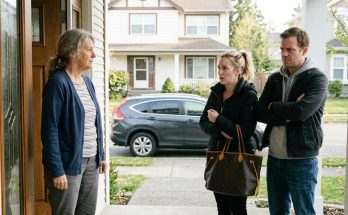
Emily Bishop held the pistol with a steady hand.
Not the grip of someone panicking.
Not the tremor of someone improvising.
She had expected this moment.
The medical case in her other hand looked almost ordinary—black plastic, molded handle, stainless clasps.
Sarah looked at it, then at Emily.
“You’re going to inject me.”
“No.”
Emily sounded mildly disappointed by the assumption.
“I’m going to give you a choice.”
Joseph laughed bitterly.
“You’ve never given anyone a choice.”
Emily looked at him.
“You mistake me for my father.”
“You continued his work.”
“I corrected it.”
“You kidnapped Claire.”
“I protected Claire.”
“You tried to drug Nathan.”
Emily’s expression tightened.
“I tried to stop Nathan from destroying twenty-five years of evidence.”
“With enough sedative to kill him?”
“He took more than I intended.”
I watched her carefully.
That answer mattered.
Not denial.
Qualification.
Sarah noticed too.
“Victor said you were trying to kill him.”
Emily smiled faintly.
“Victor assumes everything is about Victor.”
“He’s your father.”
“Biology is not loyalty.”
Sarah’s gaze dropped toward the medical case.
“What’s inside?”
“Records.”
“And?”
“One dose.”
Joseph moved forward.
Emily pointed the weapon at him.
“Stay where you are.”
He stopped.
I could feel Sarah’s transmitter beneath her clothing.
Chen was listening.
If the signal worked inside the old farmhouse.
If Emily had not anticipated that too.
Sarah asked, “One dose of V-17?”
“No.”
“What?”
“Something newer.”
I stepped closer to Sarah.
Emily noticed.
“Ethan Caldwell.”
“You’ve watched me long enough to know the name.”
“Yes.”
“Then you know I’m not letting you inject her.”
Emily looked almost sympathetic.
“You still believe I came here to force her.”
“You came armed.”
“Because Joseph is armed.”
I looked at him.
He said nothing.
Sarah turned.
“Dad?”
Joseph’s eyes remained on Emily.
“I have a pistol in my coat.”
“Take it out slowly,” I said.
Emily’s aim shifted toward his chest.
“No.”
Sarah’s voice cut through both of us.
“Everyone stop.”
Nobody moved.
She looked at Joseph.
“Is your gun loaded?”
“Yes.”
“Take it out with two fingers and put it on the floor.”
“Sarah—”
“Do it.”
For a second, I saw something neither Joseph nor Emily expected.
Not Subject S-4.
Not seventeen-year-old Sarah.
Not the confused woman who woke believing it was 2001.
The woman I had married.
Joseph obeyed.
He lowered the pistol to the floor.
I kicked it beneath the kitchen table.
Emily’s weapon remained raised.
Sarah looked at her.
“Your turn.”
Emily shook her head.
“You don’t control this situation.”
“You came here because you need me cooperative.”
Emily’s expression changed slightly.
Sarah had found the pressure point.
“If you wanted me unconscious,” Sarah continued, “you could have tried at the hospital. If you wanted me dead, you had opportunities. You came here with a medical case and a speech because whatever you’re planning requires my consent, or at least my participation.”
Emily said nothing.
“That means I have leverage.”
“You’re very different from the seventeen-year-old girl in Victor’s notes.”
“I hope so.”
“She was remarkable too.”
“Stop talking about me like I’m a specimen.”
Emily’s face softened.
“I understand why you hate that language.”
“No, you understand that I hate it. That isn’t the same thing.”
I almost smiled.
Sarah pointed toward the table.
“Put down the gun.”
“No.”
“Then we don’t talk.”
Emily looked toward the windows.
Perhaps calculating police distance.
Perhaps wondering whether Joseph had betrayed her.
Then she lowered the pistol.
Not all the way.
Sarah waited.
Emily placed it on the counter.
I moved between her and the weapon.
“Now the case.”
Emily set it on the table.
Joseph whispered, “Don’t open it.”
Sarah looked at him.
“Why?”
“Because she lies.”
“So do you.”
He flinched.
Sarah opened the case.
Inside were vials, syringes, several old notebooks, and a modern tablet.
No hidden compartments obvious.
Emily pointed to the notebooks.
“Anne’s.”
“Your mother.”
“Yes.”
“Claire’s biological mother.”
“Yes.”
“Did Victor kill her?”
Emily looked toward the floor.
“I believe so.”
“You believe.”
“I was twenty-seven when she disappeared. Victor told me she left the country.”
“And you accepted that?”
“For three months.”
“What changed?”
“I found blood in his laboratory.”
Joseph turned away.
Emily continued.
“Anne’s blood type.”
“Could have been old samples.”
“That was what Victor said.”
“But you didn’t believe him.”
“No.”
“What did you do?”
“I started copying records.”
Sarah glanced toward me.
That sounded familiar.
Claire.
Daniel.
Everyone who discovered the truth became an archivist.
“You kept working with Victor.”
“Yes.”
“For decades.”
“Because leaving would have meant losing access.”
Joseph scoffed.
“You built a career from his research.”
Emily turned on him.
“You kept Daniel’s evidence in a box for twenty-five years.”
“And I regret it.”
“So do I.”
Sarah raised a hand.
“This is not a competition.”
Silence.
She opened one notebook.
Anne Bishop’s handwriting was small and precise.
Pages of chemistry.
Dosage calculations.
Patient observations.
Then a line circled repeatedly:
Memory suppression is injury, not treatment.
Sarah touched the sentence.
“She knew.”
Emily nodded.
“She tried to stop everything.”
“Why didn’t Nathan help?”
“He eventually did.”
“Eventually.”
“Yes.”
That word carried a history of delayed courage.
Sarah flipped another page.
Anne described Subject S-4.
Not by name.
But unmistakably.
Teenage female presented following compounded trauma, family coercion, pregnancy loss narrative.
Sarah’s hand paused.
“Pregnancy loss narrative.”
“She knew Lily was alive.”
“Yes.”
“And knew they told me she died.”
“Yes.”
“What did Anne think?”
“She was furious.”
“Then why treat me?”
“She refused after she learned.”
“So Victor continued.”
“With Nathan initially.”
Sarah read farther.
Anne recorded concern that S-4 had already been exposed years earlier to prototype compound P-3.
Age eight.
Claire’s disappearance.
The first erasure.
Then Anne wrote something unexpected.
S-4 is not forgetting normally. Memories appear dissociated from emotional access rather than erased.
Mara had said something similar.
The memories might remain.
Connections damaged.
Paths buried.
Emily tapped the modern vial.
“That is what I learned to reverse.”
Sarah’s eyes moved to it.
“You made a drug that restores memory.”
“Not exactly.”
“Then what?”
“It creates a temporary state in which suppressed associations become unusually accessible.”
“Sounds convenient.”
“It’s dangerous.”
“Finally something we agree on.”
Emily ignored the sarcasm.
“Potential consequences include seizures, cardiovascular stress, psychosis, permanent cognitive injury.”
I stared at her.
“And you brought it for a woman recovering from surgery.”
“Yes.”
“No.”
Sarah looked at me.
“Ethan.”
“No.”
“This is my decision.”
“It is.”
That stopped her.
I stepped closer.
“And I’m telling you what I think. That’s different from deciding.”
She held my gaze.
Then nodded.
Fair.
Emily looked between us.
For the first time, something like envy crossed her face.
Sarah saw that too.
“Why do you care whether I remember?”
Emily’s answer came quietly.
“Because if you remember everything, I can prove Victor’s theory was wrong.”
Sarah stared.
“This is still about research.”
“No.”
“Yes.”
Emily’s composure fractured.
“My mother died trying to prove memory could not be ethically manipulated. Victor spent his life claiming the harm was temporary, that identity returned, that damaged recall could be reconstructed.”
“And you want to prove him wrong by experimenting on me again.”
“I want you to remember enough to testify.”
“I already can testify about what I know.”
“Not about what happened at the clinic.”
Sarah went still.
“The night after the party.”
“Yes.”
Emily pointed to Anne’s notebook.
“My mother wrote that something happened during your first adult exposure that terrified her.”
“What?”
“She never recorded it.”
“Why not?”
“She wrote only one sentence.”
Emily found the page.
Sarah read aloud.
S-4 saw V.H. and N.V. with the missing Morgan evidence before D.M.’s death.
Joseph stepped forward.
“What?”
Emily looked at him.
“Sarah saw Daniel’s evidence before Daniel died.”
“That’s impossible.”
“No.”
Sarah’s face had gone blank.
“Where?”
“Victor’s laboratory.”
“How?”
“We don’t know.”
“I was drugged.”
“Yes.”
“And somehow saw evidence Daniel hadn’t stolen yet?”
Emily nodded.
“That contradiction is why Anne was frightened.”
Joseph grabbed the edge of the table.
“Unless Daniel had already copied it once.”
Emily looked at him.
“What?”
Joseph spoke slowly.
“Daniel told me the records had been moved.”
“When?”
“Before he died.”
Sarah stared.
“He may have taken them, then put them back.”
“Or copied them.”
“Yes.”
Emily’s eyes sharpened.
“Victor may have known Daniel had discovered the study earlier than we thought.”
Meaning Daniel’s death might have been planned well before the escape.
Sarah turned toward the silver case.
“Open it.”
Joseph hesitated.
“Dad.”
He unlatched it.
Inside were folders sealed in aging plastic.
Photographs.
Audio cassettes.
Medical charts.
A small vial.
And a stack of photocopies.
Emily reached.
I stopped her.
“Hands where I can see them.”
She glared.
Sarah removed the top folder.
Daniel’s handwriting.
Dates.
Names.
Payments.
Michael Trent.
Victor Hale.
Nathan Vale.
Anne Bishop.
Margaret Whitmore.
Then another name.
Judith Trent.
Michael’s mother.
Sarah looked up.
“What did Judith do?”
Joseph answered.
“She worked in hospital administration.”
“So she covered records.”
“Yes.”
“Did Michael know?”
“Probably not all of it.”
Another page.
Daniel had diagrammed the research group.
At the center:
V.H.
Beside him:
N.V.
A.B.
J.T.
Then a question mark.
Below:
E.B.?
Emily stared at her own initials.
“He knew about me.”
Sarah looked at her.
“How involved were you?”
“Not in the trials.”
“But?”
“I helped my mother copy files.”
“Daniel suspected you.”
“Yes.”
Sarah kept reading.
One entry was dated two days before Daniel died.
Saw S. leaving lab. She looked sick. Victor said routine treatment. Sarah says she remembers nothing.
Sarah’s breathing changed.
“Daniel saw me there.”
Emily leaned closer.
“He already knew you were being treated.”
“He must have started investigating because of me.”
“Yes.”
Daniel had not stumbled upon the files through maintenance work alone.
He had followed Sarah.
Because she was disappearing in pieces.
Another entry:
S says she woke with blood on sleeve. Not hers. Victor says nosebleed. She remembers woman crying.
Sarah froze.
Woman crying.
Anne.
“What happened that night?”
Emily whispered, “That’s what Anne never wrote.”
Sarah touched the vial in the silver case.
“What is this?”
Joseph moved quickly.
“Don’t.”
The faded label read:
S-4 / SESSION 3.
Emily stared.
“That shouldn’t exist.”
“Why?”
“Biological sample?”
“No.”
She leaned closer without touching.
“Original compound.”
Twenty-five years old.
Preserved.
Evidence.
Joseph said, “Daniel stole that.”
Emily’s eyes filled with recognition.
“This could prove what they gave Sarah.”
“It already does,” Sarah said.
“No. Chemical analysis could connect Victor’s work directly to the old illegal trials.”
Sirens sounded faintly outside.
Emily turned toward the window.
She realized.
“You brought police.”
Sarah said nothing.
Emily looked almost betrayed.
“You agreed to come.”
“I agreed to meet my father.”
“You were wired.”
“Yes.”
Emily reached toward the pistol.
I moved first.
I shoved the weapon farther across the counter.
Joseph blocked her path.
Emily stopped.
The sirens grew louder.
“You don’t understand,” she said.
“Then explain quickly.”
“If police seize everything, Victor’s attorneys will bury it in chain-of-custody challenges for years.”
Chen’s voice came from outside.
“Emily Bishop! Step away from all weapons and come outside with your hands visible!”
Emily looked at Sarah.
“One dose.”
“No.”
“You could remember the clinic.”
“No.”
“You could remember Daniel’s final days.”
Sarah’s face tightened.
“No.”
“You could remember Lily’s birth.”
That hit.
Emily knew it.
“You could remember holding your daughter.”
Sarah stared at the vial.
For one terrible second, I thought she might agree.
I wanted to tell her not to.
Instead, I remained silent.
Her choice.
Sarah touched the ringless place on her finger.
Then looked at Lily’s name in Daniel’s notes.
When she spoke, her voice was steady.
“If a memory comes back, I want to know it belongs to me.”
Emily’s face fell.
“I can help.”
“You can’t undo what you did by doing it again.”
Outside, Chen repeated the command.
Emily slowly raised her hands.
Joseph exhaled.
I moved the pistol away.
Then Emily looked at the silver case.
“Ask him about the missing page.”
Sarah turned.
“What?”
Joseph went still.
Emily smiled sadly.
“The case is incomplete.”
Sarah looked at her father.
“What page?”
Joseph’s face lost color.
Emily continued.
“The page Daniel gave Joseph personally.”
Sarah stared.
“Dad?”
He lowered his eyes.
“What was on it?”
Joseph whispered, “A name.”
“Whose?”
Silence.
“Whose name?”
Joseph looked at me.
Not Sarah.
Me.
My stomach tightened.
Sarah noticed.
“Why are you looking at Ethan?”
Joseph’s answer came like a blow.
“Because Daniel wrote Caldwell.”
I stared at him.
“My family?”
Joseph nodded.
Sarah’s face emptied.
“What did Ethan’s family have to do with any of this?”
Joseph looked toward me.
“His father knew Victor.”
And suddenly the story reached into my side of the marriage.
Click here to continue reading: PART 22: Daniel’s Missing Page Connected My Father to Victor’s Secret Research, and Sarah Learned Why Our First Meeting May Not Have Been Accidental
Three Years After Our Quiet Divorce, Sarah Came Home for One Night and Left Her Wedding Ring Behind
Part 21 of 50