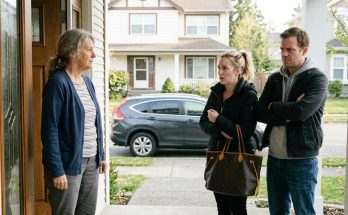
The morning Sarah testified, she burned the toast.
Not slightly.
Black edges.
Smoke detector complaining.
I stood under it waving a dish towel while she stared at the toaster.
“This feels deliberate,” I said.
“The toaster is intimidated by court.”
“It should retain counsel.”
Sarah laughed.
That sound mattered more than the breakfast.
Six weeks earlier, the morning of testimony would have begun with medication charts, police calls, hidden files, or another person explaining what Sarah supposedly could not remember.
Today she complained about toast.
Then swallowed her cancer medication with coffee.
Put on dark blue trousers.
Buttoned a cream blouse.
Checked the wedding ring on her finger.
And asked me whether I had remembered to feed the neighbor’s cat.
Normal had not returned.
We had built a different version.
“You nervous?” I asked.
“Yes.”
“Want me to lie?”
“No.”
“You’ll be brilliant.”
“That’s still a lie.”
“Probably.”
She smiled.
Then looked toward the kitchen window.
“I’m not scared of him.”
“Victor?”
“No.”
“What are you scared of?”
“Getting something wrong.”
I understood.
After everything, Sarah still feared one imperfect memory could somehow invalidate all the true ones.
I set down my coffee.
“You’re allowed to get something wrong.”
“I know.”
“Do you?”
She sighed.
“Dr. Patel said the same thing.”
“She’s smarter than me.”
“Substantially.”
“Rude.”
Sarah stepped closer.
“What if I remember something differently from a recording?”
“Say that.”
“What if I don’t remember something everyone else does?”
“Say that.”
“What if his lawyer makes me look confused?”
“You have been confused.”
She frowned.
“Terrible pep talk.”
“You were drugged, operated on, deprived of oxygen, lied to for decades, and deliberately subjected to memory manipulation. Confusion is evidence of what happened to you, not a moral failure.”
Sarah studied me.
“That one was better.”
“I warmed up.”
At the courthouse, the hallway was crowded but controlled.
The larger federal case had swallowed parts of the state investigations.
Some defendants had begun negotiating.
Others had not.
Peter had taken a plea that included his role in Daniel’s death and the later violence surrounding the evidence recovery.
He would spend the rest of his useful years in prison.
Judith had entered a conditional plea to obstruction, falsification, and conspiracy counts after medical evaluation found her competent.
Her age and health would affect sentencing.
They did not rewrite what she had done.
Nathan had pleaded guilty to charges tied to unauthorized administration and conspiracy while continuing to cooperate.
Emily had not yet finalized her agreement.
Her lawyers were still arguing over whether her attempts to expose Victor mitigated the experiments she continued herself.
That question belonged to the court.
Not Sarah.
Not Anne.
Not Claire.
Victor rejected every meaningful offer.
He wanted trial.
Maybe because trial still gave him an audience.
Maybe because he believed evidence remained another system he could manipulate.
I stopped guessing what he believed.
His motives had occupied enough rooms in our lives.
Sarah entered the courtroom.
Lily sat behind us.
Rebecca beside her.
Claire and Anne farther down.
Joseph came.
Thomas too.
Michael sat with Dylan.
David had returned from Utah and sat beside Steven Reeves, the father who raised him.
Jessica sat alone at first.
Then Diane entered quietly.
She stopped near the back.
Jessica saw her.
For several seconds, neither moved.
Then Jessica lifted one hand.
Not invitation exactly.
Permission.
Diane sat one seat away.
That was enough.
My half-sister Laura and half-brother Thomas were not there.
We had finally met them the previous weekend.
Neutral ground.
A diner halfway between cities.
Laura hugged me after asking.
Thomas shook my hand, then changed his mind and hugged me too.
We talked for four hours.
Nobody called Margaret Ellis anything Sarah or I had not chosen.
My mother.
Their mother.
Our mother.
Carol remained Mom.
Henry remained Dad.
The vocabulary stretched.
It did not break.
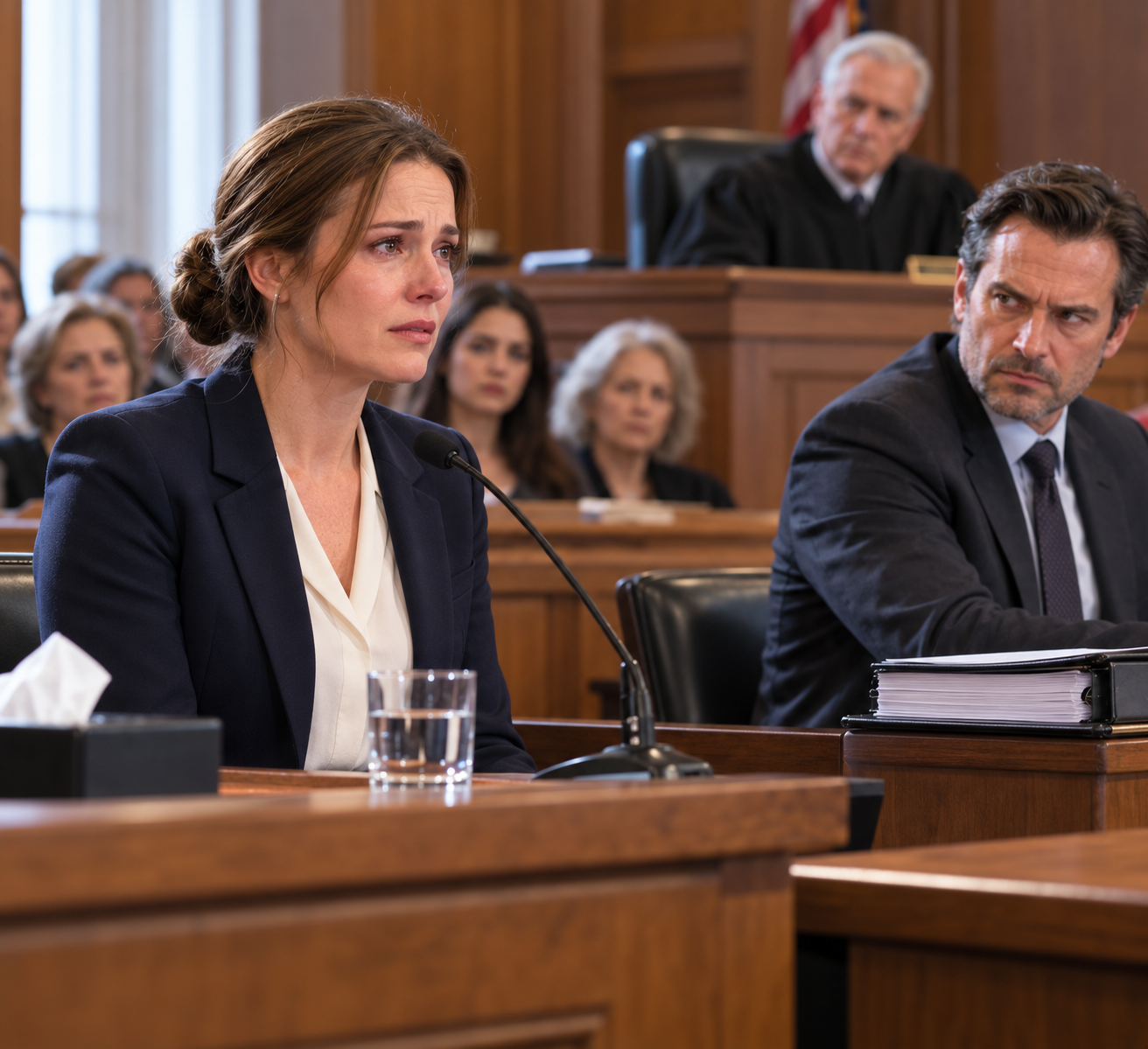
Now Sarah was called to testify.
She stood.
Swore to tell the truth.
Sat.
The prosecutor began with easy things.
Name.
Age.
Marriage.
Divorce.
Medical history.
Sarah answered carefully.
Then cancer.
Dr. Adrian Cole.
She identified Victor.
He watched her without expression.
The prosecutor asked:
“Do you recognize the defendant?”
“Yes.”
“How?”
“He treated me under the name Adrian Cole. I later learned he was Victor Hale.”
“Do you remember meeting him before your cancer treatment?”
Sarah paused.
“Fragments.”
Victor’s attorney looked up.
The prosecutor asked:
“Can you distinguish between what you personally remember and what you later learned from records?”
“Yes.”
“Please do so whenever possible.”
“I will.”
That became the rhythm.
“I remember.”
“I do not remember.”
“I learned that from a recording.”
“I recognize the handwriting but do not independently remember writing it.”
“I remember the room, not the conversation.”
“I remember Daniel’s voice, but the exact words come from the tape.”
No performance.
No pretending memory had become whole.
The gaps remained visible.
They no longer embarrassed her.
When the prosecutor showed Ruth’s videotape, Sarah watched only the portion necessary.
Young Sarah holding Lily.
Counting fingers.
Touching the crescent birthmark.
Present Sarah looked toward Lily.
Lily touched her shoe.
The prosecutor asked:
“Do you remember this moment?”
Sarah considered.
“Parts of it.”
“What parts?”
“The weight.”
“Of the baby?”
“Yes.”
“Anything else?”
“Her hair against my chin.”
The prosecutor waited.
“And?”
Sarah swallowed.
“The feeling that I had to make everyone think I had stopped fighting.”
Victor watched.
The prosecutor asked whether Sarah remembered handing Lily to Ruth.
“No.”
“Do you dispute that you did?”
“No.”
“Why?”
“Because I can see myself doing it on the recording.”
“Do you believe you abandoned your daughter?”
Victor’s attorney objected.
The judge sustained.
Good.
Courts were not places for philosophical conclusions disguised as evidence.
The prosecutor moved on.
The wedding.
Jessica’s seating decision.
Emily’s drink.
Sarah and I returning home.
The ring on the pillow.
Then the hospital.
Cancer.
Surgery.
Amnesia.
Sarah’s voice changed slightly when she described waking and seeing me older than expected.
“What did you believe?”
“That I had married Ethan recently.”
“Was that accurate?”
“No.”
“Did Mr. Caldwell attempt to convince you that you were still married?”
“No.”
“What did he tell you?”
“That we had divorced.”
“And how did that make you feel?”
“Angry.”
“At him?”
“At everyone.”
A few people smiled.
Even the judge.
Then the prosecutor asked:
“Did Mr. Caldwell tell you what to remember?”
“No.”
“Did he correct you when you remembered things differently?”
“Sometimes.”
“Did that influence your current memory?”
“Probably.”
Victor’s attorney looked up again.
Sarah continued before anyone asked.
“Everything influences memory. Photographs. Conversations. Smells. Places. That is why I distinguish what I independently recall from what records establish.”
Dr. Patel had prepared her well.
Or perhaps Sarah had simply become tired of other people pretending certainty was the same thing as truth.
Cross-examination began after lunch.
Victor’s attorney was professional.
That almost made it harder.
No villainous sneering.
No theatrical cruelty.
He had a job.
He challenged reliability.
Dates.
Drug exposure.
Oxygen deprivation.
The wedding compound.
Later conversations with Rebecca, Lily, Nathan, Joseph, me.
He asked whether Sarah understood that repeatedly discussing an event could alter recollection.
“Yes.”
“So your memories may be inaccurate.”
“Some may.”
“Some may be completely false.”
“Possibly.”
The attorney paused.
Maybe he expected resistance.
“You accept that?”
“Yes.”
“Then how can this jury rely on you?”
The prosecutor objected.
Overbroad.
Sustained.
The attorney reframed.
“How can you be confident about any recovered memory?”
Sarah looked at him.
“I’m not equally confident about all of them.”
“So you choose which memories feel true.”
“No.”
“How do you decide?”
“Corroboration where available. Sensory continuity. Independent records. Other witnesses. And sometimes I say I don’t know.”
The attorney walked toward his table.
“Mrs. Caldwell, you have described Mr. Caldwell as an emotional anchor.”
“I believe that phrase came from Victor’s research.”
“Your husband—”
“Ex-husband.”
The attorney glanced at the ring.
“Your ex-husband.”
“Yes.”
“You currently live together?”
“Yes.”
“You wear your former wedding ring?”
“Yes.”
“You have expressed an intention to consider remarriage?”
Sarah looked toward me.
Then back.
“Yes.”
“Would you agree that Mr. Caldwell has a powerful emotional influence on you?”
“Yes.”
“Could that influence what you believe you remember?”
“Yes.”
The attorney turned toward the jury.
“Could your desire to rebuild this relationship cause you to reconstruct your past in a way that makes Mr. Caldwell appear safer, more loving, or more important than he actually was?”
Sarah did not answer immediately.
I felt every person behind us waiting.
Then:
“Yes.”
The attorney turned.
He had not expected that.
Sarah continued.
“That is possible.”
“So you cannot know.”
“I can know some things.”
“What?”
“That we were married twenty-two years.”
“Documented.”
“Yes.”
“That is not memory.”
“No.”
“What else?”
“That after my divorce I continued driving past his house.”
“According to others.”
“And location records.”
The attorney frowned.
Sarah continued.
“That I kept gifts for him.”
“Physical evidence.”
“Yes.”
“That I asked Jessica to seat us together.”
“Her testimony.”
“Yes.”
“That after the wedding I went home with Ethan.”
“Yes.”
“That I left my ring.”
“Yes.”
“That I named him as medical power of attorney eight months earlier.”
“Yes.”
“That when I woke without twenty-five years of memory, I trusted him after he told me something I did not want to hear.”
The attorney paused.
Sarah looked at Victor.
“And I know what I feel now.”
The attorney said:
“That is not evidence of what you felt thirty years ago.”
“No.”
Sarah nodded.
“It isn’t.”
No argument.
No overreach.
Then:
“But you asked whether Ethan’s influence could make me reconstruct the past.”
“Yes.”
“It could.”
“And therefore—”
“But Victor’s influence could too.”
Silence.
Sarah continued.
“So could my mother’s. Rebecca’s. Nathan’s. Lily’s. Yours, if we talk long enough.”
The judge watched carefully.
Sarah said:
“That is why I stopped treating memory like a courtroom where only one version is allowed to survive.”
Victor’s attorney tried another direction.
“Isn’t it true that you once voluntarily chose to divorce Mr. Caldwell?”
“Yes.”
“Signed the papers?”
“Yes.”
“Told him you wanted the marriage over?”
“Yes.”
“Moved away?”
“Yes.”
“So your claim that outside manipulation destroyed your marriage is an interpretation.”
Sarah looked at him.
“I have never said I had no agency.”
I felt my chest tighten.
She continued.
“I filed.”
“Yes.”
“I signed.”
“Yes.”
“I left.”
“Yes.”
“I did those things while sick, frightened, misinformed, and manipulated.”
The attorney said:
“But you did them.”
“Yes.”
Sarah leaned slightly toward the microphone.
“That is what makes what Victor did wrong.”
The courtroom went silent.
“If I were a puppet, none of this would matter. I was a person making choices with information other people deliberately corrupted.”
The attorney stopped moving.
Sarah continued.
“He did not steal my agency by controlling every action. He interfered with the conditions under which I used it.”
Even Victor looked at her differently.
Maybe he understood the accusation better now.
Not that he had controlled everything.
That he had tried.
And that trying had caused real damage.
The attorney changed subjects.
Daniel.
Sarah’s pregnancy.
Lily.
He asked whether Sarah remembered conceiving Lily.
She said yes.
Asked whether she remembered giving birth.
Parts.
Whether she remembered Daniel dying.
Fragments.
Whether she remembered the fake grave.
Yes.
Whether she could prove the memory existed independently before recent investigation.
Sarah answered:
“No.”
Then the prosecution introduced an old diary page from Sarah’s twenties.
Found in Rebecca’s boxes.
Written years before Victor’s later cancer surveillance.
I dreamed about the little grave again. Mom says I never had a baby. Why does grief have a shape if nothing was there?
Sarah stared at her own handwriting.
She had never seen that page during recovery.
Rebecca had found it only two days earlier.
Independent evidence that the buried grief had persisted.
Victor’s attorney stopped challenging that point.
Near the end, he asked:
“Mrs. Caldwell, do you hate Dr. Hale?”
Sarah looked at Victor.
“No.”
I was surprised.
So was everyone.
“Why not?”
“I don’t want to spend that much time with him.”
A few quiet laughs.
The judge allowed them.
Sarah continued.
“I’m angry. I want accountability. I want him prevented from doing this to anyone else.”
“But not hatred.”
“No.”
“Forgiveness?”
“No.”
The attorney paused.
Sarah added:
“Those aren’t the only two choices.”
That was Sarah now.
Refusing false binaries.
The testimony ended.
She stepped down.
Victor watched her pass.
He said something too quietly for the jury.
Sarah heard.
She stopped.
The judge immediately warned him.
Sarah turned anyway.
“What?”
Victor looked at her.
“I underestimated the anchor.”
Sarah glanced at me.
Then back at him.
“No.”
Victor frowned.
“You misunderstood the person.”
She walked away.
Outside the courtroom, her knees started shaking.
I caught her.
“Hey.”
“I’m fine.”
“You’re visibly not.”
“I’m upright.”
“Technical victory.”
She laughed against my chest.
Then cried.
Lily joined us.
Rebecca.
Jessica.
Eventually a cluster formed.
Not everyone.
Enough.
That evening, Sarah wanted no discussion of testimony.
We ordered Chinese food.
Watched half a terrible movie.
She fell asleep on the couch with her feet in my lap.
I did not move for almost two hours because waking her felt criminal.
At midnight she opened one eye.
“You’re trapped.”
“Yes.”
“Good.”
Then she sat up.
“I want to go somewhere tomorrow.”
“Where?”
“The cemetery.”
My stomach tightened.
“Daniel?”
“Yes.”
“And Mom.”
Margaret.
Sarah had not visited her mother’s grave since recovering the truth.
We went the next morning.
Daniel first.
His marker was simple.
Sarah stood with Lily.
I remained several yards away until she waved me closer.
She touched the stone.
“I remember your laugh.”
Lily cried.
Sarah continued.
“I remember you were scared.”
Pause.
“So was I.”
She placed no grand speech on the grave.
Only one of the surviving train tickets.
A copy.
The original remained evidence.
“You were trying to get us out,” she said.
Then:
“We didn’t make it.”
She looked at Lily.
“But she did.”
Lily pressed fingers against her mouth.
Sarah smiled through tears.
“She made it.”
They stood together.
Daniel’s daughter.
Daniel’s first love.
Two people he had tried to protect.
Alive.
Then Margaret’s grave.
Sarah stood alone at first.
Longer.
No flowers.
No touching the stone.
Finally she said:
“I know you loved me.”
Rebecca, behind us, began crying.
Sarah continued.
“That doesn’t make what you did loving.”
The wind moved through dry grass.
“I spent years trying to decide whether you were a monster or my mother.”
She looked down.
“You were my mother.”
Pause.
“You hurt me.”
Another pause.
“You were afraid.”
Then:
“You still hurt me.”
No absolution.
No simplification.
Sarah turned away.
Rebecca remained.
She needed more time.
Sarah let her have it.
On the drive home, Sarah said:
“I’m tired of graves.”
“Reasonable.”
“I want to go somewhere people are alive.”
“Shop?”
“No.”
“House?”
“No.”
“Restaurant?”
She looked at me.
“County clerk.”
I nearly drove onto the shoulder.
“What?”
“Eyes on road.”
“Sarah.”
“I said I wanted to wait until after testimony.”
“You testified yesterday.”
“I can read calendars.”
“You want—”
“I want information.”
“You already got information.”
“More information.”
I laughed.
“Coward.”
“Possibly.”
We went.
The clerk gave us marriage-license forms.
Sarah took one.
Did not fill it out.
We sat outside on a bench.
She read every line.
Then handed it to me.
“What?”
“Read.”
“I know what it says.”
“Read.”
I did.
Names.
Addresses.
Prior marriages.
Dates.
Signatures.
Simple paperwork.
Nothing like the forged documents that had controlled so many lives.
This paper required both people.
Both signatures.
Both present.
Sarah looked at the blank line.
“I like that.”
“What?”
“It doesn’t have a box for why.”
I smiled.
“No.”
“No medical history.”
“No.”
“No childhood records.”
“No.”
“No memory test.”
“No.”
“Just whether we choose.”
“Yes.”
She took the form back.
Then folded it.
“We’re not doing it today.”
I laughed.
“Okay.”
“You’re disappointed.”
“Yes.”
“Good.”
“But?”
“But I’m still here.”
Sarah looked at me.
“I know.”
We drove home.
That night, she placed the blank marriage application inside the drawer beside our bed.
Not hidden.
Not signed.
Waiting.
For once, waiting did not feel like fear.
It felt like freedom.
Click here to continue reading: PART 50: Three Years After Their Divorce, Sarah Finally Made Her Choice With Every Truth Exposed and Nothing Left for Victor to Control
Three Years After Our Quiet Divorce, Sarah Came Home for One Night and Left Her Wedding Ring Behind
Part 49 of 50