I had wanted the missing money to be an administrative mistake.
A delayed transfer.
A misplaced document.
Something that could be corrected with a phone call and a few signatures.
That would have been painful enough.
But the account at Westbridge Community Bank had made the situation more complicated than I could have imagined.
The application didn't merely show an error in a number or a date.
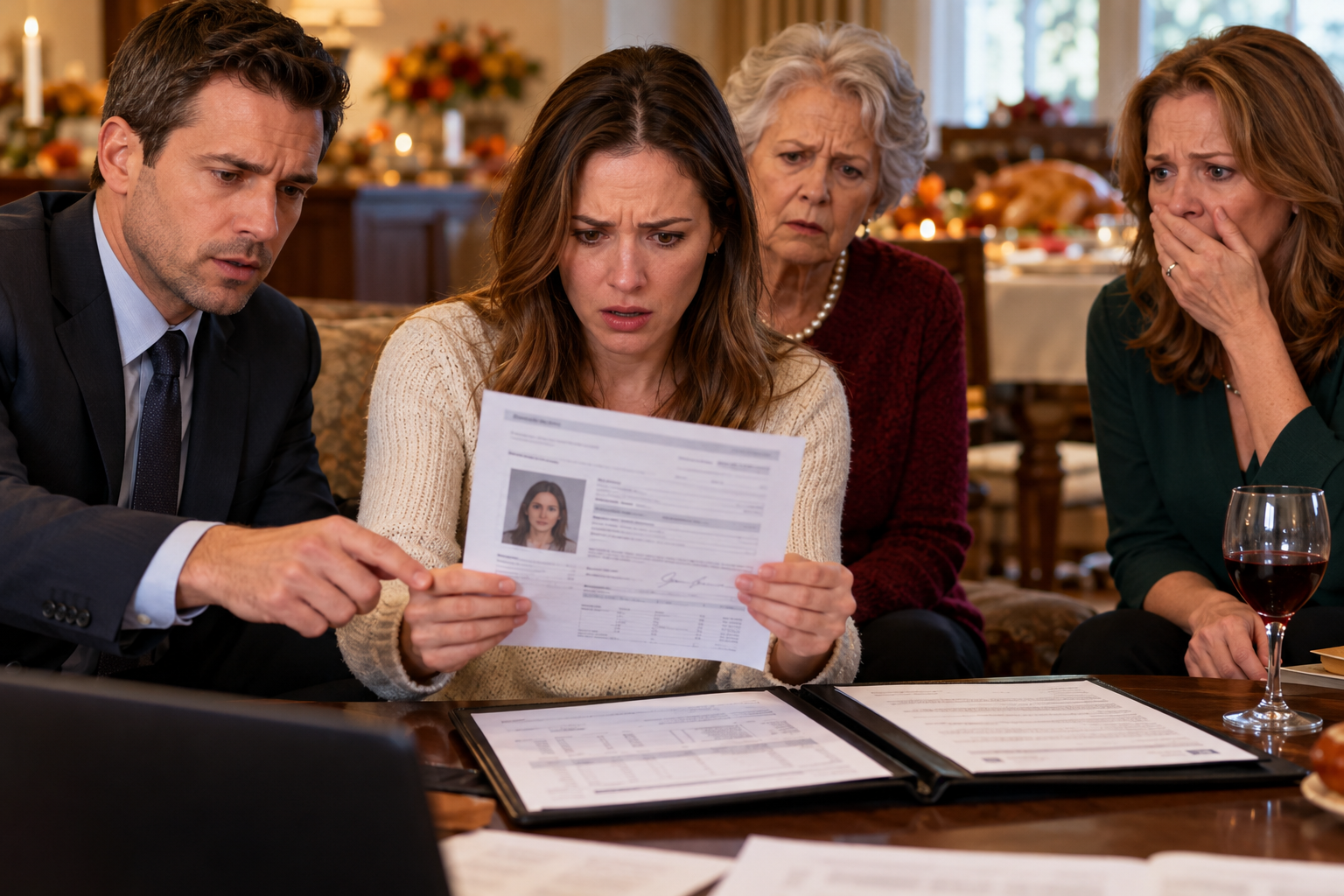
It showed my identity attached to an account I had never knowingly opened.
It showed a signature I did not recognize as my own.
And the first transfer had followed only three days after the account was established.
I couldn't make those details fit the explanation that I had simply forgotten.
I tried to remain fair.
I reminded myself that I did not know who had prepared the application.
I did not know who had supplied the documents.
I did not know who had arranged the transfer.
I had no evidence that allowed me to point to one person and say that person was responsible.
But I also knew that the lack of a name did not make the problem disappear.
Someone had to explain how the account had come to exist.
Someone had to explain why it was associated with my identity.
And someone had to account for the money that had not reached me.
Those were not accusations.
They were questions raised by the records themselves.
Grandma continued to treat them that way.
She didn't rush me.
She didn't demand that I decide what I believed about my mother.
She understood that I needed time to face the possibility that the situation might be more serious than any of us had expected.
I was grateful for that.
I had been grieving for my husband while trying to rebuild an ordinary life.
I had not wanted another reason to question the people around me.
I had wanted to believe that the arrangements he made were still protecting us.
The discovery of the account forced me to reconsider that belief.
It did not erase my husband's intentions.
He had wanted to leave us something useful.
He had tried to make plans for a future he might not be part of.
The failure was not in the care he had shown us.
The failure was in the fact that the money had not reached its intended destination.
I needed to remember that.
I did not want the missing funds to become the only thing I remembered about him.
He had been more than the arrangements he made.
He had been my husband.
He had been the person who thought ahead because he wanted the people he loved to be safe.
I could honor that part of him by taking the problem seriously.
I could not honor it by pretending nothing had happened.
One evening, after my daughter had settled, I sat quietly and thought about how much had changed since Thanksgiving.
Before Grandma asked her question, I had believed the financial arrangements were being handled.
I had not known that my name appeared on an unfamiliar bank account.
I had not seen the application.
I had not had any reason to question the signature.
Now I knew all of those things.
I could not return to the earlier version of my life.
I had to decide what to do with the knowledge I had.
I chose to keep asking for an explanation.
It wasn't a dramatic decision.
There was no speech.
No confrontation.
No moment when I suddenly felt brave.
I was simply tired of allowing uncertainty to make me doubt what I knew.
I had not knowingly opened the account.
I had not knowingly signed the authorization.
I had not received the money.
I could say those things without anger.
I could say them without deciding who was guilty.
And I could continue to ask what had happened next.
That was enough for now.
I thought again about my mother's explanation.
She had suggested that the medication might have affected my memory.
I could not prove what she had intended by saying it.
Maybe she had genuinely believed it was possible.
Maybe she had wanted to calm me.
Maybe she had been trying to move the conversation away from something she did not want to discuss.
I did not know.
I had to leave that question unanswered until I had more information.
What I could not leave unanswered was the account itself.
The dates were recorded.
The account number was there.
The application existed.
The disputed signature remained visible on the page.
I wanted those details followed wherever they led.
I was not looking for revenge.
I was not trying to embarrass my family.
I wanted to understand what had happened to something my husband had intended for our future.
That future belonged to my daughter, too.
She was too young to understand money or bank accounts.
She could not know that a decision made before she was old enough to remember it might affect the life she would grow into.
But I knew.
And that meant I had a responsibility to keep looking.
I had spent months learning how to live with what I could not change.
I was learning that this situation required something different.
It required me to question what could still be questioned.
It required me to speak when silence would have been easier.
And it required me to accept that loving my family did not mean every family member would always tell me the truth.
I hated that possibility.
I wasn't ready to decide what it meant for my relationships.
But I could no longer pretend it didn't exist.
The missing money had brought us to the account.
The account had brought us to the signature.
The signature had raised a question about who had used my name.
And that question remained open.
I didn't know what the next set of records would show.
I didn't know whether the explanation would come from the bank, from somebody in the family, or from information we had not yet examined.
I only knew that the facts we already had were enough to justify continuing.
So I kept the dates in mind.
March 11.
March 14.
I remembered the application and the unfamiliar signature.
I remembered my mother's suggestion that I might have forgotten.
And I remembered Grandma's original question at Thanksgiving.
Why hadn't the money reached me?
I still didn't have an answer.
But I no longer believed that the absence of an answer meant there was nothing more to discover.
The account had been opened.
The money had moved.
And my name had been used.
Until those facts could be explained, I would keep asking questions.
Click here to continue reading: PART 9: I Wanted to Believe My Mother Had Been Trying to Help Me, but Her Explanation Left One Question She Couldn’t Answer
The Thanksgiving Question That Turned a Family Gathering Into Something None of Us Could Pretend Was Ordinary Anymore
Part 8 of 20