
By then, I had learned how to live with questions that had no immediate answers.
I hadn't learned to like it.
I still wanted to know who had opened the account at Westbridge Community Bank.
I still wanted to know why my name appeared on the application and why the signature didn't look like mine.
And I still wanted to know what had happened to the one hundred and eighty thousand dollars my husband had intended for me.
Those questions had not changed.
What had changed was my willingness to keep asking them.
At first, I had been afraid that questioning the account would damage my family.
Now I understood that the damage had begun long before I saw the paperwork.
Something had happened to the money.
Something had connected my identity to an account I didn't recognize.
And I had been left believing that everything was being handled properly.
I couldn't repair any of that by staying quiet.
I also couldn't repair it by accusing somebody without evidence.
I had to keep my attention on the facts, even when my feelings pulled me somewhere else.
Grandma understood that better than anyone.
She had asked the original question at Thanksgiving, and she had never pretended that the answer would be easy.
She wanted to know what had happened.
I wanted the same thing.
I thought about the day she first mentioned the money.
I remembered the food cooling on the table.
I remembered how quickly the conversation had changed.
Most of all, I remembered the look on my mother's face.
At the time, I hadn't understood why she seemed so uncomfortable.
Now I wondered whether she had been surprised by the question or worried about what might follow.
I couldn't know.
I refused to turn that memory into proof of something I had not established.
But I couldn't forget it, either.
There was a difference between refusing to make an accusation and pretending not to notice something troubling.
I was learning to live with that difference.
My mother and I had not suddenly become strangers.
She was still my mother.
Our history did not disappear because I had questions about a bank account.
I remembered the ways she had been present during my recovery.
I remembered needing help when I couldn't manage everything alone.
Those memories were real.
So was the application.
I couldn't use one to erase the other.
I had to allow myself to remember the good without letting it decide what the documents meant.
That was harder than I expected.
Sometimes I wanted to call my mother and talk about something ordinary.
I wanted to hear her voice without wondering whether the conversation might return to the missing money.
I wanted to ask about the family without feeling that every answer needed to be examined.
But I couldn't force myself to forget what had happened.
The account had become part of our family history whether anybody wanted to discuss it or not.
And the question remained unanswered.
I found myself thinking about my daughter whenever I felt tempted to give up.
She was too young to understand any of this.
She would not remember the Thanksgiving conversation.
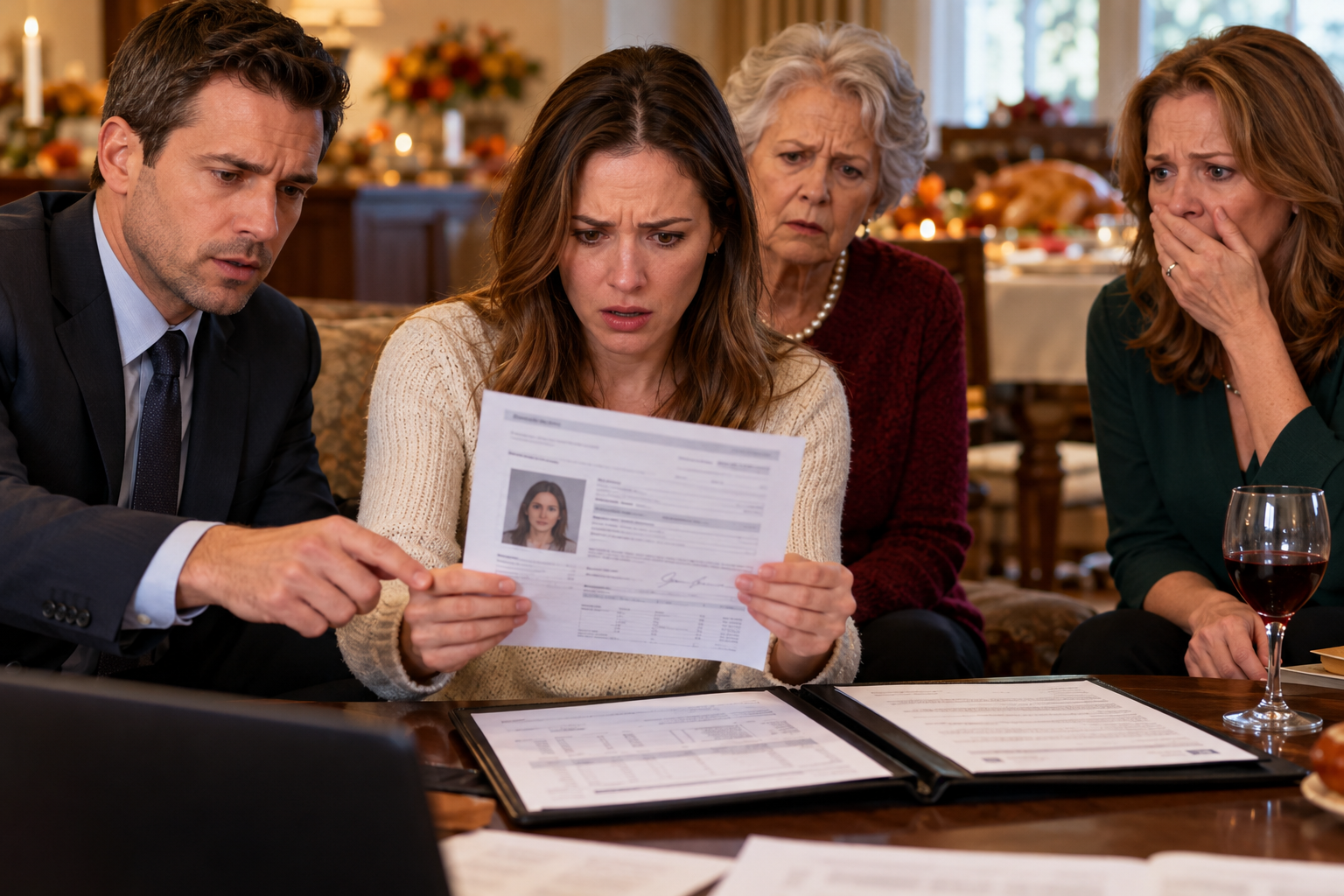
She would not remember the application spread across the table or the way I had stared at my own photograph.
But the future my husband had wanted for her was part of the reason I could not walk away.
The money had been intended to help us.
I wanted to know whether that intention could still be honored.
I also wanted to know why the arrangements had failed.
Those were not unreasonable wishes.
They were the questions a person should be able to ask about money meant for her own future.
I no longer apologized to myself for wanting answers.
I didn't have to be angry to take the matter seriously.
I didn't have to accuse someone to refuse an explanation I couldn't accept.
And I didn't have to choose between loving my family and trusting what I knew about my own life.
I could do all of those things at once.
That realization made me feel steadier.
It did not make the uncertainty disappear.
I still had no established answer about who had opened the account.
I still had no complete explanation for the transfer.
I still did not know whether the person responsible had acted alone or what had happened after the money moved.
I wasn't going to invent those answers.
I would wait for the evidence.
But I would not mistake waiting for giving up.
I kept the dates in mind.
March 11.
March 14.
The account opening and the first transfer.
I kept remembering the application, too.
My photograph.
My address.
My date of birth.
The signature that did not belong to my own hand.
Those details were the reason I had to continue.
They were more reliable than the fears that sometimes filled my mind.
They were more useful than the explanations people offered without being able to establish them.
And they reminded me that the problem was real, even when the family preferred to talk about something else.
I wanted the truth to bring us closer to an answer.
I wanted the money accounted for.
I wanted to stop wondering whether my own identity had been used without my knowledge.
I couldn't promise that learning the truth would restore the relationships I had before Thanksgiving.
I couldn't promise that everyone would agree with what the evidence showed.
But I could promise myself that I would not knowingly abandon the questions.
That was the only promise I could make with confidence.
For the first time, I no longer felt that I was waiting for permission to ask.
I had every right to know what had happened.
Click here to continue reading: PART 18: The Question Grandma Asked Had Changed Everything, Because Now Nobody Could Pretend I Had Received a Gift That Never Reached Me
The Thanksgiving Question That Turned a Family Gathering Into Something None of Us Could Pretend Was Ordinary Anymore
Part 17 of 20

One Comment on “PART 17 – I Had Finally Stopped Doubting My Own Memory, but I Still Had to Face the People Who Might Never Want the Questions Answered”