“Rick, keep your hand away from your belt.”
Grandpa said it in a level voice.
There was no shouting.
No warning delivered with a dramatic gesture.
Just a sentence.
Rick stopped moving.
His hand dropped to his side.
For a moment, nobody behind the counter seemed to know what to do.
The customers had been watching an awkward exchange between an older farmer and a young teller.
Now they were watching something else.
The security guard took a step back.
Grandpa turned toward the counter again.
I followed his gaze.
Brittany was still standing behind the desk, but the confidence had disappeared from her face.
She looked at Rick.
Then she looked at Grandpa.
I had never seen my grandfather make a room uncomfortable without saying much of anything.
He had done it now.
The clock on the wall seemed louder than before.
I could hear the faint hiss of the coffee machine near the waiting area.
Somebody shifted a shoe against the carpet.
Nobody laughed.
Grandpa looked down briefly.
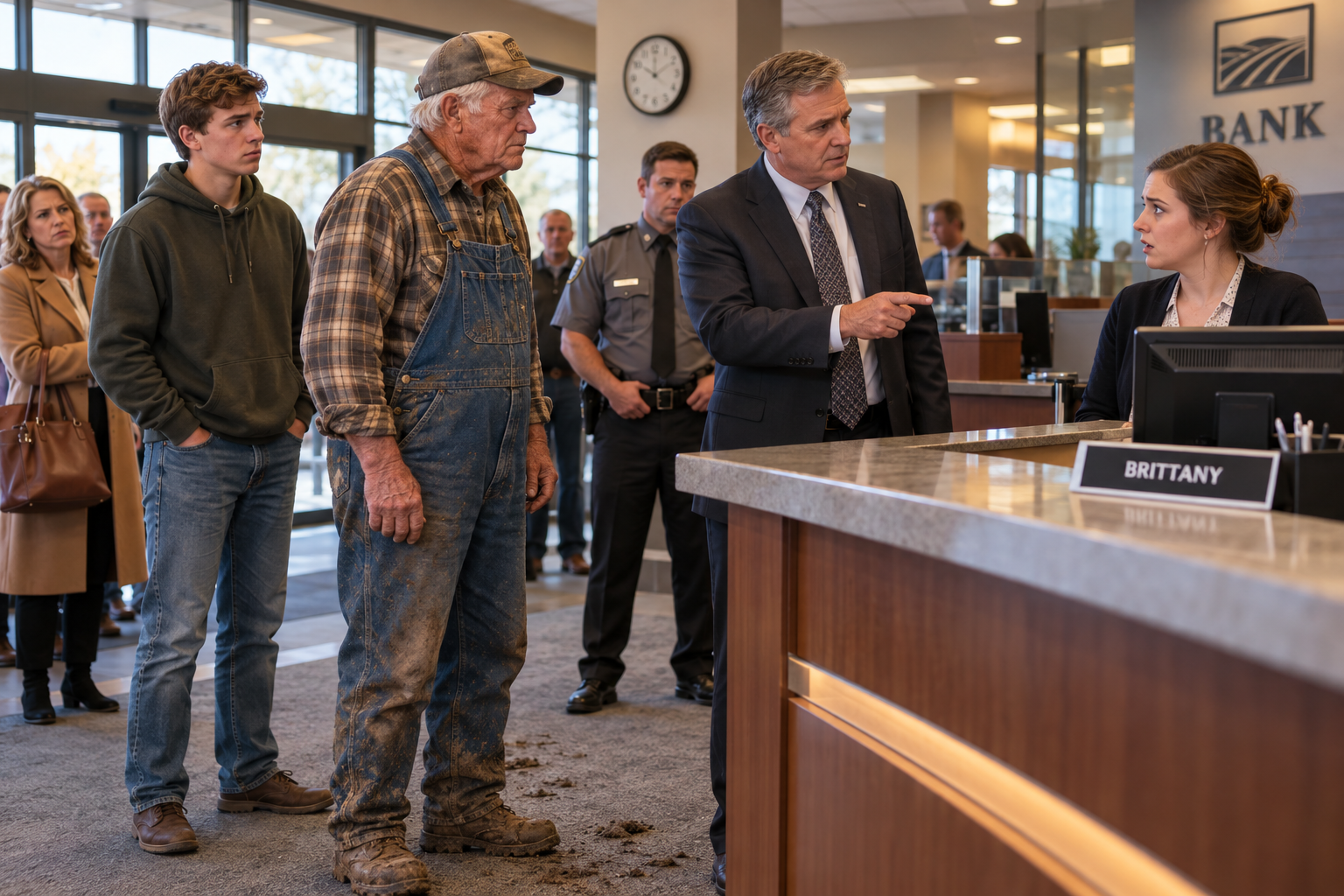
The mud on his boots had left marks on the gray flooring.
He studied them for a second.
Then he looked back at Brittany.
The teller's nameplate sat neatly beside the computer.
BRITTANY.
I remember the letters because I kept staring at them.
They seemed ordinary.
The situation did not.
Grandpa didn't ask her to apologize.
He didn't demand that Rick explain himself.
He didn't even mention the way the woman in the camel coat had laughed.
He simply waited.
Then a man came from the other side of the lobby.
He was older than Brittany and wore a suit that fit him properly.
He moved with purpose, but the moment he saw Grandpa, his steps slowed.
His name was Tom Callahan.
I knew him by sight.
Most people in Marlow did.
He was connected to the bank, and he had the kind of presence that made people straighten their backs when he walked past.
Tom looked at Rick first.
Then he noticed the marks on the carpet.
Then he looked at Grandpa's boots.
Finally, he turned toward Brittany.
His expression changed.
It wasn't the look of a man who had just discovered an unexpected customer.
It was the look of a man who recognized that something had gone very wrong.
He asked Brittany whether she knew the identity of the man standing in front of her.
She struggled to answer.
She told him the name Grandpa had given her.
Earl Doyle.
Tom repeated it.
For a second, he seemed to be choosing how much to say.
Then he began explaining something I had never heard discussed at home.
Grandpa had helped make the bank's second branch possible.
Back in 1974, when the bank needed support to expand, he had signed a loan agreement alongside the people trying to get the project started.
He had put his own land behind that agreement.
Not a small patch.
A section of his farm.
Tom explained that the property had served as collateral at a time when other people in the county had been unwilling to take that risk.
The bank had needed someone to trust the project enough to put something real on the line.
Grandpa had done it.
And he had done it without making a show of himself.
Tom paused.
He looked around the lobby.
Then he continued.
The building around us, the offices, the floor beneath our feet, and the jobs inside it had all been made possible in part by decisions like the one Grandpa had made.
Tom said that even his own place in the bank's history was connected to that signature.
He wasn't speaking loudly.
He didn't need to.
Every person in the lobby could hear him.
I watched Brittany's face lose its color.
She seemed unable to find a response that wouldn't make the situation worse.
The woman in the camel coat stopped smiling.
She lowered her eyes toward her handbag.
Then she looked toward the entrance.
She didn't say anything to Grandpa.
She didn't offer an explanation for laughing.
She simply walked away.
The glass doors opened.
Then they closed behind her.
I watched her disappear through the windows.
I remember thinking that leaving was easier than staying and admitting what she had done.
But I didn't know her story.
I only knew what I had seen.
Tom turned back toward Grandpa.
For the first time that morning, I felt the tension shift.
Until then, I had been waiting for someone to treat my grandfather with basic respect.
Now the people around us seemed to understand that they had misjudged him.
That should have felt satisfying.
Part of me was relieved.
Another part was ashamed that his history had been required before anyone thought he deserved courtesy.
Grandpa had not changed.
He was still wearing the same overalls.
His boots were still dirty.
His hands were still resting near the counter.
The only thing that had changed was what the people in the room knew about him.
I looked at him, waiting for some sign that he was pleased with the turn of events.
He gave me nothing.
No proud smile.
No glance toward Brittany to make sure she understood.
He looked at Tom and waited for him to finish.
That was when I realized something about my grandfather that I had never properly understood.
He didn't need people to be impressed by him.
He needed them to do their jobs without deciding that his appearance made him less deserving of their time.
Tom seemed to understand that too.
He addressed Grandpa directly.
He didn't talk over him.
He didn't treat him like a problem that had to be managed.
He treated him like a man who had come into a bank to conduct business.
Ordinary.
The way it should have been from the beginning.
I wanted to ask Grandpa why he had never told me about the loan.
I wanted to know why he had never mentioned putting part of the farm at risk to help a bank expand.
Six hundred and forty acres was a lot of land.
It represented years of labor, seasons of uncertainty, and decisions that could affect a family for generations.
And Grandpa had apparently been willing to place a portion of it behind a promise made to other people.
Yet he had never brought it up at the dinner table.
He had never told me the story while we drove between fields.
He had never used it to make himself sound important.
I thought about the way he handled repairs on the farm.
He never announced that he had fixed something.
He simply put the tool away and returned to work.
Maybe the bank had been the same.
Maybe he had signed the papers, gone home, and considered the matter settled.
Tom continued speaking, but I found myself studying Grandpa's hands.
They were rough and broad.
The skin was marked by years of work.
Those hands had planted seeds, repaired equipment, lifted feed bags, and held my grandmother's hand when she was still alive.
They had also signed a document that helped a bank grow.
I had known the hands all my life.
I had never understood the reach of the decisions they had made.
Grandpa shifted his weight.
His boots creaked slightly against the floor.
He looked toward the counter again.
He had come there for a reason.
The conversation about the past wasn't going to change that.
Tom appeared ready to help him.
Grandpa, however, had not come to hear a speech about his own importance.
He had asked for the manager.
And now that the manager was standing in front of him, he expected the original problem to be addressed.
Click here to continue reading: PART 3: The More the Bank Manager Explained My Grandfather’s Past, the More I Wondered How Much of His Life I Had Never Thought to Ask About
The Morning My Grandfather Walked Into the Bank Looking Like Every Other Farmer in Iowa, Nobody Expected the Room to Change
Part 2 of 20