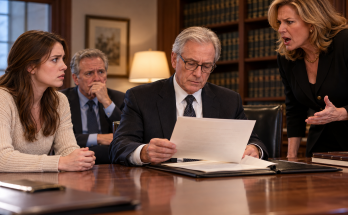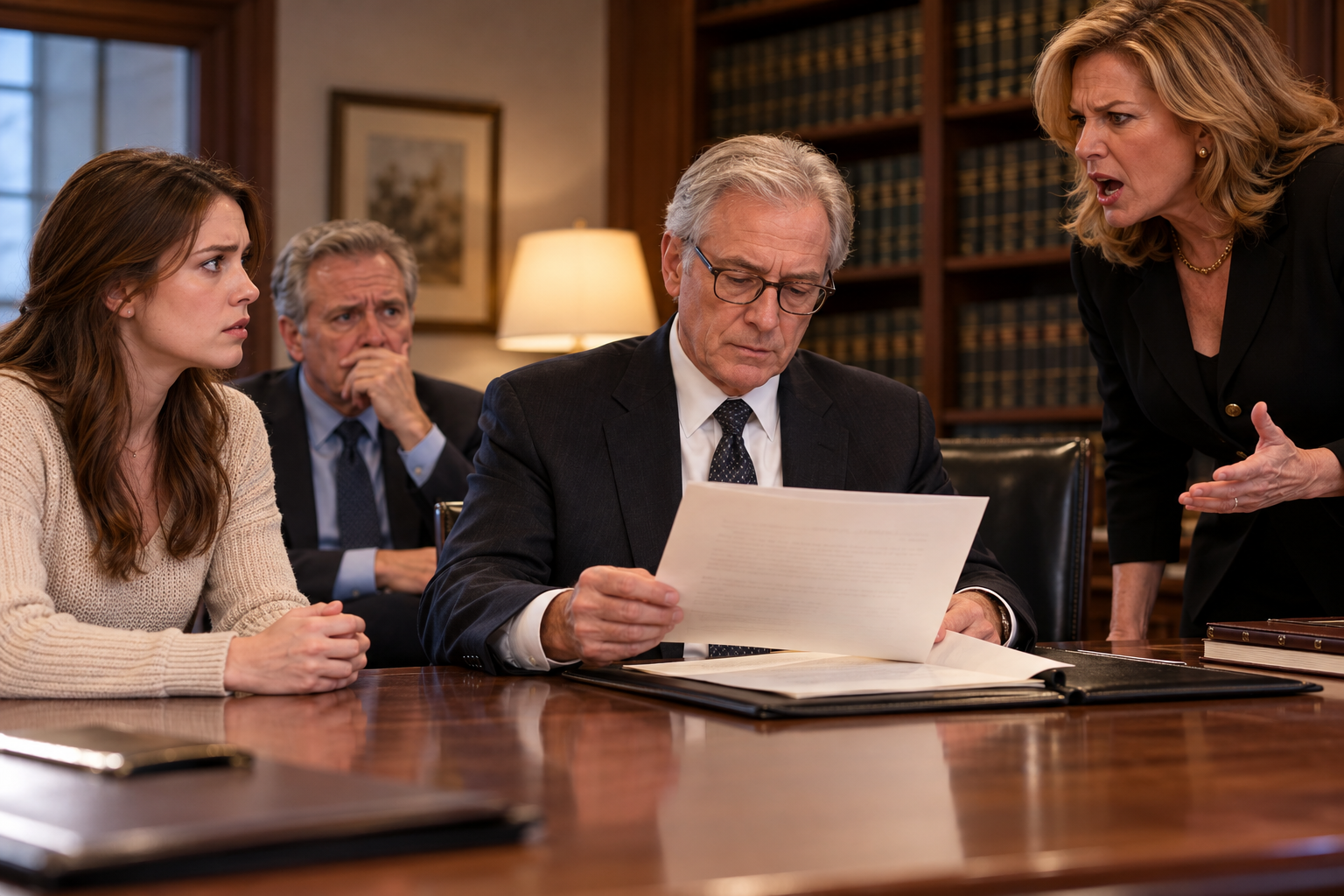
My father’s expression was the one detail I could not put aside.
My mother had shouted.
Mr. Caldwell had answered her.
I had spoken.
But my father had remained quiet.
And when I looked at him, I saw fear.
Not the anger I had expected.
Not the frustration of someone caught in a difficult family discussion.
Something that looked much worse.
I kept wondering what he knew.
Then I corrected myself.
I did not know that he knew anything.
I only knew he looked frightened.
That distinction mattered.
I had nearly turned an expression into an accusation.
And I did not want to do that.
I thought about how the moment had unfolded.
Mr. Caldwell announced that Nana’s previous estate instructions were subject to review under a later amendment.
My mother rose immediately.
She rejected the possibility.
The lawyer explained when Nana signed.
Three days before her death.
He mentioned the witnesses and notarization.
My mother challenged Nana’s mental state.
He answered with the physician’s written confirmation.
That was when my attention moved to my father.
His face had changed.
I could not explain it.
But I could not forget it either.
I wondered whether he was frightened by the document itself.
I wondered whether he feared the argument would become worse.
I wondered whether he was simply overwhelmed by the situation.
Any of those explanations might have been possible.
I had no evidence to choose among them.
And that was what made the memory difficult.
The more I thought about his face, the more I wanted a definite reason.
But I had not been given one.
I looked toward my mother.
Her behavior had been easier to describe.
She had spoken.
She had objected.
She had told me to stay out of the conversation.
Those were actions I could identify.
My father’s silence was different.
It invited interpretation.
And interpretation could go wrong.
I had to be careful.
It would have been easy to write a secret into that silence.
To decide he had known something about Nana’s amendment.
To imagine that the lawyer was about to expose him.
To turn the reading into a confrontation that had not appeared in the source.
But none of that was established.
I could not honestly claim it happened.
The only thing I knew was that I had seen fear.
And that fear made me suspect the amendment involved something my parents did not want to face.
A suspicion.
Nothing more.
I remembered looking at Mr. Caldwell.
He had not reacted the way my parents had.
He remained focused on the formal document.
That steadiness mattered to me.
When my mother challenged its validity, he did not become angry.
He supplied facts.
When she questioned Nana’s competence, he referred to the doctor.
He was not explaining my father’s fear.
He was explaining the circumstances of Nana’s amendment.
I understood that distinction better as the reading continued toward the second page.
A lawyer could tell us what the document said.
He could explain how it had been signed.
But he could not automatically tell me what someone else was feeling.
That was not his role.
And it was not something I should demand from him.
I had to listen for what he could actually establish.
The document concerned Nana’s estate.
It had been amended late in her life.
Its execution had been formally witnessed.
Its notarization had been confirmed.
Her physician had attested to her competence.
Those facts were important.
But they did not prove that anyone had committed wrongdoing.
They did not reveal who would inherit.
They did not explain my parents’ private thoughts.
I kept repeating that because my fear was growing.
I wanted certainty.
I wanted to know whether my father’s reaction meant something terrible.
I wanted to know why my mother had been so determined to stop the reading.
And I wanted to know whether Nana had anticipated any of this.
But I could not answer those questions.
Not from what had been supplied.
I remembered how I had spoken to my mother.
She told me to stay out of the discussion.
I refused.
That exchange remained the clearest decision I had made.
It was not a victory over anyone.
It was not proof that I understood Nana better than my parents did.
It was simply a refusal to leave my grandmother’s final instructions unheard.
I could stand by that.
I did not need to exaggerate it.
I looked down at the opened page.
I felt the same uncertainty I had felt when Mr. Caldwell first unfolded it.
What would it say?
Would it explain my father’s fear?
Would it clarify my mother’s anger?
Would it change what I believed about Nana?
I did not know.
The account had not provided those words.
And I could not supply them without inventing the plot.
That was the limit I kept encountering.
A page had been opened.
Its contents had not been revealed.
I could imagine a hundred possibilities.
But imagining them would not make them part of Nana’s story.
I did not want to tell a false version of what happened.
Not about my father.
Not about my mother.
Not about Nana.
And not about myself.
I had been frightened.
I had been confused.
I had nearly stayed silent.
Then I had chosen to speak.
Those were real parts of the moment.
I could describe them honestly.
I could admit my suspicions.
I could acknowledge how deeply my parents’ reactions unsettled me.
But I could not turn those suspicions into a revelation.
I had to leave the truth where the known events left it.
In the document.
On the second page.
Waiting to be heard.
Click here to continue reading: PART 16: Nana Had Made Her Final Amendment Three Days Before She Died, and I Knew I Could Not Let Anyone Rewrite Her Wishes for Her
I Thought My Grandmother’s Will Would Finally Bring Us Answers, Until the Lawyer Announced Something My Mother Refused to Accept
Part 15 of 20