I kept thinking about Nana’s signature.
It was the clearest evidence that she had made a decision of her own.
Mr. Caldwell had told us when she signed.
Three days before her death.
He had explained the witnesses.
He had explained the notarization.
And he had referred to her physician’s written confirmation that she was mentally capable.
Those facts mattered to me.
They did not reveal the amendment’s contents.
But they established why the document deserved to be heard.
My mother had rejected it.
My father had looked frightened.
And I had refused to leave the conversation.
That was where everything stood.
I wished I could say the next page gave me the answers.
I wished I could explain why my parents reacted as they did.
But I could not.
The actual instructions on that page had not been included in the source I was given.
I did not know what Nana changed.
I did not know who would benefit.
I did not know whether the amendment contained anything beyond revised estate instructions.
And I did not know what happened afterward.
That uncertainty frustrated me.
But it also forced me to think carefully.
I could not claim my parents had been exposed.
I could not claim Nana had punished anyone.
I could not claim she had left me a secret inheritance.
None of those things had been established.
The only honest path was to remain with the facts.
Nana signed an amendment.
Mr. Caldwell explained its formal validity.
My mother objected.
My father appeared afraid.
I asked the lawyer to continue.
My mother tried to silence me.
I refused.
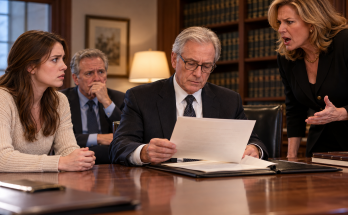
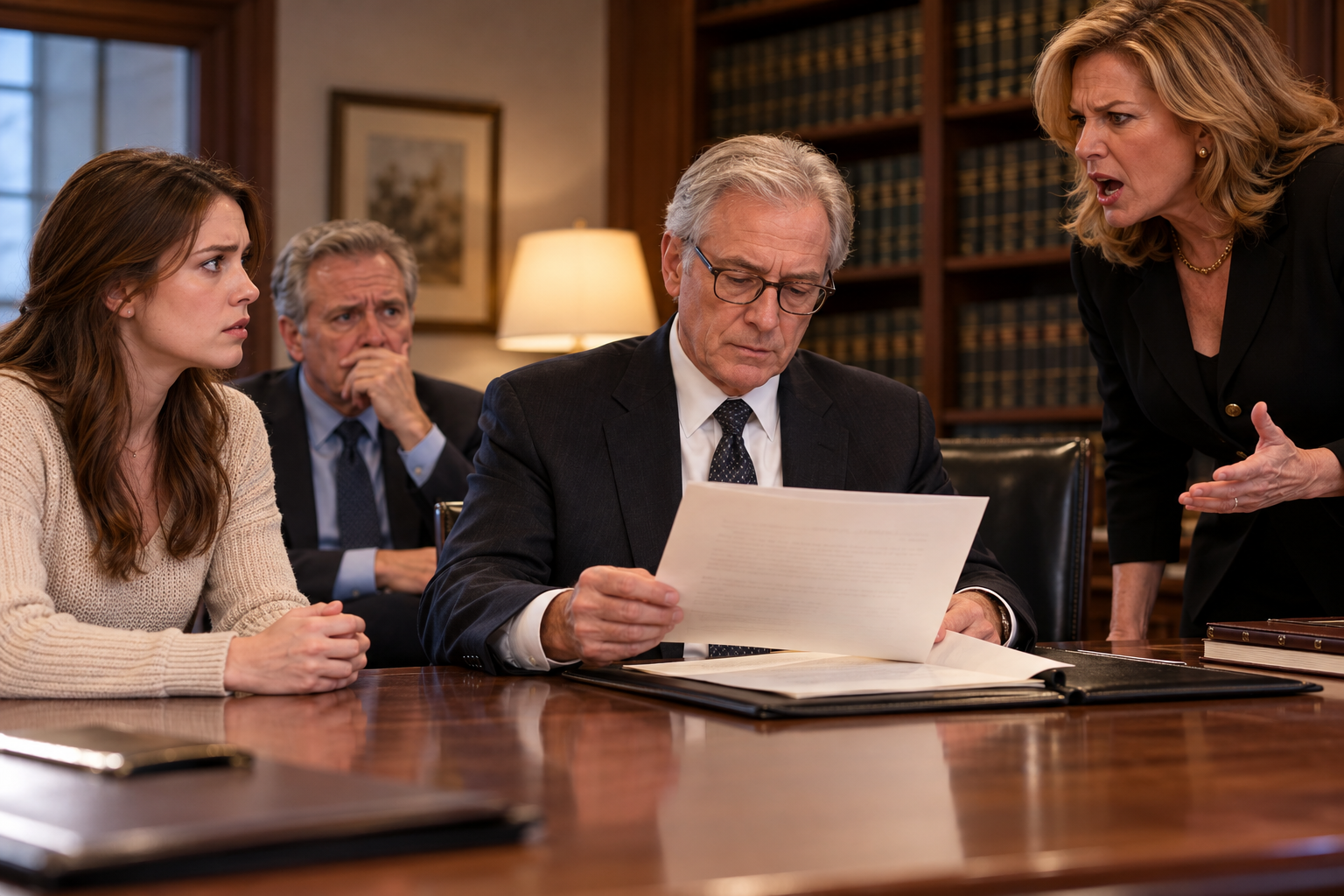
Mr. Caldwell unfolded the second page.
Those events were enough to show a family under strain.
They did not provide an ending.
I had to accept that.
I looked toward my mother.
Her anger still hurt.
But I did not know everything behind it.
I could criticize the way she tried to silence me.
I could disagree with her attempt to dismiss Nana’s amendment.
But I could not invent her motives.
I looked toward my father.
His frightened expression remained troubling.
But I had no proof of what caused it.
I could describe what I saw.
I could not tell him what he had been thinking.
That was a boundary I needed to respect.
I thought about Nana.
She was the one person whose actual wishes mattered most in that room.
And she was the one person who could no longer speak.
The document was supposed to preserve her decisions.
Not my interpretation of them.
Not my mother’s objections.
Not my father’s silence.
Her decisions.
I wanted to remember that.
Even if the amendment disappointed me.
Even if it raised more questions.
Even if it forced me to reconsider what I believed about the people around me.
I could not decide its meaning before hearing it.
I had nearly made that mistake when I saw my father’s face.
For a moment, his fear seemed like proof that something terrible was about to be revealed.
But it was not proof.
It was a reaction.
I had to separate those things.
That was perhaps the hardest lesson of the reading.
Not every frightening expression came with an explanation.
Not every angry objection proved wrongdoing.
And not every late legal amendment contained a hidden secret.
Sometimes the truth remained unknown until the document was read.
And sometimes the account available to tell the story stopped before that happened.
I did not like that.
I wanted a conclusion.
I wanted the lawyer to finish.
I wanted to know what Nana had decided.
But wanting an ending did not give me permission to invent one.
I had to remain honest about what I knew.
I looked again at the second page.
That was the last established action in the source.
Mr. Caldwell had unfolded it.
No further contents had been supplied.
There was no later exchange I could truthfully recreate.
No confirmed distribution.
No revealed secret.
No final outcome.
Only the document and the people waiting to hear it.
I remembered my own words to my mother.
I had told her I would stay.
And that was still the decision I could defend.
I would listen.
I would ask questions when necessary.
I would not let anger decide what counted as truth.
And I would not let my own fear do the same.
Nana’s wishes deserved to be represented accurately.
Even when accuracy meant admitting that the next part of the story was missing.
Especially then.
I could not speak for her.
I could not speak for my father.
I could not explain everything my mother felt.
But I could speak for myself.
I had refused to be silenced.
And I had chosen to wait for the words Nana actually left behind.
That was the last decision I could honestly carry forward.
Click here to continue reading: PART 17: I Watched Mr. Caldwell Hold Nana’s Amendment and Realized That Neither My Mother’s Anger Nor My Father’s Fear Could Explain Her Decision
I Thought My Grandmother’s Will Would Finally Bring Us Answers, Until the Lawyer Announced Something My Mother Refused to Accept
Part 16 of 20