The call came on Tuesday afternoon.
I was folding laundry on the bed when the telephone rang.
I nearly let it go to voicemail.
Then I remembered the document request and reached for the phone.
"Hello?"
"May I speak with Elnora Whitsett?"
"This is she."
"This is the county records office. I'm calling about the document you requested."
I sat down on the edge of the bed.
"Have you found it?"
"We've located a copy of the instrument referenced in the deed book. It is available for pickup, and the copying fee is listed on your request."
I let out a breath I had not realized I was holding.
"Thank you. I'll come in tomorrow."
The clerk gave me the office hours and repeated the reference number.
I wrote everything on the back of an envelope.
When the call ended, I sat with the pen in my hand.
I had imagined that hearing from the courthouse would make me feel certain.
Instead, I felt nervous.
The document might explain everything.
It might also make the situation more complicated.
I finished folding the laundry before I allowed myself to think about it again.
I put the clean towels into the linen cupboard and carried the basket back to the laundry room.
Then I made dinner.
I did not call Rosella's friend until the dishes were washed.
"They found the document," I told her.
"That's good news."
"I'm going tomorrow."
"Would you like me to come with you?"
I considered it.
"Yes, if you can."
"I'll meet you there."
I thanked her and went to bed earlier than usual.
Sleep came slowly.
I kept remembering Rosella's kitchen, especially the small table near the window where she used to sort her mail.
She had been particular about paper.
Bills went into one pile.
Letters went into another.
Anything that needed attention was placed beneath a brass paperweight shaped like a bird.
If she wanted me to move something, she would tell me first.
She did not like having important papers handled carelessly.
I wondered whether the document I was about to collect had ever sat beneath that paperweight.
The thought followed me into the morning.
I arrived at the courthouse a little before ten.
Rosella's friend was waiting near the entrance.
"Ready?" she asked.
"No."
She nodded.
"That's honest."
We went to the records office together.
The clerk recognized me and brought out a thin envelope.
She checked my identification again and asked me to sign for the copy.
I paid the fee.
The envelope was ordinary, with the reference number written across the front.
It weighed almost nothing.
Still, I held it carefully.
"Is this the full instrument?" I asked.
"This is the copy we located under the reference number. If you need a certified copy or additional related records, we can explain how to request them."
"Thank you."
I stepped away from the counter.
Rosella's friend and I found a small table in a quiet part of the hallway.
I opened the envelope.
Inside were several sheets of paper.
The first page carried the county name, a recording number, and a date.
Below that was the formal wording of a property instrument.
The language was dense.
I understood enough to know that I needed to read it slowly.
I began at the top.
The document referred to the same property description I had seen in the deed book.
The farmhouse.
The pecan grove.
The gravel drive.
The fields toward the creek.
Every familiar detail seemed strange when it appeared in official language.
I moved down the page.
There was Rosella's name.
Then there was mine.
My full name appeared in a section I did not immediately understand.
I read the paragraph twice.
Then I went back to the first page and started again.
"Do you understand it?" Rosella's friend asked.
"Not all of it."
"Don't rush."
I pressed the papers flat against the table.
The document was not a simple note from Rosella.
It was a formal record with legal wording, dates, and references to other documents.
That alone told me I should not try to decide its meaning from one sentence.
I looked at the recording number and copied it into my notebook.
Then I wrote down the date.
The date matched the older entry in the deed book.
I turned to the next page.
There were additional terms, but the language was unfamiliar enough that I could not tell exactly what they meant.
I knew the difference between owning a house, renting a house, and being allowed to live in a house.
I did not know enough about property instruments to understand every arrangement that could be recorded in a county book.
I did not want to pretend otherwise.
"This mentions another record," I said.
Rosella's friend leaned closer.
"Where?"
I pointed to the reference near the bottom of the page.
She read it carefully.
"Can we ask the clerk for that one?"
"I think we should."
I put the papers back into the envelope and returned to the counter.
The clerk listened while I explained that the instrument referred to another record I had not seen.
She looked at the number.
"That appears to be a related filing," she said. "I can check whether a copy is available."
"Would it explain the entry with my name?"
"It may provide additional context. I can't promise what it will establish without reviewing the whole chain of records."
I appreciated her caution.
She searched the index and made a note.
"This one may need a separate request," she said. "I'll tell you what information is available and what the fee would be."
She explained the process.
I listened carefully and wrote down the steps.
I was beginning to understand that the courthouse would not hand me one piece of paper that answered every question.
There were records, references, and dates that had to be read together.
I had spent years believing that paperwork was something other people handled.
I had signed leases, tax forms, and employment documents without needing to know much beyond what they required from me.
Now I had a reason to pay attention.
I filled out the second request.
Before I left, I asked the clerk whether I could have another copy of the property description.
She printed the relevant information and gave it to me.
I folded it once and placed it behind the first document in my envelope.
Outside the office, Rosella's friend waited while I checked that I had everything.
"Well?" she asked.
"I know more than I did yesterday."
"Does it tell you why your name is there?"
"Not enough for me to say."
She looked relieved that I was being careful.
I had been tempted to call Rosella's son as soon as I saw my name in the first document.
But I did not know what I would tell him.
I could not say that Rosella had given me the land.
I could not say that the record meant nothing.
Both statements would have gone beyond what I knew.
Instead, I wanted the related filing.
I wanted to understand the dates and the language.
Then I could decide whether I needed a lawyer or another professional to explain the arrangement.
Rosella's friend walked with me down the courthouse steps.
The sky had cleared, and sunlight fell across the parking lot.
I held the envelope against my side.
For the first time since the discovery, the situation felt less like a mystery and more like work.
There was a record to read.
There was another record to request.
There were questions that needed proper answers.
I could take them one at a time.
Before we parted, Rosella's friend touched my arm.
"Don't let anybody pressure you into deciding what this means before you understand it."
"I won't."
"And don't let the waiting make you believe the answer has to be something terrible."
I looked down at the envelope.
"I'll try."
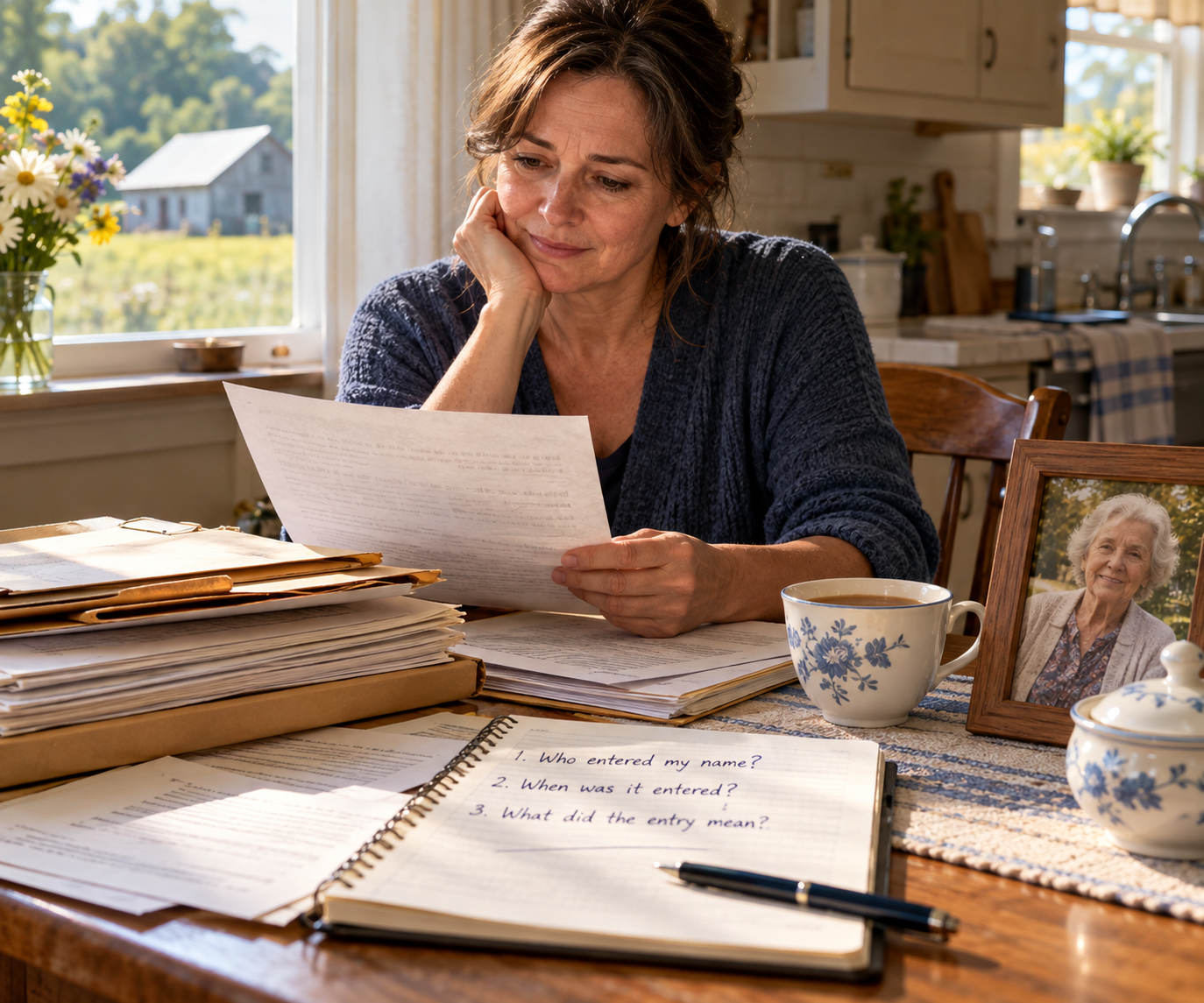
At home, I cleared a space on the kitchen table.
I moved the sugar bowl to the counter and set the envelope in the center of the table.
The sight of the bowl brought back a memory of Rosella reaching beneath it for a folded note.
At the time, I had thought she was looking for a shopping list.
She had tucked the paper away before I could see what was written on it.
I had not asked.
Rosella had always valued her privacy, and I had respected that.
Now I wondered whether that small moment had meant something.
I did not write it down as evidence.
I wrote it down as a memory.
Then I placed the document beside my notebook and copied the exact wording of the paragraph that contained my name.
I left space beneath it for questions.
I wrote down the meaning of the words I understood and marked the ones I needed help with.
I did not try to translate the entire document into something simpler by guessing.
That would have been no better than ignoring it.
The next morning, I planned to contact the courthouse again about the related filing.
After that, I would look for a qualified person who could explain the documents without taking sides.
I still did not know what Rosella had intended.
I still did not know what her sons had been told.
And I still did not know whether my name in the record represented a right, an obligation, or a part of a larger arrangement.
But I finally had something concrete to work with.
For twenty-six years, I had believed that my place in Rosella's life was easy to describe.
I was the woman who cleaned her house.
I had been paid for my work, and I had done it faithfully.
Now the record suggested there was something else I needed to understand.
I did not know whether that something would change my life.
I only knew that Rosella's name and mine had been connected in a way I had never expected.
I folded my notebook closed and left the envelope where I could see it.
I would not rush to claim anything.
I would not let anyone frighten me into silence.
I would read what had been recorded, ask for help where I needed it, and follow the facts wherever they led.
That was the only fair way to honor the truth, whatever it turned out to be.
Click here to continue reading: PART 13: I Took Rosella’s Papers to Someone Who Understood Property Records, and He Told Me Not to Confuse a Name With an Answer
I Spent Twenty-Six Years Cleaning a Wealthy Woman’s Home Without Knowing Why She Never Let Me Leave It Behind
Part 12 of 20