I called the courthouse the next morning.
The clerk confirmed that my second request had been entered, but the related filing had not yet been retrieved.
I wrote down the reference number and thanked her.
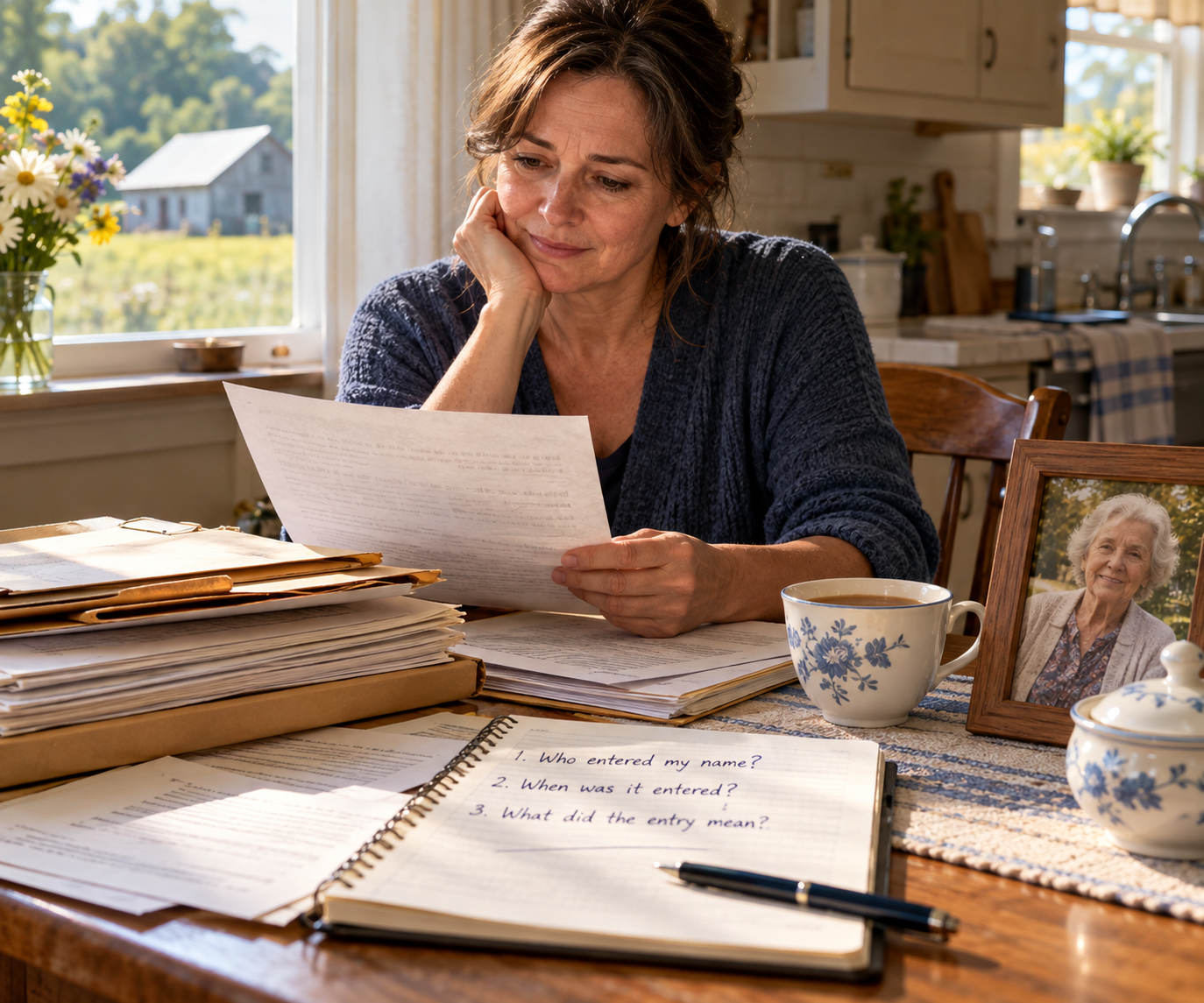
Then I sat at my kitchen table with the first document spread in front of me.
The paper looked less intimidating than it had the day before.
I had already read it several times, and I could recognize the places where my name appeared.
What I still could not do was explain what those appearances meant.
I did not want to ask Rosella’s sons to explain a document they might not understand themselves.
I also did not want to rely on a friend’s memory of conversations that had happened years earlier.
I needed someone who could read the paperwork without guessing.
A woman I knew from church had once mentioned that her brother worked with property records.
I called her and asked whether she would be willing to give me his contact information.
She asked why I needed it.
I hesitated before answering.
“My name has appeared in a record connected to a property I worked at for twenty-six years,” I told her. “I need help understanding the document.”
She did not ask me whether I was trying to get the property.
She simply gave me her brother’s number.
His name was Mr. Harris, and he worked as a real estate attorney.
I called his office that afternoon.
The receptionist asked what kind of assistance I needed, and I explained that I had obtained a copy of an old property instrument from the county records office.
She scheduled a short consultation for the following week.
I was relieved to have an appointment, but the days before it seemed longer than they should have.
I kept the papers in a plain folder.
I did not leave them lying around where a visitor might pick them up.
I made a second copy of my notes and put it in a drawer beside my important household documents.
Then I returned to my usual routine.
I cleaned the kitchen.
I paid my bills.
I changed the sheets and washed the towels.
The work helped because it gave my thoughts somewhere to rest.
Still, whenever I opened the cupboard beneath my sink, I remembered the cleaning supplies I used to keep at Rosella’s house.
I remembered the way she checked the kitchen windows before leaving for town.
I remembered the sugar bowl on the counter.
Most of all, I remembered how she sometimes looked at me as if she wanted to say something and then decided against it.
I had never understood those moments.
Now I wondered whether I had missed something important.
But I could not change the past by examining it from a new angle.
I could only gather what I knew and let the rest wait.
The day of my appointment arrived with a cold wind blowing across the parking lot.
I carried the folder into Mr. Harris’s office.
The waiting room had two chairs, a small table, and a framed photograph of a farmhouse surrounded by trees.
I found myself looking at the photograph longer than I intended.
A woman came out of the back office and called my name.
Mr. Harris was older than I had expected, with silver hair and reading glasses resting low on his nose.
He invited me to sit at his desk.
"What brings you in, Ms. Whitsett?"
I opened the folder.
I told him about Rosella, the twenty-six years I had worked for her, and the discovery of my name in the deed book.
I explained that I had requested a copy of the related instrument and was waiting for another filing.
I made a point of telling him what I did not know.
"I don't know whether the property belongs to me," I said. "I don't know whether I have any claim to it. I just want to understand why my name appears there."
He nodded.
"That's a sensible place to start."
I handed him the first document.
He read it quietly, turning the pages without rushing.
I watched his face, hoping for some sign that the answer was simple.
He gave me none.
After several minutes, he placed the pages on the desk.
"This document needs to be read with the related filing," he said.
"Does my name mean I own the property?"
"Not necessarily."
I felt my stomach tighten.
He continued before I could ask another question.
"A name in a property record can appear for several reasons. The exact wording, the type of instrument, and the documents connected to it all matter."
"So I shouldn't assume anything yet?"
"Correct."
I nodded.
I had already told myself that several times, but hearing it from someone who understood the records made the warning feel more solid.
He asked whether I had a will, a letter, or any other document from Rosella that referred to the property.
I told him I did not have a will or a formal letter explaining the entry.
I mentioned that Rosella had sometimes asked whether I wanted a home of my own.
He listened without interrupting.
"That conversation may be meaningful to you," he said, "but it does not establish the legal meaning of this document."
"I understand."
He asked whether Rosella was still alive.
I told him she had died.
He asked whether her estate had already been settled.
I did not know the full answer.
I had heard that her sons were handling matters, but nobody had explained the details to me.
Mr. Harris wrote down that uncertainty.
"Before drawing conclusions, we need to establish what was recorded, what happened afterward, and whether any later documents changed the arrangement."
I looked at the folder.
"Could the related filing answer some of that?"
"It could. It may also point us toward additional records."
I felt disappointed, but not surprised.
I had hoped the first document would explain everything.
Instead, each answer seemed to show me where the next question began.
Mr. Harris asked whether I had requested a certified copy.
"No. I requested the available copy from the records office."
"That is fine for an initial review. Depending on what we find, we may need certified records."
He returned to the first page and pointed to the recording number.
"This number matters. Keep it with your notes. It will help us identify the document accurately."
I wrote that down.
He also asked me to keep the original copy in a safe place and avoid writing on it.
I promised I would.
Then he gave me advice I had not expected.
"Until we understand the paperwork, don't make promises to anyone about the property. Don't sign anything related to it without independent advice, and don't let anyone pressure you into making a decision."
I thought of Rosella's son in the grocery store.
"I don't want a fight with her family."
"You don't need to look for one," he said. "But you also shouldn't abandon a legitimate question because somebody is uncomfortable with it."
I sat quietly for a moment.
That was the second time someone had told me that I could ask questions without doing something wrong.
I was beginning to believe it.
Before I left, I asked what I should do next.
"Bring me the related filing when you receive it," he said. "Then we can examine the documents together. I can explain what they establish and what remains uncertain."
I thanked him and put my folder back into my handbag.
Outside, the wind had grown stronger.
I stood beside my car for a moment, holding the strap of my handbag.
I had arrived hoping to find out whether Rosella had left me something.
I left understanding that I could not answer that question yet.
It was not the answer I wanted.
It was the answer I needed.
When I got home, I placed the folder in the drawer beside my household papers.
I checked that the drawer closed properly.
Then I took out my notebook and wrote down what Mr. Harris had said.
A name was not an answer.
The related filing mattered.
Later records might matter too.
I underlined the first sentence.
For years, I had thought that if a person wanted something known, she would simply say it.
That belief had served me well in ordinary matters.
If Rosella wanted the kitchen cleaned, she told me.
If she wanted the curtains washed, she told me.
If she wanted me to stay late, she asked.
But perhaps she had handled this matter differently.
I did not know why.
I did not know whether her silence had been deliberate or whether I was attaching meaning to things that had never been connected.
For now, I would not decide.
I put the notebook away and made myself a cup of tea.
The house was quiet.
I sat near the window and watched the branches move in the wind.
I had worked for Rosella long enough to know that she disliked carelessness.
Whatever she had intended, I believed she would have wanted the details handled properly.
That thought gave me a little peace.
I would not guess.
I would not rush.
I would read the records, ask the questions, and let the evidence speak for itself.
Click here to continue reading: PART 14: The Second Record Arrived With More Dates Than Explanations, and I Began to See Why Rosella Had Kept Her Plans to Herself
I Spent Twenty-Six Years Cleaning a Wealthy Woman’s Home Without Knowing Why She Never Let Me Leave It Behind
Part 13 of 20