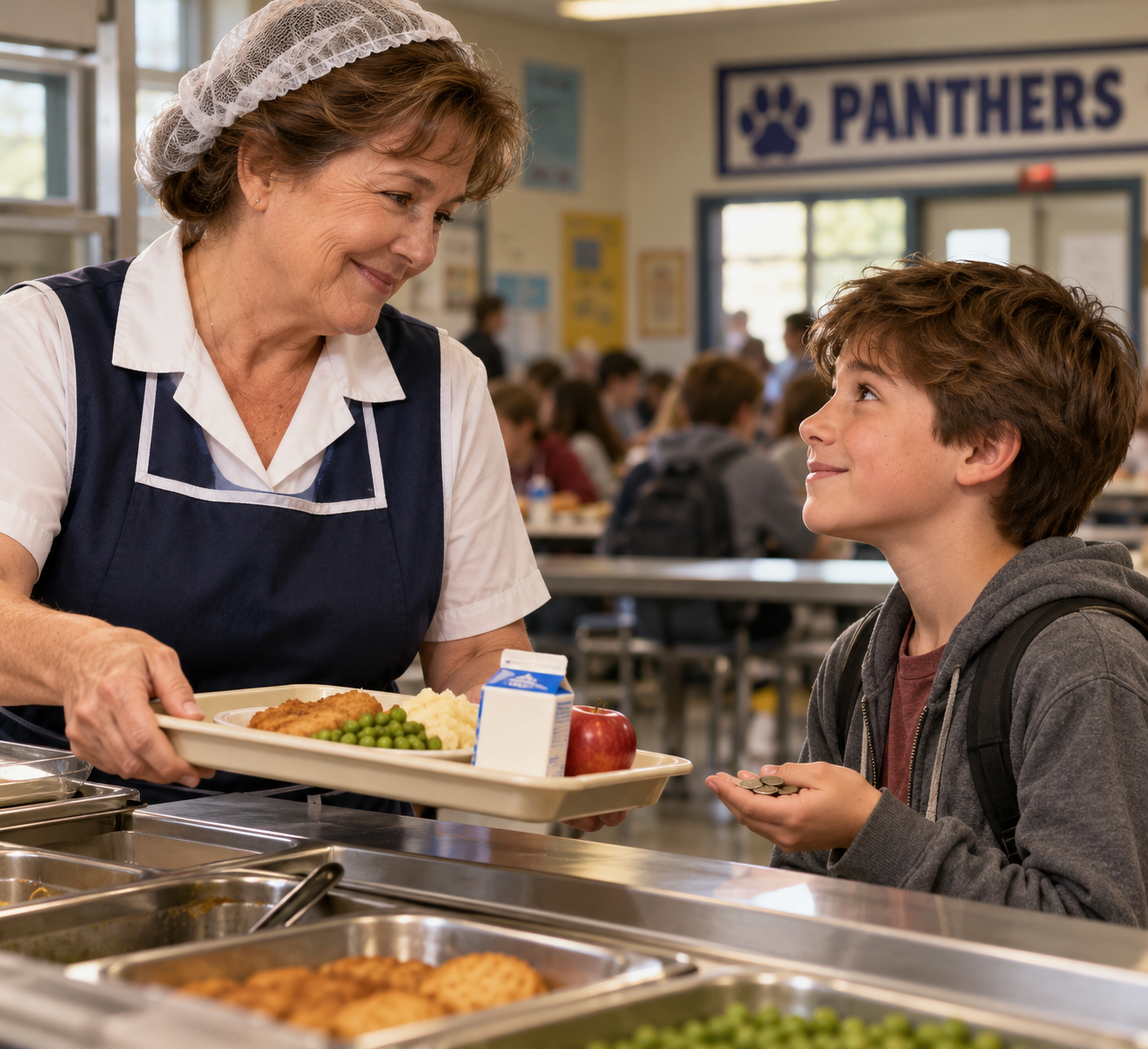
Several weeks after the retirement party, Mom was still talking about Daniel.
Not constantly.
Not in a way that suggested she expected anything else to happen.
His name simply came up now and then.
She would wonder whether he was busy at the medical center.
She would remember the look on his face when she recognized the blue science book.
Sometimes, she would mention the receipt.
"I still can't believe he kept that piece of paper."
I knew what she meant.
The receipt had been small and ordinary.
It had probably been printed on the same kind of paper the cafeteria used every day.
There was nothing valuable about it in the usual sense.
Yet Daniel had preserved it for years.
He had carried it through the changes in his life.
He had kept it even when the boy who received it became a man with responsibilities of his own.
I thought about that whenever I saw the box of retirement cards.
The things we save are not always the things other people would choose.
A stranger might have thrown the receipt away.
Daniel had kept it because of what it represented.
It reminded him of a time when he had been struggling and someone had helped him without demanding an explanation.
It reminded him that he had been seen.
And it reminded him of the promise he had made to carry that kindness forward.
I understood that now.
I also understood why Mom had never expected him to return.
She had not fed him in order to create a memory.
She had fed him because he needed food.
The memory came later.
The gratitude came later.
The lesson had continued long after the meal was over.
One afternoon, Mom and I were sitting together when she asked me something I hadn't expected.
"Do you think I did enough?"
I looked at her.
"What do you mean?"
She glanced toward the retirement cards.
"All those years at the school."
I was quiet.
She continued before I could answer.
"I sometimes wonder whether there were things I should have done differently."
I thought about the question.
There was no way for me to know every decision she had made during forty-two years.
I couldn't tell her that she had never made a mistake.
Nobody could honestly say that about a lifetime of work.
But I knew what she was really asking.
She wanted to know whether the years had mattered.
I took her hand.
"I think you did more than you realized."
She looked at me.
I told her about Daniel again.
I reminded her how he had stood in the break room, holding that faded receipt.
I told her that he had spent twenty-three years trying to live by what she had taught him.
And I told her that he had come back because he wanted her to know.
Mom listened.
She didn't interrupt.
When I finished, she looked down at our hands.
"I hope I was kind to him."
I felt my throat tighten.
"You were."
She nodded slowly.
Then she smiled.
"Good."
That was enough for her.
She didn't ask me to repeat the story.
She didn't ask whether Daniel had told the teachers about his career.
She didn't ask whether people had been impressed.
She wanted to know whether the boy had been treated kindly.
I had finally learned to hear the difference.
The following day, she asked me to help her move the retirement box to a different shelf.
She wanted it somewhere she could reach without standing on a chair.
I carried it into the living room.
She opened it and checked the contents.
The cards were still there.
So was the photograph of her younger self behind the cafeteria counter.
The old schedule remained folded beneath it.
She picked up Daniel's card.
For a moment, she looked at the handwriting.
Then she placed it back in the box.
I waited.
She closed the lid.
"That's all right," she said.
I looked at her.
"What's all right?"
She smiled.
"I don't need to keep wondering whether people remember me."
She tapped the box gently.
"Some of them do."
I nodded.
She didn't need to say anything else.
We put the box away.
That evening, I found myself thinking about the way Daniel had entered the school on her retirement day.
He had not demanded attention.
He had not arrived expecting to be treated as an important visitor.
He had come carrying a memory.
He had wanted to return something to the woman who had once helped him.
Not money.
Not a gift.
Not a payment for the meals he had received.
He had brought the truth about what those meals had meant.
And he had given Mom the chance to see the boy she remembered as the man he had become.
I wondered whether he had been nervous before entering the break room.
I imagined him standing in the hallway, holding the envelope and trying to decide what to say.
Perhaps he had worried that she wouldn't remember him.
Perhaps he had wondered whether the receipt would look foolish after all those years.
Perhaps he had simply wanted to make sure he thanked her before the opportunity passed.
Whatever he had felt, he had walked through the door.
That mattered too.
Gratitude can be difficult to express.
Sometimes people wait because they think there will always be another chance.
Sometimes they wait because they are embarrassed by how much somebody's kindness meant to them.
Sometimes they wait because they don't know how to explain something that has stayed with them for years.
Daniel had waited a long time.
But he had come.
And Mom had been there to hear him.
I realized that I had my own words I had been postponing.
I had spent years assuming my mother understood that I loved her.
I had assumed she knew I appreciated everything she had done for me.
I had treated those feelings as though they didn't need to be spoken.
Daniel's visit had made me see how foolish that assumption could be.
So I told her again.
Not in a long speech.
Not with carefully prepared words.
I told her I was proud of her.
I told her I was grateful for the life she had built.
And I told her that I was sorry for the years when I had failed to understand the value of her work.
She listened quietly.
Then she reached over and squeezed my hand.
"You don't have to apologize for growing up."
I shook my head.
"I know."
She smiled.
"Just remember what you've learned."
I nodded.
That was her way.
She never asked for a grand promise.
She wanted the lesson to continue.
The days went on.
Mom settled into retirement.
She found new routines.
She kept the flowers from the party until they began to wilt, then replaced them with fresh ones from the garden.
She read the cards when she felt like it.
Sometimes, she talked about the school.
Other times, she was happy to leave the subject alone.
I stopped asking whether she missed the cafeteria.
I understood that she could miss it and still be ready for what came next.
The school had been a major part of her life.
It would always be part of her story.
But it was no longer the place she had to be every morning.
She had earned the right to rest.
And the people she had helped would carry their memories without needing her to return.
I thought about Daniel whenever I passed a school cafeteria.
I thought about the students waiting in line.
I thought about the children who tried to hide that they needed something.
I wondered how many adults remembered a meal or a kind word from someone whose name they had almost forgotten.
Then I thought about the receipt.
A little piece of paper.
A few handwritten words.
A reminder that a person could accept help without losing dignity.
Daniel had kept it because he wanted to remember.
Mom had written it because she wanted him to keep going.
Neither of them could have known where that small exchange would lead.
And perhaps that was the point.
She had not needed to know.
He had not needed to become a surgeon for the kindness to matter.
The meal would still have been worth giving.
The note would still have been worth writing.
The boy would still have deserved to eat.
I finally understood that my mother's greatest achievement was not a single moment at the retirement party.
It was not the crowd in the hallway.
It was not the tears Daniel shed when she remembered his science book.
Those were the moments that allowed us to see what had been there all along.
Her achievement was the ordinary work itself.
Forty-two years of showing up.
Forty-two years of preparing food.
Forty-two years of noticing people.
She had never needed to know how every story ended.
She had done her part when the chance appeared.
And sometimes, years later, someone returned to tell her what had happened next.
That was what Daniel had done.
He had come back with his old receipt and his memories.
He had shown her that the boy she fed had grown into a man who spent his life helping others.
He had reminded her that kindness could travel farther than the person offering it ever expected.
And he had reminded me that the work we dismiss as ordinary may be the very work another person remembers for the rest of their life.
I still think about that retirement party.
I think about Mom standing beside the cake.
I think about the teachers gathering in the doorway.
I think about Daniel holding the faded paper.
Most of all, I think about the eleven cents.
He had offered those coins because he wanted to pay.
She had let him keep them because she understood that he needed more than a meal.
He needed to know that accepting help did not make him less worthy of respect.
He needed somebody to treat him like a child who mattered.
Mom had done that.
And decades later, he had returned to tell her.
I used to believe a person's importance could be measured by the position they held.
Now I know better.
A title can tell you what someone does for a living.
It cannot tell you who they were to the people who needed them.
Daniel was a chief surgeon.
Mom was a cafeteria worker.
But on that day, neither title explained what mattered most.
He was the boy she had fed.
She was the woman who had remembered him.
And I was the child who had finally learned to see his mother clearly.
The retirement party had ended.
The flowers had faded.
The cafeteria had moved on to another school day.
But the lesson remained.
When somebody needs help, don't look away simply because you cannot do everything.
Offer what you can.
Make room.
Let them keep their dignity.
And never assume that an ordinary act of kindness will be forgotten.
Sometimes, the person you help will carry it for years.
Sometimes, they will return when you least expect it.
And sometimes, they will remind you that the smallest thing you did was never small to them.
Click here to continue reading: PART 9: The First Morning She Woke Without a Cafeteria to Prepare
I Thought My Mother’s Retirement Would Be Just Another School Gathering Until Someone Walked In and Asked for Her
Part 8 of 20