The following week, Mom received another telephone call from Daniel.
I was in the kitchen when the phone rang.
She answered it from the living room.
“Hello?”
I heard her voice brighten.
“Well, hello there.”
I knew who it was before she said his name.
She settled into her chair and listened.
Daniel asked how she was adjusting to retirement.
Mom told him she was doing well, although she still woke up early.
He laughed at something she said.
Then she asked how work was going.
I could hear only her side of the conversation, but I understood enough from her questions.
She asked whether he was getting enough rest.
She asked whether he had been eating properly.
She asked whether the hospital was keeping him too busy.
At one point, she shook her head and smiled.
“I know you have responsibilities, Daniel, but you have to look after yourself, too.”
I returned to the kitchen and gave them privacy.
I did not want to listen to a conversation that belonged to them.
Still, I could not help thinking about how natural it sounded.
Mom had known Daniel as a student who carried a blue science book.
Now she was speaking to him as a grown man with a demanding career.
The years between those two moments had not erased the care she felt for him.
When she finished the call, she came into the kitchen.
“He wanted to check on me,” she said.
I smiled.
“That was kind of him.”
“He asked whether I've been enjoying my mornings.”
“What did you tell him?”
“That I'm still learning how to have them.”
She laughed softly.
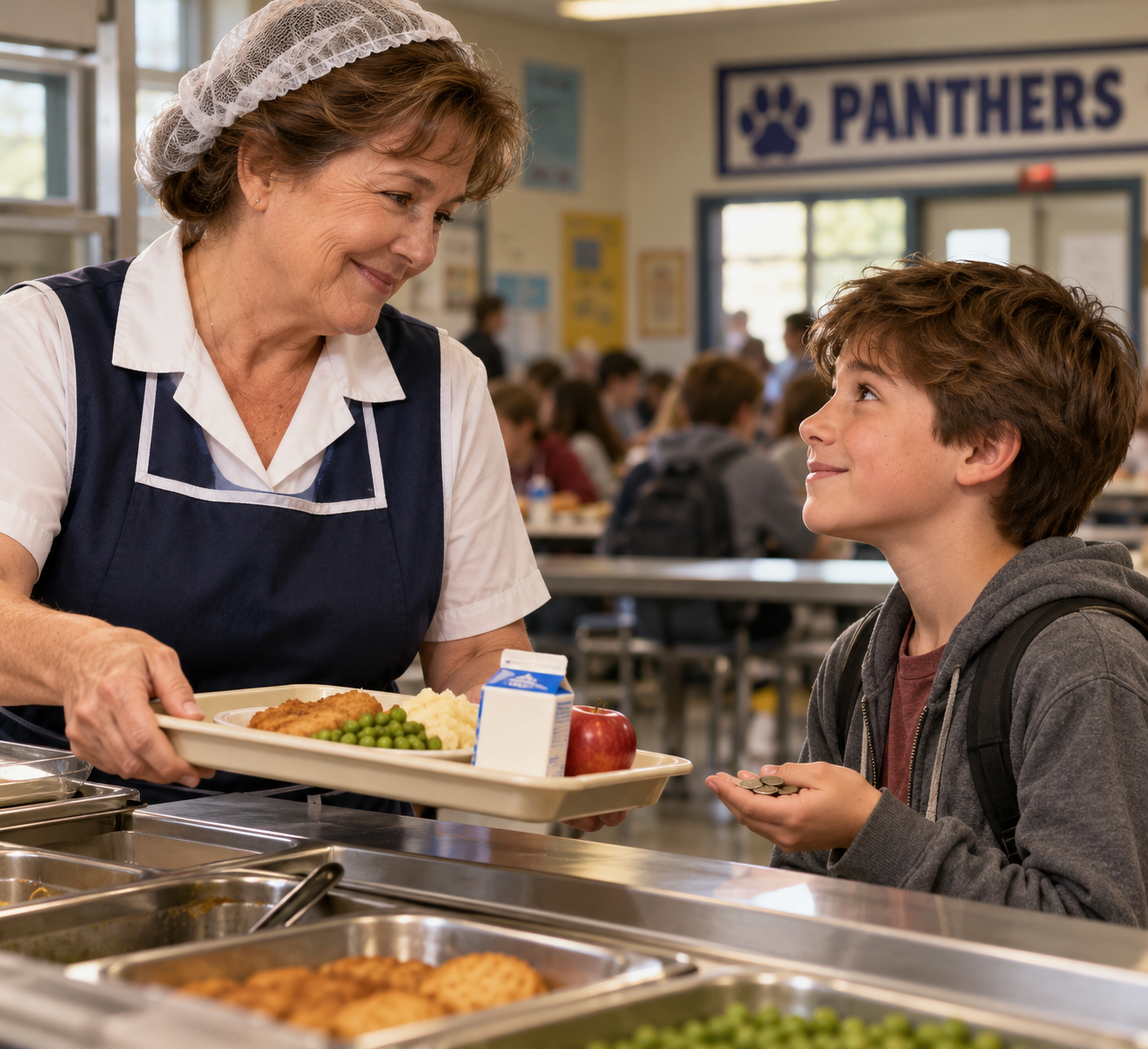
“He said he remembers how early the cafeteria opened.”
I leaned against the counter.
“Does he remember much else?”
Mom smiled.
“He remembers a lot.”
I waited.
“He said he used to carry that science book everywhere because he was trying to keep up with his classes.”
She shook her head.
“He must have been exhausted.”
I pictured Daniel walking through the school with the heavy blue book tucked against his chest.
Perhaps he had carried it because he wanted to do well.
Perhaps studying had offered him something steady during a difficult period.
I could not know.
But I could imagine a young man trying to hold his life together while hiding a problem as ordinary and painful as not having enough money for lunch.
Mom had seen only a small part of what he was carrying.
She had not needed to understand everything before helping him.
“What else did he say?” I asked.
“He said he still thinks about the advice I gave him.”
I felt a familiar warmth in my chest.
“The promise about helping other people?”
She nodded.
“He said it stayed with him.”
I sat down.
“Did he tell you how?”
“Not in detail.”
Mom poured herself a glass of water.
“He said it helped him remember that people don't always tell you what they need.”
I looked up.
That was a simple sentence.
It was also a powerful one.
Daniel had spent years working in a place where people often arrived frightened and vulnerable.
A patient might be worried about pain.
A family might be struggling to understand a diagnosis.
Someone might be too overwhelmed to ask the question they needed answered.
Perhaps the lesson from the cafeteria had stayed with him because it was useful in places far removed from the school.
He knew what it felt like to need something and not know how to ask.
He knew that a person could be embarrassed by circumstances they had not chosen.
And he knew that kindness did not have to wait for a perfect explanation.
“I'm glad he told you,” I said.
“So am I.”
Mom placed her glass on the counter.
“But he did the hard work himself.”
I nodded.
She had said something similar before.
She would never take credit for Daniel's career.
She had given him lunch.
He had done the studying, the training, and the work that followed.
Her kindness had mattered, but it had not replaced his effort.
That distinction seemed important to her.
It mattered to me, too.
I had begun to understand that helping someone did not mean taking ownership of their future.
It meant giving them something they could use and allowing them to decide what came next.
Mom had not tried to direct Daniel's life.
She had not asked him to become a particular kind of person.
She had asked him to remember how it felt to receive kindness and to offer it when he could.
The promise belonged to him.
And he had carried it forward in his own way.
Later that afternoon, Mom sat near the window with the retirement box beside her chair.
She opened it and took out one of the cards.
I watched her read it.
“Do you ever think about going back to the school?” I asked.
She looked up.
“To visit?”
“Yes.”
“Maybe someday.”
She returned the card to the box.
“I don't think I need to go back right away.”
I understood.
The school had been a large part of her life.
She did not need to rush toward it or away from it.
She could let the memories settle.
She could enjoy the quiet.
She could decide what she wanted to do with the time that had opened before her.
“What would you do if you went back?” I asked.
She smiled.
“I'd probably ask how the kitchen is running.”
I laughed.
“Of course you would.”
“And I'd want to know whether the children like the new menus.”
“You're retired.”
“I am aware.”
She gave me a playful look.
“But I can still be interested.”
I sat beside her.
For a moment, neither of us spoke.
Then I asked something that had been on my mind.
“Do you think Daniel would have become a different person if you hadn't helped him that day?”
Mom looked at me for a long time.
“I can't answer that.”
I waited.
“He might have found another way to get lunch. Someone else might have helped him. Or he might have managed on his own.”
She folded her hands.
“I don't know what would have happened.”
I had expected a more certain answer.
Instead, she gave me the truth.
She could not know what difference one meal had made in the larger course of Daniel's life.
Neither could I.
Perhaps the lunch had changed his day.
Perhaps it had made the next school lesson easier.
Perhaps the note had comforted him at a time when he needed encouragement.
Perhaps the memory had simply remained with him as proof that one person had noticed.
There was no way to measure the effect.
But we did not need to claim that Mom had changed his entire life to recognize that she had made one part of it better.
That was enough.
Mom looked toward the window.
“Sometimes you do something because it needs doing,” she said.
“Then you move on.”
I nodded.
“And sometimes,” she continued, “you find out years later that the person remembers.”
She smiled.
“That's a wonderful thing.”
I thought about Daniel's call.
He had not needed to contact her.
He had already thanked her at the retirement party.
He had already shared the receipt and told the story.
Yet he had called again to see how she was doing.
The kindness had traveled in both directions now.
Mom had helped a boy who needed lunch.
Years later, the man he became had returned to offer gratitude.
Now he was checking on her as she entered a new part of her life.
Neither of them had to do it.
They did it because they cared.
That evening, Mom asked me to help her move a small table closer to the window.
She wanted a better place to read.
We shifted it a few inches and adjusted the chair.
When she sat down, the afternoon light fell across the newspaper in her lap.
“Is that better?” I asked.
“Much.”
She opened the paper.
I returned the retirement box to the shelf.
Before leaving the room, I glanced back at her.
She looked comfortable.
There was no cafeteria schedule in her hand.
There was no bell telling her to hurry.
For once, she could read without watching the clock.
I thought about the promise Daniel had carried for so long.
Help someone else when you have the chance.
The words had begun in a school cafeteria, but they had not stayed there.
They had traveled into a hospital.
They had returned to Mom's retirement party.
They had reached our kitchen and our quiet afternoons.
And now they had reached me.
I could not know how many people Daniel had helped because of that promise.
I could not know how many moments of kindness had grown from the meal Mom had served him.
But I knew that the lesson had survived.
It had survived because Daniel remembered it.
And because Mom had never asked him to forget.
Click here to continue reading: PART 16: The Evening I Finally Understood What Mom Meant by Showing Up Every Day
I Thought My Mother’s Retirement Would Be Just Another School Gathering Until Someone Walked In and Asked for Her
Part 15 of 20