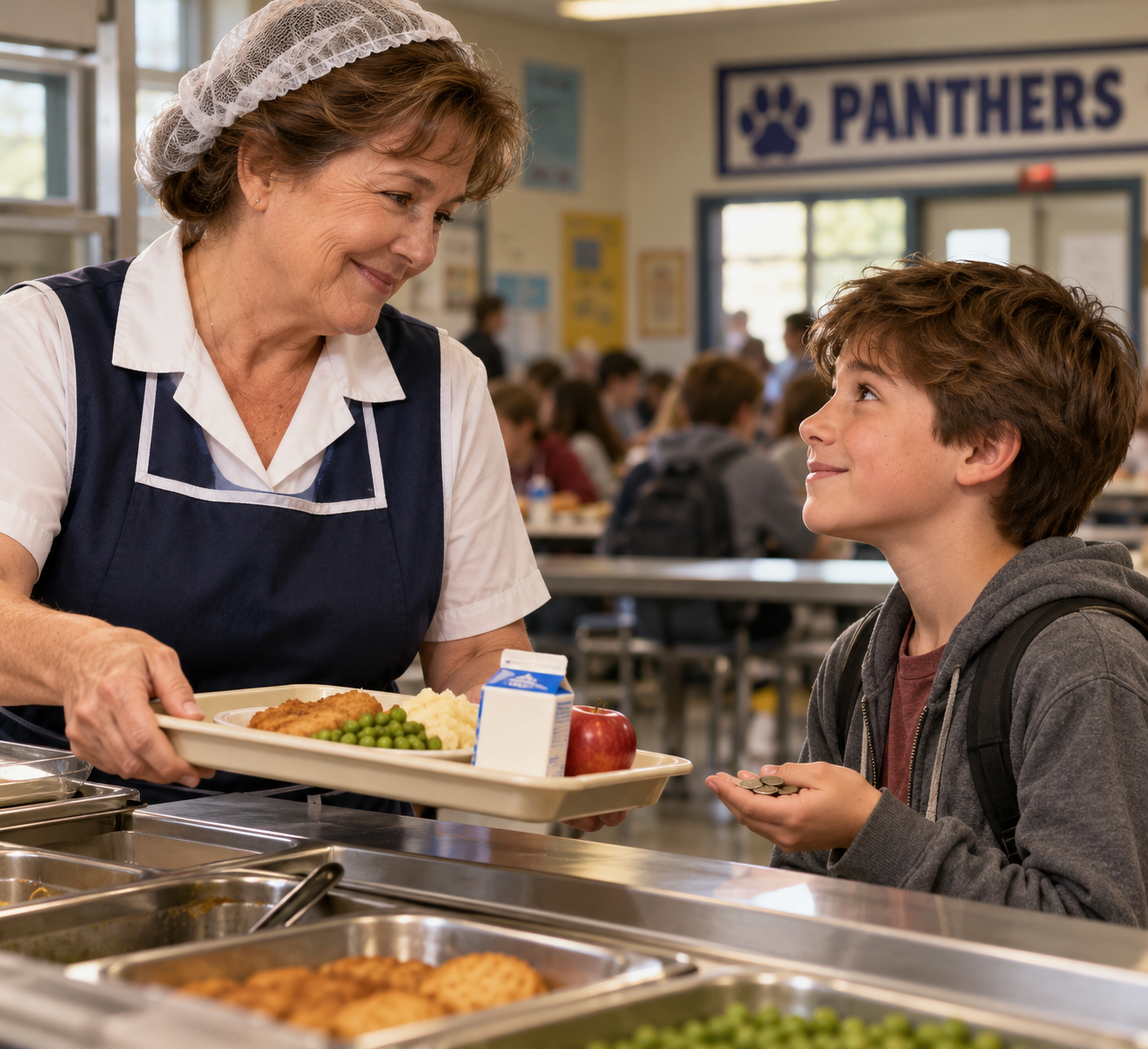
The first morning without the school cafeteria felt strange.
I woke up expecting my mother to be getting ready for work.
For forty-two years, her mornings had followed almost the same routine.
She would get dressed, make herself something to drink, and check the time before leaving.
Sometimes she would mention a delivery that had arrived late the previous afternoon.
Sometimes she would complain about a machine that needed repairing.
Mostly, she talked about the students.
That morning, nobody was waiting for her behind a counter.
There were no trays to prepare.
No lunch bell to beat.
No children lining up with empty stomachs.
Mom was retired.
And I had no idea what that meant for her.
When I saw her later that morning, she was sitting at the kitchen table with a cup beside her.
Her retirement flowers stood in a vase near the window.
The petals were beginning to open.
She had arranged them herself.
I sat across from her.
For a while, neither of us said anything.
Then she looked at me.
"Do you think Daniel made it home all right?"
I almost laughed.
That was the first thing she wanted to know.
Not whether people had enjoyed the party.
Not whether the teachers had appreciated everything she had done.
She wanted to know whether the man who had returned to thank her had arrived home safely.
"I'm sure he did," I told her.
She nodded.
"I hope so."
I watched her stir her drink.
She had always been a woman who found something to worry about.
If a student missed lunch, she wondered whether he was sick.
If a child looked upset, she wondered whether something had happened at home.
If somebody came through the cafeteria line without speaking, she tried to remember whether they had seemed unhappy the day before.
I used to think she worried too much.
Now I wondered how much of her life had been spent noticing things the rest of us overlooked.
After breakfast, I helped her put away the retirement cards.
She wanted to keep them in a box.
Not a special box.
Just an ordinary one that had once held household supplies.
She placed the cards inside carefully.
When she reached Daniel's card, she stopped.
"He was such a polite boy," she said.
I looked at her.
"You remember him from all those years ago?"
She smiled faintly.
"I remember his face now."
She tapped the card with one finger.
"And I remember that blue book."
I sat down beside her.
"What else do you remember?"
She thought about it.
"He was always trying to make himself smaller."
That answer surprised me.
Mom continued arranging the cards.
"He didn't want anyone to notice when he needed something."
I pictured Daniel standing in the break room the day before.
I pictured the chief surgeon holding a faded receipt with both hands.
I pictured him trying to explain what those lunches had meant.
"Did you know he was struggling back then?" I asked.
Mom paused.
"I knew he needed help."
She didn't say anything more.
I waited.
She looked toward the window.
"I didn't know everything about his life. He didn't tell me everything."
Then she turned back to me.
"But I didn't need to know everything to give him lunch."
There it was again.
That simple way she had of looking at the world.
I had spent years thinking that helping somebody required a special reason.
A serious problem.
A clear explanation.
Proof that the person deserved assistance.
Mom had never worked that way.
She had seen a boy who was hungry.
She had food.
So she had fed him.
I wondered how many times I had made a simple thing complicated.
That afternoon, we took the flowers out of their wrapping and found another vase.
Mom insisted that the cards be arranged neatly.
She read some of them again.
One had been written by a former student.
Another came from a teacher who had worked beside her for years.
There were messages filled with gratitude, but Mom kept stopping at the ones that mentioned small things.
A remembered meal.
A kind word.
An afternoon when she had stayed a little longer to help somebody.
She seemed more moved by those details than by the grand compliments.
I began to understand why.
Those were the moments she recognized.
She had never thought of herself as a person who changed lives.
She thought of herself as someone who showed up and did the work.
The next few days were quieter than either of us expected.
Mom still woke up early.
She still looked at the clock.
Sometimes, she would start to gather her things before remembering she had nowhere to go.
Then she would sit down again.
I didn't know what to say when that happened.
Retirement had given her time, but it had also taken away the routine around which she had built most of her adult life.
She missed the school.
She missed the noise.
She missed the familiar faces.
She even missed the students who complained about the food.
One morning, she admitted that she had wondered whether the new cafeteria worker would remember to put enough rolls on the serving line.
I smiled.
"Mom, they'll manage."
She gave me a look.
"Of course they'll manage."
Then she sighed.
"I just hope they do."
I knew that look too.
She was trying to let go of something she had spent forty-two years caring about.
And letting go was harder than she had expected.
A few days later, we received a telephone call.
Mom answered it in the kitchen.
I was nearby, putting away groceries.
She listened quietly, then glanced toward me.
Her expression changed.
Not alarm.
Recognition.
"Yes, sweetheart," she said.
She listened again.
Then she smiled.
When she finished the call, she placed the receiver back in its cradle.
"That was Daniel."
I turned toward her.
"What did he want?"
"Just to see how I was doing."
She returned to the groceries as though nothing unusual had happened.
I stood there, waiting for more.
Finally, she looked at me.
"He said he was glad he came to the party."
I smiled.
"I'm glad he did too."
Mom nodded.
Then she picked up a carton of milk and placed it in the refrigerator.
"He's a good man."
I agreed.
But I also knew that his kindness had begun long before that telephone call.
He had learned to notice people because somebody had noticed him.
He had learned that help did not always require an explanation.
And he had carried that lesson into a profession where people often arrived frightened and vulnerable.
I thought again about the eleven cents.
It wasn't much money.
It might not even have been enough to buy anything useful at the time.
But Daniel had offered it because he wanted to pay his own way.
He had wanted to preserve his dignity.
Mom had refused the coins without making him feel ashamed.
She had let him keep them.
That mattered.
She had helped him without taking away his pride.
I hadn't understood the importance of that until I heard him speak.
That evening, Mom sat in the living room with the retirement cards beside her.
She picked up one of the flowers and adjusted it in the vase.
I sat down across from her.
"Mom?"
She looked up.
"What is it?"
"I wish I'd understood sooner."
She frowned slightly.
"Understood what?"
"How much your work meant."
She was quiet.
Then she gave me a small smile.
"You were busy growing up."
It was a generous answer.
Maybe too generous.
I had been busy growing up, but I had also been busy judging things by how impressive they looked.
I had wanted my mother to have a job that sounded important.
I hadn't understood that importance could exist without a title.
I hadn't understood that a person could spend a lifetime doing something ordinary and leave behind memories that were anything but ordinary.
Mom reached for another card.
"You don't have to feel bad about that."
I looked at her.
"I do, a little."
She shook her head.
"Then do something useful with it."
I waited.
She placed the card back in the box.
"Pay attention to people."
I nodded.
She didn't give me a speech.
She didn't need to.
For the first time, I understood that she had been teaching me the same lesson she had taught Daniel.
Not through a receipt.
Not through a lecture.
Through the way she lived.
And I had been standing close enough to see it for years.
Click here to continue reading: PART 6: I Had Known My Mother for My Entire Life, Yet a Stranger’s Old Receipt Made Me See the Years Behind Her Cafeteria Counter Differently
I Thought My Mother’s Retirement Would Be Just Another School Gathering Until Someone Walked In and Asked for Her
Part 5 of 20