The invitation arrived on a Thursday morning.
Mom was sitting at the kitchen table, reading the newspaper, when the telephone rang.
She answered it and listened quietly.
Then she smiled.
“Of course I remember you.”
I continued making coffee while she talked.
She asked a few questions, laughed twice, and promised to think about the invitation.
When she hung up, she remained seated for a moment.
“Who was that?” I asked.
“One of the teachers from the school.”
“Everything all right?”
“Everything is fine.”
She reached for her coffee.
“They're having a small gathering next week. Some of the staff want to see me.”
I smiled.
“You should go.”
“I haven't decided yet.”
I looked at her.
“Why not?”
She turned the cup slowly between her hands.
“I suppose I'm not sure how I'll feel walking back in there.”
I understood.
The school had been part of her life for forty-two years.
She had left the building as a retiree, carrying flowers and cards, but the place itself had not changed just because she had stopped working there.
The cafeteria was still there.
The serving counter was still there.
The kitchen would still fill with the same familiar sounds when lunchtime approached.
Only someone else would be standing where Mom had once stood.
“Do you think it'll be strange?” I asked.
“Probably.”
She smiled a little.
“But I would like to see everyone.”
That afternoon, she called the teacher back and accepted the invitation.
For the next several days, she did not talk much about the visit.
She went about her new routine.
She watered the plants.
She read her newspaper.
She met a friend for coffee.
But on the morning of the gathering, she spent longer than usual choosing what to wear.
I stood in the doorway while she adjusted the collar of her blouse.
“You look fine,” I told her.
She glanced at me in the mirror.
“I wasn't asking.”
I laughed.
“I know.”
She smiled.
Then she reached for her handbag.
Before leaving, she stopped by the kitchen table.
The old cafeteria schedule was no longer sitting there, but she still seemed to remember exactly where it had been.
She looked at the sugar jar beside the coffee maker.
“What is it?” I asked.
“Nothing.”
She picked up her keys.
“I'm ready.”
We drove to the school together.
The familiar roads brought back memories I had not thought about in years.
Mom pointed out a building that had once been a small shop.
She mentioned a road that had been repaired more times than she could count.
She recognized the corner where school buses used to turn.
When we reached the school, she grew quiet.
The building looked much as I remembered it.
Students moved across the grounds in small groups.
A few teachers stood near the entrance, talking before the next class.
Somewhere inside, a bell rang.
Mom sat with her hand resting on the door handle.
For a moment, she did not move.
Then she took a breath.
“Let's go.”
We walked inside.
A teacher saw her almost immediately.
“Bernie!”
Mom smiled as the woman hurried toward us.
They hugged.
Then another teacher came over.
Soon, Mom was surrounded by familiar faces.
People asked how retirement was treating her.
They asked whether she was sleeping later.
They asked whether she missed the cafeteria.
Mom answered each question with her usual warmth.
“I miss the people most,” she said.
One of the teachers laughed.
“You should have seen the kitchen last week. We were still looking for things you used to keep in the same place.”
Mom shook her head.
“You'll find them.”
“We did. Eventually.”
They laughed together.
I stood nearby, watching her relax.
At home, she had been learning how to live without her old routine.
Here, she seemed to remember exactly who she was.
Not because she needed the job back.
Because she was among people who understood the years she had spent doing it.
Someone brought her a cup of coffee.
Another teacher asked whether she wanted to see the cafeteria.
Mom looked at me.
I nodded.
“Go ahead.”
She followed the teacher down the hall.
I stayed behind for a moment, speaking with someone who remembered Mom from the last few years of her career.
Then I followed them.
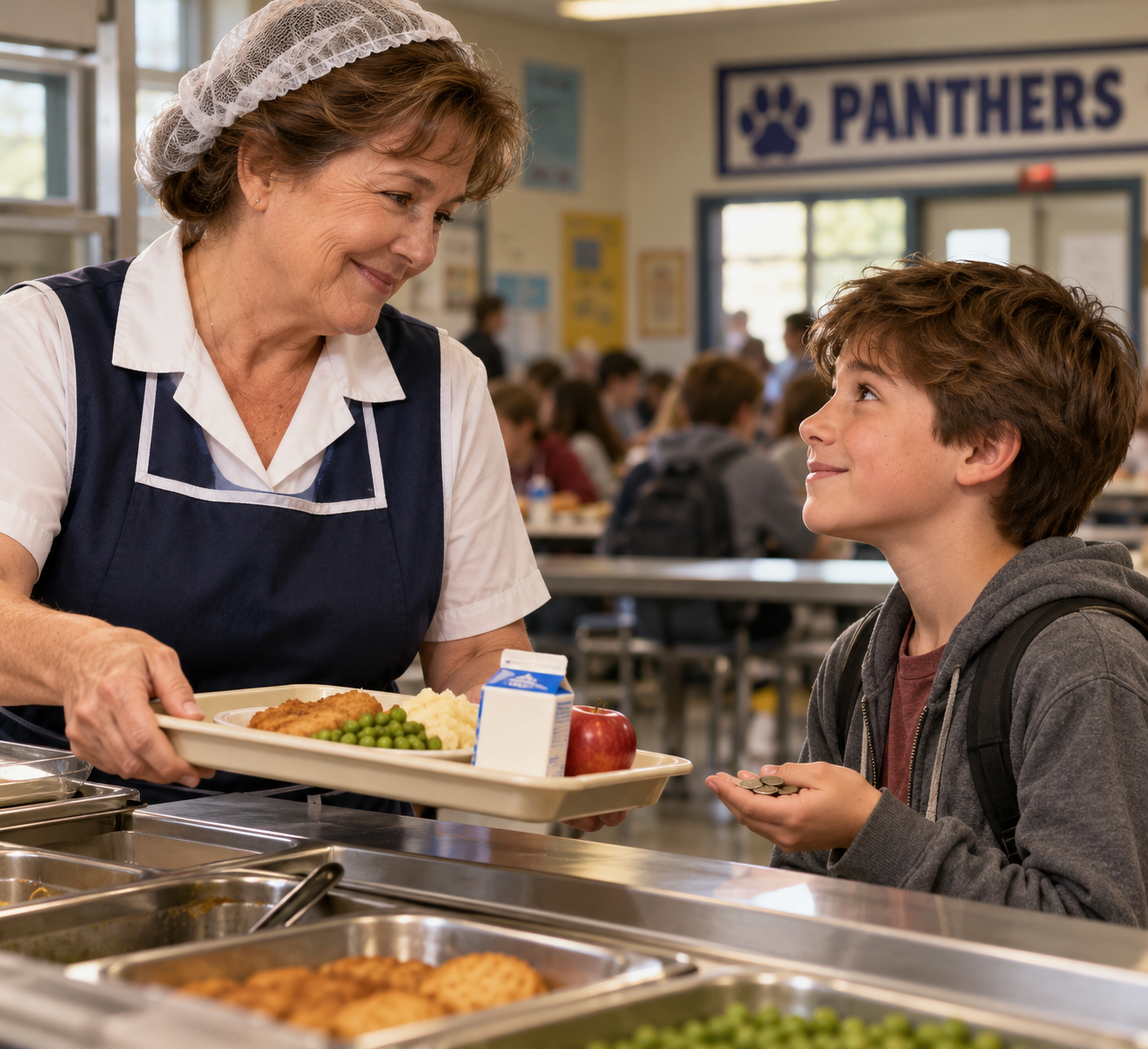
When I reached the cafeteria entrance, Mom was standing beside the serving counter.
The room was busy.
Students moved between tables, and the sound of conversation filled the space.
The kitchen staff worked behind the counter.
Trays clattered.
A refrigerator door opened and closed.
Someone called out for another container of food.
Mom watched everything with a familiar expression.
She looked pleased.
She also looked a little lost.
The teacher beside her noticed.
“You miss it, don't you?”
Mom considered the question.
“Parts of it.”
She looked toward the line.
“But I'm glad someone else is doing it now.”
I watched her eyes move over the students.
For a moment, I wondered whether she was looking for Daniel.
Then I realized how unlikely that was.
Daniel had graduated years ago.
He was a surgeon now.
He would not be standing in the cafeteria line with a science book tucked under his arm.
Yet the memory of him had become part of what the room meant to Mom.
She had fed many students in that cafeteria.
Most had gone on to lives she knew little about.
Daniel had returned and shown her one small piece of what happened afterward.
That knowledge had changed how I understood the room.
The counter was no longer just a place where meals were served.
It was where people had passed through Mom's life, sometimes briefly, sometimes for years.
Some had complained about the food.
Some had asked for extra gravy.
Some had come through the line laughing with their friends.
And some had arrived carrying worries they did not know how to explain.
Mom had been there for all of them.
Not in the same way.
Not with the same conversation.
But with the same willingness to notice what was in front of her.
A student approached the counter and asked a staff member a question.
The staff member answered, and the student moved along.
Mom watched him go.
Then she turned toward me.
“You know what I used to worry about most?”
“What?”
“Running out of food before everyone had been served.”
She smiled.
“I always wanted to make sure there was enough.”
I thought about the extra milk she had bought at home.
The habit had followed her even after retirement.
“I'm sure you managed,” I said.
“Most days.”
She laughed.
“Some days were more difficult than others.”
We stood there for a while.
Then the teacher suggested that we return to the staff room.
Mom gave the cafeteria one last look.
She did not linger.
She did not ask to take over the serving line.
She did not act as if the room belonged to her.
She simply turned and walked back down the hall.
I followed beside her.
As we reached the staff room, she touched my arm.
“I'm glad I came.”
I smiled.
“So am I.”
She looked back toward the cafeteria.
“It's nice to know the work continues.”
That sentence stayed with me.
For years, I had imagined retirement as the end of a job.
For Mom, it was the end of her daily responsibility, but not the end of her connection to the people she had served.
The cafeteria would continue.
The students would continue arriving hungry.
The staff would continue preparing meals.
New children would pass through the line, and someone else would learn their names.
Mom did not need to remain in that room for her years there to matter.
She had already done her part.
When we left the school, she seemed lighter.
She talked about the teachers she had seen and laughed about the kitchen staff searching for things she used to keep in particular places.
Then she leaned back in her seat.
“I think I'll sleep well tonight.”
I glanced at her.
“Because you went back?”
“Because I saw that everything is all right.”
I understood.
She had needed to see that the school could continue without her.
And perhaps she had needed to see that she could continue without it.
We drove home together.
The afternoon sun rested on the dashboard.
Mom looked out the window, quiet but content.
I thought about Daniel and the receipt he had kept.
I thought about the promise he had carried into adulthood.
And I thought about the woman sitting beside me, who had spent forty-two years doing her work without knowing which moments would remain in someone's memory.
She had returned to the school for an afternoon.
She had greeted old friends.
She had watched the cafeteria continue its ordinary work.
Then she had come home.
Nothing dramatic had happened.
But I knew that the visit had given her something important.
It had allowed her to leave without feeling that she had abandoned the place.
The work was continuing.
The children were being fed.
And Mom was finally free to discover what the next part of her life might look like.
Click here to continue reading: PART 18: The Small Kindness I Almost Walked Past Because I Was Too Busy Thinking About My Own Day
I Thought My Mother’s Retirement Would Be Just Another School Gathering Until Someone Walked In and Asked for Her
Part 17 of 20