The change in me did not happen all at once.
I wish I could say that after Daniel returned to thank Mom, I became the kind of person who always noticed when someone needed help.
That would make the story easier to tell.
It would also be untrue.
I still hurried through ordinary days.
I still became distracted by my own responsibilities.
I still sometimes assumed that someone else would notice a problem before I did.
But I had started paying attention to those habits.
And once I began noticing them, I could no longer pretend they were invisible.
One afternoon, I stopped at a small grocery store on my way home.
I had a short list and planned to be inside for only a few minutes.
I needed bread, milk, and a few things for dinner.
The store was busy.
A family stood near the produce section, trying to keep a young child from pulling apples out of a display.
Someone was asking an employee where to find a particular item.
At the checkout, a man in front of me was searching through his pockets.
He looked tired.
He held a small basket containing bread, eggs, and a carton of milk.
The cashier told him the total.
He counted the money in his hand.
Then he checked his wallet.
He was short.
Not by much.
He looked at the items on the counter and quietly asked whether he could put something back.
The cashier nodded.
The man picked up the milk.
He hesitated, then placed it beside the register.
I watched him.
My first thought was that I needed to get home.
I had dinner to prepare.
I had things to do.
The line was moving slowly, and I had already spent longer in the store than I wanted.
Then I thought about Daniel.
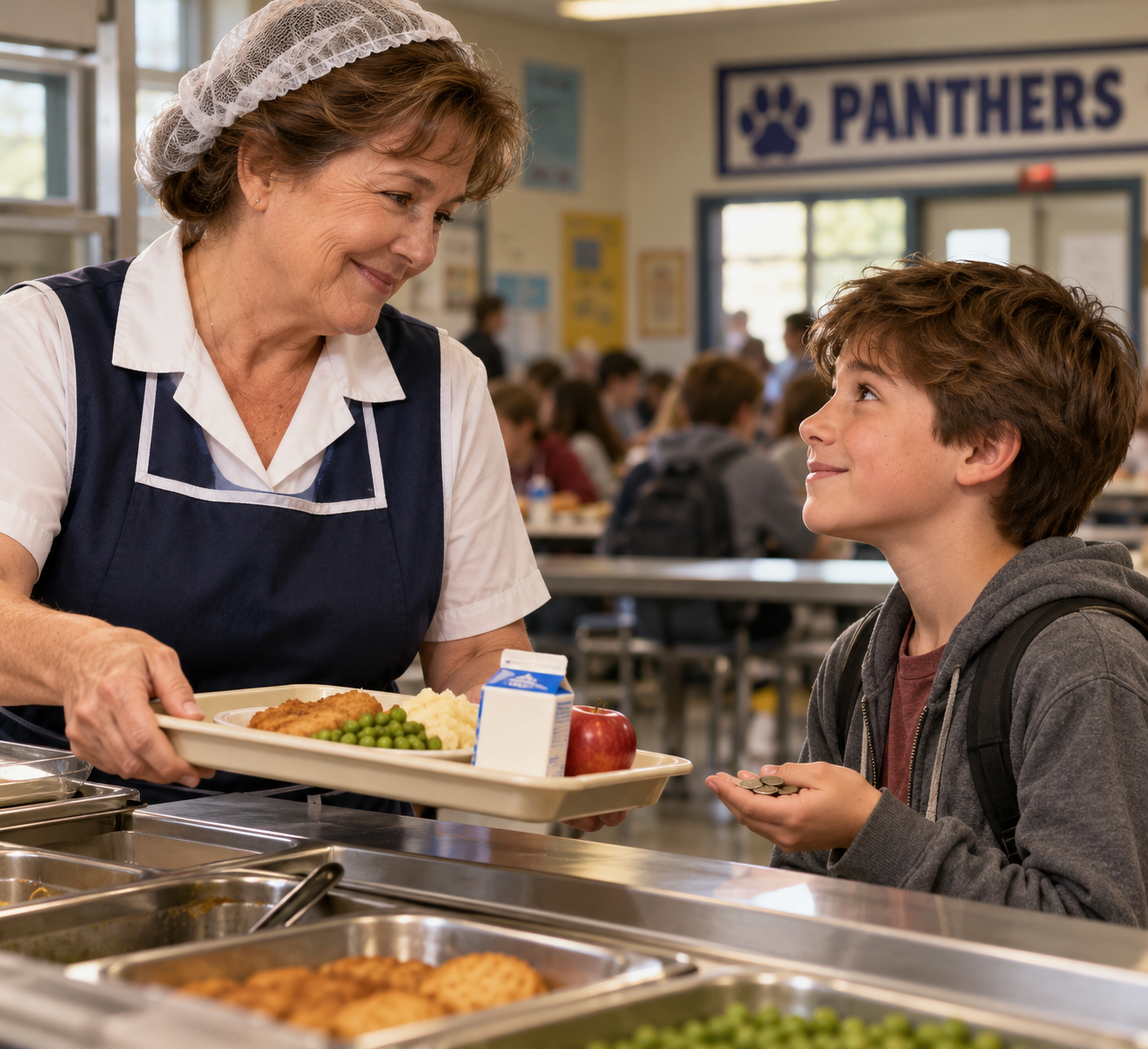
I pictured him standing in the cafeteria with eleven cents in his hand.
I pictured Mom placing a tray in front of him without making him explain himself.
I remembered what she had said about helping someone without forcing them to reveal more than they wanted to share.
The man in front of me was not Daniel.
I did not know his circumstances.
I did not know whether he was having a difficult week or simply had less money than he expected.
I did not know whether he wanted anyone to notice.
I only knew that he had looked at the milk and decided he could not afford it.
I stepped forward slightly.
“Excuse me,” I said to the cashier. “Could you add the milk to my groceries?”
The man turned around.
His expression changed immediately.
“Oh, no,” he said. “You don't have to do that.”
“I know.”
I tried to keep my voice casual.
“I was buying milk anyway.”
That was not entirely true.
I already had milk at home.
But it seemed like a harmless way to make the offer easier to accept.
The man looked at me.
Then he glanced at the carton beside the register.
“I appreciate it,” he said quietly.
The cashier added the milk to my total.
I paid for my groceries.
The man thanked me again.
I nodded and moved toward the exit.
That was all.
There was no speech.
No one applauded.
The man did not tell me his life story.
I did not ask.
We went our separate ways.
Outside, I placed my groceries in the car and sat behind the steering wheel for a moment.
I felt strangely unsettled.
Not because I regretted helping him.
Because I realized how close I had come to doing nothing.
I had been ready to walk past a small need because I was thinking about my own schedule.
I had not been cruel.
I had not said anything unkind.
I had simply been busy.
And that was exactly what Mom had taught me to question.
She had never suggested that people were bad because they failed to notice everything.
She knew that everyone had responsibilities.
She knew that no one could help every person they encountered.
But she had also known that the person in front of you was still a person, even when you had somewhere else to be.
I drove home more slowly than usual.
When I arrived, Mom was in the kitchen preparing vegetables.
She looked up as I came through the door.
“You're late.”
“There was a line at the store.”
She nodded.
“Did you get everything?”
“Yes.”
I put the groceries away.
Then I told her what had happened.
She listened without interrupting.
When I finished, she smiled.
“That's kind of you.”
I shook my head.
“I almost didn't do it.”
She continued cutting the vegetables.
“But you did.”
“I was thinking about getting home.”
“That's normal.”
She placed the knife on the cutting board.
“You can't stop having your own life just because other people sometimes need help.”
I looked at her.
She was not trying to excuse my hesitation.
She was putting it into perspective.
“You have responsibilities,” she continued. “You won't be able to help everyone.”
“I know.”
“But when you can help without causing a bigger problem, you can choose to do it.”
She picked up the knife again.
“That's all.”
I stood beside the counter.
I had expected her to tell me that I had done something wonderful.
Instead, she had made the decision seem ordinary.
Perhaps that was the point.
Helping the man had not made me a hero.
It had made me someone who had noticed an opportunity and chosen to act.
Mom had done the same thing with Daniel.
She had not expected praise.
She had not expected him to become a surgeon.
She had not expected him to return with an old receipt.
She had simply fed a student.
And now I had paid for a carton of milk.
The difference in scale was not important.
What mattered was the choice.
Over dinner, I found myself thinking about the man again.
I hoped the milk helped.
I hoped he had a better evening.
I also knew I might never see him again.
That was all right.
I did not need to know the rest of his story to recognize the moment we had shared.
After dinner, Mom and I sat in the living room.
She asked whether I had enjoyed the rest of my shopping.
I laughed.
“Nothing else happened.”
“Good.”
She folded the newspaper.
“Not every day needs a story.”
I looked at her.
For a moment, I understood why Daniel had waited so long to tell her what she meant to him.
He had not needed to turn every meal into a memory.
He had simply kept living.
He had studied, worked, and built a career.
Then, when the right moment came, he had returned.
The man at the grocery store might never think about me again.
Perhaps he would remember the milk for a day.
Perhaps he would forget it before the week was over.
I did not need to know.
I could not control what the gesture meant to him.
I could only decide whether I was willing to make it.
That evening, I thought about Mom's words again.
You can't help everyone.
You can do the part that's yours.
It was not a promise to fix the world.
It was a way to live inside it.
The next morning, I noticed a neighbor struggling with a heavy package near the entrance to our building.
I asked whether she wanted help carrying it.
She accepted.
We took the package inside.
She thanked me, and I went on with my day.
A few hours later, I called Mom.
I told her about the package.
She laughed.
“You're going to start noticing everything now.”
“Maybe.”
“Just remember that people are allowed to say no.”
“I know.”
“And don't turn every kind thing you do into a report for your mother.”
I laughed so hard that she started laughing, too.
She was right.
The point was not to collect stories about my own goodness.
The point was to pay attention.
I had spent too long believing that the meaningful parts of Mom's life were hidden somewhere in the past.
Now I could see that the lesson was still available to me.
It was there in a grocery store.
It was there beside a heavy package.
It was there whenever I had a choice between rushing past someone and offering a little help.
The opportunities were ordinary.
That was why I had missed so many of them.
I was learning to see them now.
Click here to continue reading: PART 19: The Last Time We Spoke About Daniel’s Eleven Cents, Mom Gave Me an Answer I Had Never Expected
I Thought My Mother’s Retirement Would Be Just Another School Gathering Until Someone Walked In and Asked for Her
Part 18 of 20