
The following week, I found Mom looking through an old drawer.
She had been searching for something she needed for the house.
Instead, she had uncovered a collection of things she had kept from her years at the school.
There were a few photographs.
Some old notes.
A faded cafeteria schedule.
And several small pieces of paper that looked as though they had been saved without any particular plan.
She held one photograph in her hand.
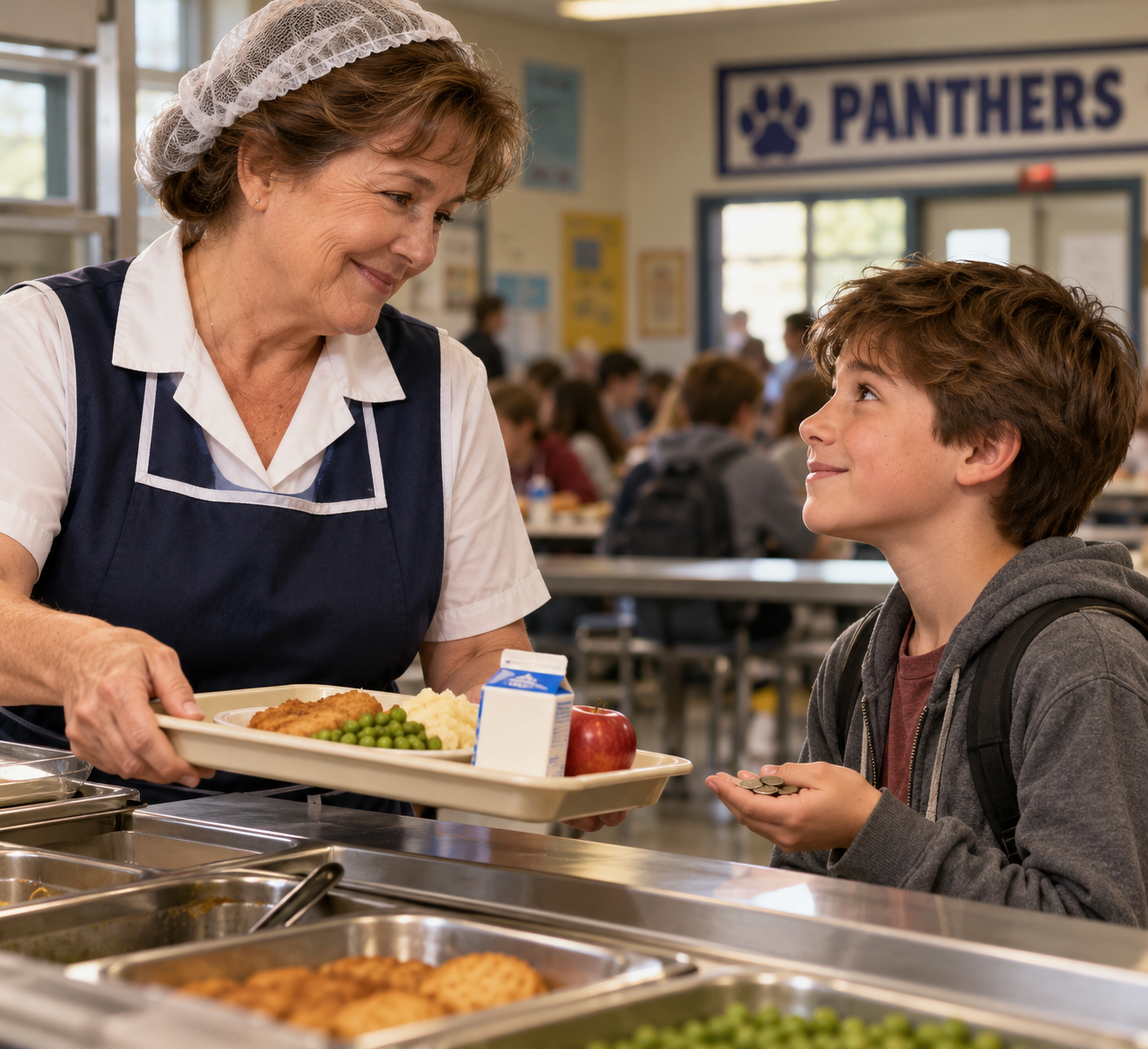
It showed her standing behind the cafeteria counter many years earlier.
Her hair was darker.
Her face was younger.
The counter looked almost exactly as I remembered it.
She studied the picture.
"I can't believe how long ago that was."
I leaned over to look.
"You look the same."
She laughed.
"Don't start lying to me."
I smiled.
Then I noticed a small blue object in the background.
It was difficult to make out, but it looked like a book.
I pointed toward it.
"Could that be Daniel's science book?"
Mom brought the photograph closer to her face.
She studied it for several seconds.
"I can't tell."
She placed it on the table.
"But I remember him carrying it."
I sat beside her.
"Did he ever tell you why he kept bringing it everywhere?"
"No."
She folded her hands.
"He liked science, I think."
She paused.
"Or perhaps he wanted people to think he was busy reading."
I looked at her.
She shrugged.
"Children find ways to protect themselves."
I had never thought about it like that.
A book could be more than something to study.
It could be a reason not to talk.
A way to keep your eyes lowered.
A small shield against questions you didn't want to answer.
Mom had noticed the book, but she had also noticed the boy carrying it.
That difference mattered.
She put the photograph aside.
Then she picked up the old cafeteria schedule.
The paper had yellowed at the edges.
She ran her thumb along one corner.
For a moment, she seemed to be somewhere else.
I didn't interrupt her.
Eventually, she folded the schedule and returned it to the drawer.
"I suppose I should decide what to keep."
"You don't have to do that now."
She smiled.
"I know."
But she continued sorting through the papers.
Some things went into a box.
Others went into a small pile she planned to throw away.
Every so often, she would stop over a particular item.
She would look at it, remember something, and smile.
Then she would put it away.
I began to see that retirement was not simply a matter of leaving a job.
It was a process of deciding what the years had meant.
Mom had spent most of her life moving from one task to another.
Now she had time to look backward.
That wasn't always comfortable.
Sometimes she laughed.
Sometimes she became quiet.
Sometimes she shook her head at a memory that seemed to have surprised her.
I wondered how many stories she had never told me.
Not because she was hiding anything.
Because she had never thought the stories were important enough to tell.
The day after we found the photograph, she received another card.
It had been mailed to her home.
The handwriting was unfamiliar to me.
Mom opened it carefully.
She read the message once.
Then she read it again.
"What does it say?" I asked.
She handed it to me.
It was a brief thank-you from someone who remembered being treated kindly at school.
There were no elaborate details.
No long explanation.
Just a few sentences about how much that kindness had mattered.
I looked at Mom.
She was smiling.
"People remember the strangest things," she said.
I thought about Daniel's receipt.
"Sometimes they remember the things that matter most."
Mom glanced at me.
Then she nodded.
We placed the card with the others.
Over the next several days, she continued receiving messages.
Some arrived by mail.
Others came by telephone.
A few were passed along by former colleagues who had heard about her retirement party.
Mom accepted every message with the same modest surprise.
She never claimed credit for anything.
If someone thanked her for helping a student, she said the student had done the hard work.
If somebody remembered a meal, she said she had been fortunate to have food available.
If a teacher praised her dedication, she said the other cafeteria workers had helped her.
I began to understand that she wasn't trying to avoid praise because she disliked the people giving it.
She simply didn't believe that kindness made her special.
She believed it made her responsible.
If someone needed help and she could provide it, she thought she should.
That was all.
One afternoon, we sat together at the kitchen table.
The old photograph lay between us.
Mom picked it up again.
"I wonder how Daniel is doing."
I smiled.
"He called you last week."
"I know."
She looked at the photograph.
"I wonder whether he ever got to buy his own science books."
I laughed softly.
"I suppose a surgeon can afford a few books."
She smiled.
"I hope he still reads them."
I could imagine Daniel hearing that question.
I could imagine him laughing.
But I also knew that the question revealed something about Mom.
She remembered the child he had been.
She was interested in the man he had become, but she had not forgotten the boy who had once stood in front of her with eleven cents.
That was how she remembered people.
Their circumstances might change.
Their jobs might change.
Their lives might move far beyond the school.
But the person she had met never disappeared completely from her memory.
I looked at the photograph again.
"Do you ever wish you had done something different?"
Mom turned toward me.
"Different how?"
"Chosen another job, perhaps."
She thought about it.
Then she shook her head.
"No."
The answer came without hesitation.
"I liked working there."
She looked toward the window.
"I liked knowing the children would have lunch."
I waited.
She continued.
"Some days were hard, of course. But there was always something that needed doing."
She gave a small smile.
"And I was good at it."
I felt a lump in my throat.
She had never said those words quite that plainly before.
Not because she lacked confidence.
Because she had never needed to announce it.
She had known her work mattered.
She simply hadn't needed the rest of us to agree.
I reached for her hand.
She looked surprised, but she let me hold it.
"I'm proud of you," I told her.
Her eyes softened.
"Thank you."
That was all.
No long conversation followed.
No grand confession.
But I felt that something between us had shifted.
I had spent years looking at my mother through the eyes of someone who wanted her to be more impressive.
Now I was beginning to see her as she had always been.
A woman who had found a way to be useful.
A woman who had cared about people without asking for recognition.
A woman who had done the same job for forty-two years because she believed the work was worth doing.
I couldn't change the years I had spent misunderstanding that.
But I could stop making the same mistake.
Later that evening, I found Mom putting the photograph into the box with her retirement cards.
She adjusted the paper around it so the corners wouldn't bend.
Then she closed the lid.
"That's enough sorting for today," she said.
I helped her move the box to a shelf.
The old cafeteria schedule remained inside.
So did the photograph.
So did the cards.
None of those things could reproduce the sound of the lunch bell or the movement of students through the line.
They couldn't bring back the years she had spent behind the counter.
But they gave her a way to hold on to what those years had meant.
I understood that.
I also understood something else.
The most important part of her work wasn't in the box.
It was in Daniel.
It was in the people who had returned to thank her.
It was in the memories that had followed them long after they left school.
And it was in me, finally learning to recognize what had been right in front of me.
Click here to continue reading: PART 7: The More I Thought About Daniel’s Visit, the More I Realized That My Mother’s Greatest Work Had Never Been Something She Could Put on a Résumé
I Thought My Mother’s Retirement Would Be Just Another School Gathering Until Someone Walked In and Asked for Her
Part 6 of 20


One Comment on “PART 6 – I Had Known My Mother for My Entire Life, Yet a Stranger’s Old Receipt Made Me See the Years Behind Her Cafeteria Counter Differently”