A few days later, I found myself thinking about the receipt Daniel had brought to the retirement party.
I had seen him unfold it carefully.
The paper was old and creased, and he handled it as if it were something fragile.
He had kept it long after the ink had faded.
I could not stop wondering why.
A cafeteria receipt was not the sort of thing most people saved.
It was not a photograph of a graduation.
It was not a letter from someone they loved.
It was not a certificate or an award.
It was a small piece of paper connected to a meal that had cost him almost nothing.
Yet Daniel had carried it with him for years.
I asked Mom about it while we were putting away the last of her retirement cards.
“Do you remember the note you gave Daniel?”
She stopped arranging the envelopes.
“I remember writing him something.”
“Do you remember exactly what you wrote?”
She shook her head.
“Not exactly.”
She picked up a card with a photograph of the school on the front.
“I wrote notes all the time. Sometimes I put them in lunch bags. Sometimes I handed them to students who looked as if they needed a little encouragement.”
I sat beside her.
“Why did you write them?”
She looked surprised by the question.
“Because sometimes people need to hear something kind.”
She said it as if there were nothing more to explain.
I looked at the cards spread across the table.
Some were handwritten by former students.
Others had come from teachers who had worked with her for years.
A few were signed by families whose names I recognized only because Mom had mentioned them at dinner.
There were messages of thanks, memories of school lunches, and stories about children who had once complained about vegetables but later admitted they had missed her cooking.
One card described a student who had arrived at school after a difficult night at home.
Another thanked Mom for always greeting a shy child with a smile.
I read each message slowly.
The words were simple.
The meaning behind them was not.
“Did you ever know how much those notes meant?” I asked.
Mom shook her head.
“Not always.”
She turned one card over.
“Sometimes you never find out.”
I thought about Daniel standing in front of the teachers' break room.
He had come to the retirement party carrying a memory that had stayed with him for nearly three decades.
He had wanted Mom to understand that the lunch she gave him had mattered.
He had not returned to show off what he had become.
He had returned because he remembered who had helped him when he was struggling.
I wondered how many other students carried similar memories.
I also wondered how many had never found a reason to tell her.
Mom gathered the cards into a neat pile.
“You can't spend your whole life waiting for people to tell you what mattered,” she said.
“I know.”
“You do what you can while you have the chance.”
She placed the pile in the box.
“Then you let people live their lives.”
I nodded, though I was still thinking about Daniel's receipt.
There was something moving about the fact that he had kept such a small object for so long.
Perhaps the paper reminded him of the boy he had been.
Perhaps it reminded him that someone had noticed him before he knew how to ask for help.
Perhaps it reminded him that accepting kindness did not make him weak.
I could not know exactly what he felt whenever he looked at it.
I only knew he had brought it back to the person who had written the note.
That seemed important.
Later, I found Mom in the living room.
She had placed a few of the cards on the coffee table and was reading them again.
I sat in the chair beside her.
“Do you ever wish you'd done something different?” I asked.
She lowered the card.
“Different how?”
“I don't know. Something bigger, maybe.”
She studied me.
“What would have been bigger?”
I struggled to answer.
I had spent years measuring success by visible things.
A promotion.
A larger house.
A better title.
A moment when people stood up and applauded.
Daniel had become a surgeon, which was a remarkable achievement.
Mom had spent forty-two years serving school lunches, which had never seemed remarkable to me until I watched him thank her.
“I guess I mean something people would remember,” I said.
Mom looked down at the card in her hands.
“You can't decide what someone will remember.”
She placed the card on the table.
“You can decide whether you treat them well while they're standing in front of you.”
I sat quietly.
She was not trying to make a speech.
She was explaining something she had practiced for most of her life.
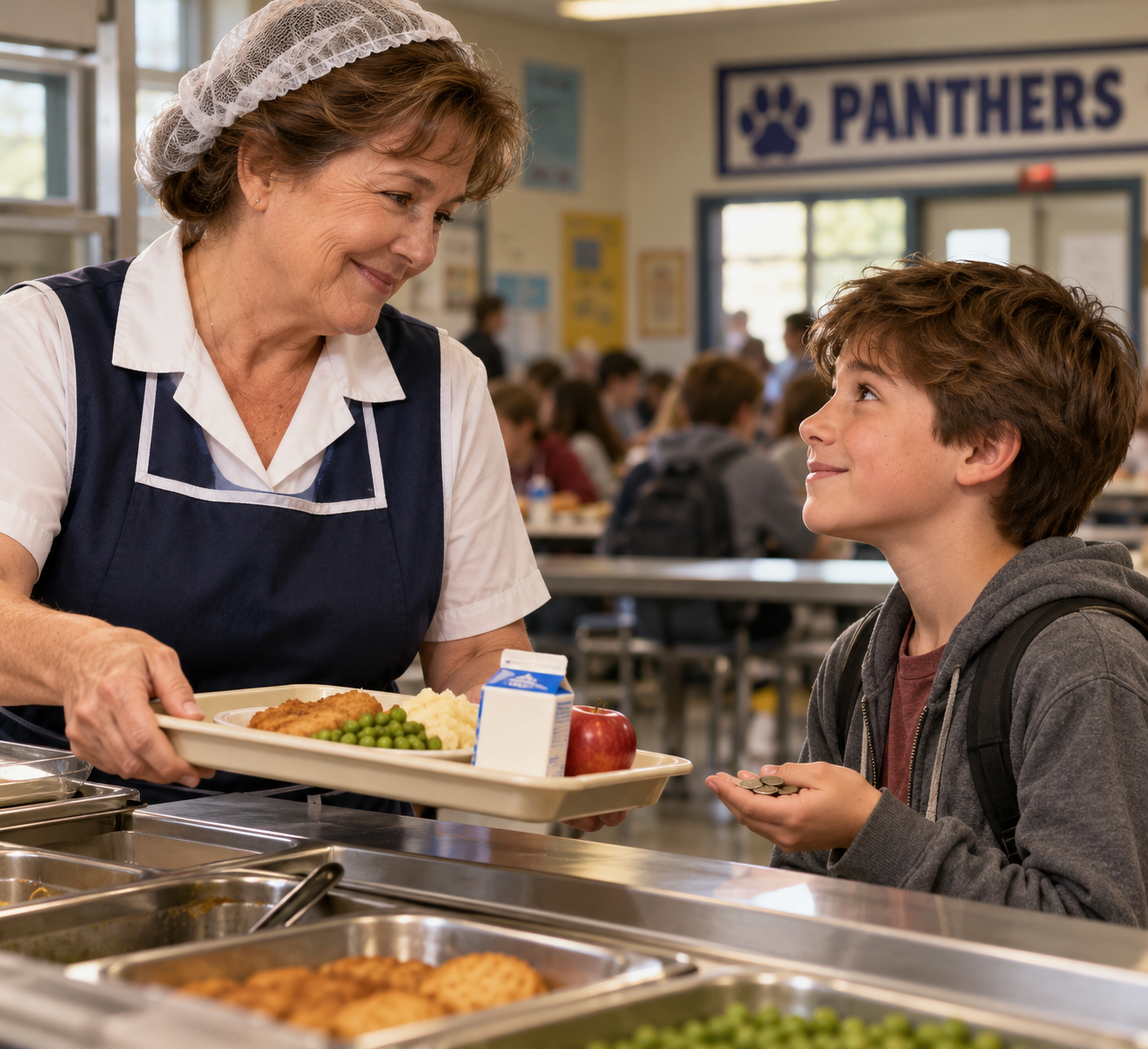
When Daniel had stood in the cafeteria in 1996, she had not known what he would become.
She had not known he would work at St. Mary's Medical Center.
She had not known he would return to her retirement party with a story that would silence a room.
She had not known he would keep a receipt.
She had only known that a boy was hungry.
That had been enough.
I thought about how often I had overlooked opportunities to help someone because I assumed the moment was too small to matter.
I had passed people who looked tired without asking if they needed anything.
I had hurried through conversations because I had somewhere else to be.
I had treated ordinary kindness as something that could wait until I had more time.
Mom had never waited for a perfect moment.
She had worked with what was in front of her.
A tray.
A roll.
A carton of milk.
A few words written on a piece of paper.
I looked at her hands resting in her lap.
They had spent decades preparing meals and carrying trays.
They had opened cans, lifted pots, wiped counters, and passed food across a serving line.
Those hands had done work that rarely appeared in school photographs.
Yet one student had remembered them.
“Mom, I think I understand now,” I said.
She looked at me.
“Understand what?”
“Why Daniel came back.”
She smiled.
“He wanted to say thank you.”
“I know. But I think he wanted you to know he hadn't forgotten.”
Her expression grew thoughtful.
“That's a nice thing to know.”
“It is.”
She reached for another card.
Then, as naturally as if she were asking about the weather, she said, “I hope he's taking care of himself.”
I laughed.
“You already told him that.”
“I know.”
She continued reading.
“People who spend all their time taking care of others sometimes forget.”
I thought about the way Daniel had spoken about his work.
He had described his life as a doctor, but the story he had told Mom was about being a boy who needed lunch.
Perhaps that memory had helped him remember what it felt like to depend on someone else.
Perhaps it had reminded him that the person needing help was more than the problem in front of him.
I hoped so.
That evening, I placed the retirement cards back in their box.
I made sure the corners were straight and the envelopes were together.
Mom watched me from the doorway.
“Careful,” she said. “Some of those are from the children.”
“I know.”
I closed the lid.
The box was not heavy.
Still, I carried it with both hands.
Inside were dozens of small messages from people whose lives had crossed Mom's for a moment or for years.
I could not measure their value.
I could only keep them safe.
And somewhere in my memory was the image of Daniel unfolding that old receipt, revealing the note he had carried for so long.
The paper had survived because he had decided it mattered.
That was a lesson I did not want to lose.
Click here to continue reading: PART 11: When I Finally Asked What She Had Seen in the Children Who Needed Her Most
I Thought My Mother’s Retirement Would Be Just Another School Gathering Until Someone Walked In and Asked for Her
Part 10 of 20