I had believed that coming home would make everything simpler.
That was one of the things I had told myself while I was away.
Distance made ordinary problems feel larger.
Being physically present was supposed to help.
I could speak to the people I loved.
I could see what was happening.
I could make decisions without relying entirely on what someone else told me.
But now I was home, and I had never felt less certain about my own household.
Mom was upstairs.
Abigail was downstairs.
And I was standing between two completely different accounts of the same situation.
One account said my mother was confused and dangerous to herself.
The other came from Mom.
She had looked directly at me and insisted she was thinking clearly.
I had only heard a little from her.
But those few words mattered.
They mattered because she had spoken for herself.
Abigail's account had been detailed enough to worry the neighbors.
It had included confusion, violent behavior, and plans for professional care.
Yet it had not explained the things I found when I opened the bedroom.
That bothered me more with every passing moment.
I began to understand how easily a person could be spoken about until nobody thought to ask them anything.
Mom had become a subject of concern.
A problem.
A responsibility.
Something Abigail was trying to manage.
That was how the conversation had sounded outside.
The neighbor had listened.
I had listened.
And upstairs, behind a locked door, Mom had not been part of the conversation at all.
The unfairness of it disturbed me.
Even if Abigail believed every word she had said, Mom deserved a chance to respond.
Even if professional care eventually became necessary, my mother was still entitled to be treated like a person.
I couldn't understand why that had become something I needed to remind myself of.
I thought about the first question I had asked Abigail.
Why was the door locked?
It had been a reasonable question.
A simple one.
But she had reacted as though I had touched something she did not want discussed.
I remembered the stiffness in her body.
I had felt it before she answered.
Then she had looked at me and explained that the lock was for Mom's protection.
I had accepted the words aloud.
I regretted that.
Not because I should have caused a scene in front of the neighbors.
I still believed I needed to understand the situation before confronting anyone.
But I regretted how easily I had allowed Abigail to believe the explanation had satisfied me.
I had made it possible for her to avoid telling me more.
And I had done that voluntarily.
I was trying to protect the chance to speak with Mom.
But every hour of pretending carried its own cost.
I kept thinking about the room.
The darkness was the first thing I had noticed.
I wondered why it had affected me so strongly.
A dark bedroom was not automatically evidence of mistreatment.
Someone could prefer darkness.
Someone could be resting.
Someone could want the curtains closed.
I knew that.
But Mom had not been resting comfortably.
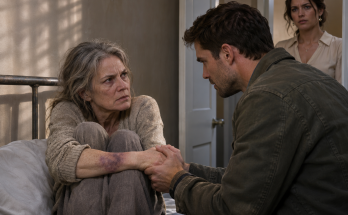
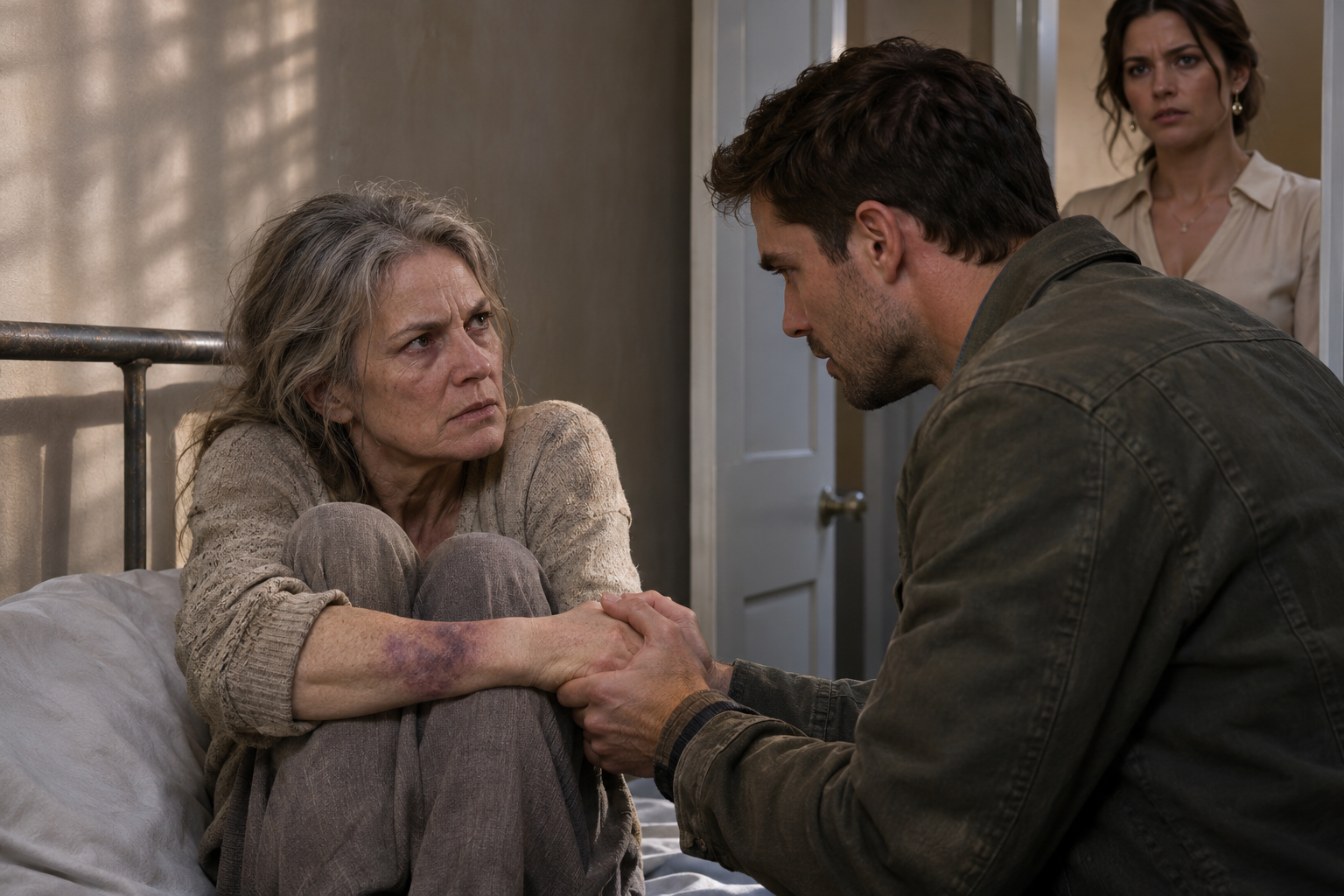
She had been huddled near the wall.
And the bed had been left bare.
Those details belonged together.
They made the room feel less like a place for recovery and more like somewhere a person had simply been left.
I didn't want to exaggerate what I had seen.
I didn't need to.
The truth was already serious enough.
I thought about the plastic cup.
It had held water that was no longer cool.
A small thing.
Almost ridiculous to remember so clearly.
But I couldn't stop picturing it.
There had been so little in the room to suggest anyone was looking after Mom's comfort.
That cup had become one of the few signs that someone had brought her anything at all.
I didn't know when it had been placed there.
I didn't know whether she had asked for more.
I didn't know whether Abigail had been bringing her meals.
Those were questions I still needed answered.
The gaps troubled me.
But I refused to fill them with guesses.
I wanted to be able to look back later and know exactly which things I had witnessed and which things I had merely feared.
That distinction was important.
Especially now.
I was angry enough to believe almost anything terrible.
And anger was not evidence.
The bruises were evidence.
I kept coming back to them.
Both wrists.
Dark marks where someone had apparently held her too tightly.
I imagined the discomfort Mom must have felt.
Then I stopped myself.
I hadn't asked her how it happened.
I didn't know whether she had struggled.
I didn't know who had been holding her.
I couldn't know until she told me.
But I knew those marks deserved to be taken seriously.
I wondered whether Abigail had noticed them.
It seemed difficult to imagine that she hadn't.
Yet I still could not say what she knew.
I thought about asking her directly.
I had nearly done so downstairs.
The words had been ready.
But I had kept them to myself.
I wondered whether that was caution or cowardice.
I didn't like the question.
I had spent much of my adult life believing I could recognize the difference between being patient and avoiding something difficult.
Now I wasn't sure.
It was easy to tell myself I was gathering information.
It was harder to admit that I was afraid of what a direct confrontation might reveal.
If Abigail explained the bruises, I might have to decide whether I believed her.
If she denied knowing about them, I would have to decide what that meant.
If she became angry, I would have to decide what to do while Mom remained upstairs.
Every possibility led to another choice.
And every choice seemed capable of hurting someone.
I looked toward the ceiling.
Somewhere above me was the room I had just left.
I imagined Mom hearing footsteps outside.
I imagined her wondering whether they belonged to me or Abigail.
I couldn't know what she was thinking.
But I remembered her hand.
The firm pressure of her fingers had felt like a message.
Not a complicated message.
Not something that required a special understanding.
She had wanted me to know she was still there.
Still thinking.
Still capable of speaking for herself.
I felt ashamed that she had needed to prove that to me.
I should have been able to walk into her room and ask how she was feeling without someone controlling the conversation.
Instead, she had needed to begin by defending her own mind.
That was the part I found hardest to accept.
Before telling me anything about the room, she had told me she was not confused.
It suggested how much Abigail's description had come to define the way other people saw her.
I thought of the neighbor.
The concerned expression.
The willingness to accept that professional care was being arranged.
Perhaps the neighbor had no reason to doubt Abigail.
I didn't blame her.
I had nearly accepted the explanation myself.
But that was exactly why I needed to be careful now.
A calm voice could sound convincing.
A sad expression could make a story feel true.
A reasonable phrase could hide a serious question.
None of those things proved someone was lying.
But none of them proved someone was telling the truth either.
I had to remember that.
I thought about Abigail's jewelry box.
The mahogany surface.
The key hidden toward the back.
I had known where to find it.
That fact had given me access to Mom.
Without it, I might still have been waiting for Abigail to decide when I could visit.
I looked at the key again.
It was such a small thing to carry so much meaning.
A piece of metal.
A lock.
A door.
An entire person's freedom to leave a room.
I wondered how long Mom had been living with that arrangement.
I didn't know.
I wondered how often the door was opened.
I didn't know that either.
I wondered whether Mom had asked to leave and been refused.
I could not answer.
Each unanswered question made me more determined to hear her account without interruption.
I didn't want Abigail speaking for her.
I didn't want anyone telling me what Mom meant before she had finished speaking.
I wanted to hear the words directly.
Then I wanted to understand how the conditions in that room had come about.
I owed her that much.
I was no longer interested in being reassured.
Reassurance was what Abigail had been offering.
Everything was under control.
The lock was necessary.
Professional help would be arranged.
Mom was not herself.
Those statements might have sounded comforting to someone who hadn't looked behind the bedroom door.
But I had looked.
And I couldn't return to believing them without explanation.
I thought about the kiss I had given Abigail when I arrived.
That memory hurt in a way I hadn't expected.
It had been an ordinary gesture between a husband and wife.
But I had already begun suspecting something was wrong.
I had used affection to make her believe I wasn't concerned.
I understood why I had done it.
Still, I felt dishonest.
I was living beside someone I no longer knew how to trust.
I didn't want to hurt her without proof.
But I couldn't protect her feelings by ignoring Mom's condition.
That would have meant choosing the appearance of peace over the truth.
And I had already done too much pretending.
I stood quietly for another moment.
I could hear ordinary sounds from elsewhere in the house.
Nothing suggested an emergency to someone who didn't know what was upstairs.
That was what frightened me.
A house could look normal.
A conversation could sound caring.
People could go about their day.
And behind one closed door, someone could be suffering.
I thought about the neighbor walking away after listening to Abigail.
I wondered whether she had looked at the upstairs window.
Whether she had seen the curtain move.
Whether she had ever questioned why Mom was not outside speaking for herself.
I couldn't know.
The only person responsible for my next decision was me.
I had seen the room.
I had heard Mom.
I had felt her hand close around mine.
I couldn't pretend I needed someone else's permission to take those things seriously.
I knew one more conversation with Abigail would not settle everything.
I knew I needed to speak with Mom again.
Not as someone investigating a problem from a distance.
As her son.
I had been gone long enough.
And I had already allowed her to spend another moment behind that door because I was afraid of making the wrong move.
I would not let the wish to avoid conflict become the reason I stopped listening.
Click here to continue reading: PART 8: I Finally Understood That Believing My Mother Was Not Enough While She Remained Behind the Door Abigail Had Ordered Locked
I Came Home From Deployment Expecting to See My Mother, but One Locked Bedroom Door Made Me Question Everything Abigail Said
Part 7 of 10