By the time the first major pretrial hearing began, Thomas’s original story had almost disappeared.
No one credible still argued that Laura had simply chosen to leave.
The physical evidence had ended that.
The question before the court was no longer whether Laura vanished voluntarily.
It was how she died, what Thomas had done afterward, and which evidence the jury would be allowed to hear.
Sarah sat behind the prosecution table.
Daniel sat farther back.
Jennifer and Emily were not in the courtroom.
That decision had been deliberate.
There was no reason for Emily to watch attorneys debate whether her mother’s final messages, Thomas’s threats, and her own interviews could be admitted.
The hearing focused first on Laura’s recorded statements.
The defense argued they were unreliable, emotionally charged, and inadmissible hearsay.
The prosecution argued certain statements were relevant under recognized exceptions and for non-hearsay purposes such as Laura’s intent and state of mind.
The judge ruled carefully.
Some recordings would come in.
Some written statements would be limited.
Some would be excluded.
Sarah listened without visible reaction.
They had prepared for that.
Then came the forensic interview challenge.
The defense questioned whether Emily’s later memories had been contaminated by adults, media, family discussion, or repeated questioning.
Lena Morris testified about the procedures.
Open-ended questions.
No disclosure of investigative theories.
No information provided about Laura’s remains before the supplemental interview.
Clear instruction that Emily could say “I don’t know.”
No reward for particular answers.
Every session recorded.
The defense pressed hard.
As it should.
Lena did not become defensive.
She admitted limitations.
Memory could change.
Children could be influenced.
Trauma could complicate recall.
Then she explained why certain details mattered.
Emily said Thomas pointed at the upstairs window.
Michael had already independently reported the same action.
Emily described the blue duffel.
Michael described the same bag.
Jennifer had independently told investigators Laura packed one.
A photograph timestamped the bag in Laura’s trunk before she died.
Emily said Thomas drove Laura’s car.
Michael said the same.
Vehicle evidence supported it.
Those details had external corroboration.
The judge allowed significant portions of the interview subject to trial objections and appropriate limits.
Next came Michael.
His credibility was the defense’s easiest target.
He had remained silent for three years.
He had omitted the wrapped object in his first police interview.
He had participated in moving vehicles.
He feared implication.
All true.
Michael did not pretend otherwise.
When asked why he initially withheld information, he answered:
“Because I was a coward.”
Sarah watched the defense attorney pause.
Michael continued.
“I told myself not seeing her face meant I didn’t know anything. That was how I slept.”
The defense asked whether police pressured him.
“No.”
“Promised immunity?”
“No.”
“Threatened you?”
“No.”
“Did you change your story after learning remains were found?”
“Yes.”
“Convenient.”
Michael looked toward the attorney.
“No. Shameful.”
He did not attempt to sound heroic.
That may have helped him more than denial would have.
Then came the scientific evidence.
The fracture-fit analyst explained how the Pine Ridge ceramic fragments physically matched the lamp base recovered from Thomas’s Birch Road property.
Photographs showed the pieces joining.
Microscopic images showed continuous fracture patterns.
Laura’s blood had been found on the grave fragment.
The medical examiner testified that the lamp was consistent with the weapon that produced the fatal head injury, though no scientist could state with absolute certainty that no other object could have caused it.
That restraint strengthened the testimony.
The defense suggested Laura might have fallen.
The medical examiner explained why the injury pattern was less consistent with an ordinary fall.
Not impossible in the abstract.
Less consistent with the total findings.
The blood path through the house followed.
Hallway.
Hidden service stair.
Garage.
Greg’s van.
Laura’s trunk.
Pine Ridge.
No single stain narrated the crime.
Together they mapped movement.
The defense attacked contamination.
Collection methods were reviewed.
Controls.
Chain of custody.
Laboratory procedures.
No material failures emerged.
Sarah felt the shape of the case settle.
Not perfect.
No case was.
But independent.
Corroborated.
Physical.
Digital.
Witness-supported.
Most importantly, no longer dependent on asking a child to carry the entire truth alone.
That had always been Thomas’s advantage.
Emily was small.
Laura was gone.
Michael was silent.
Greg was dead.
Jennifer had been pushed away.
The first welfare check had ended at the front door.
As long as no one compared information, Thomas controlled what each person believed.
Now every compartment had been opened.
At Jennifer’s house, Emily returned from school and found Naomi waiting.
They were preparing her gradually for the possibility of testimony.
Not memorizing answers.
Not practicing a story.
Practicing the process.
“What if a lawyer asks something I don’t understand?”
“I say I don’t understand.”
“What if they ask the same thing different?”
“You answer the question you understand.”
“What if they say I said something else before?”
“You listen. Then say whether you remember.”
Emily nodded.
“What if Daddy looks angry?”
Naomi paused.
“You can focus on the person asking questions, the judge, or another safe place in the room.”
“Can Aunt Jennifer be there?”
“That depends on the court rules.”
Emily looked disappointed.
Naomi continued.
“But we can talk about other support arrangements.”
Emily picked at Bunny’s ear.
“I don’t want to see him.”
“That makes sense.”
“Will he talk?”
“His lawyer will. Whether he testifies is his choice with his attorney.”
Emily frowned.
“So he can say no?”
“Yes.”
“But I might have to?”
Naomi understood the unfairness Emily heard.
“The legal system has different rules for the person accused and for witnesses.”
Emily thought.
“I don’t like that.”
“You’re allowed not to like it.”
Emily almost smiled.
Later Jennifer drove her home.
At a red light Emily asked, “Did Mommy ever go to court?”
“I don’t think so.”
“Would she be scared?”
“Probably.”
“Would she go anyway?”
Jennifer looked toward the road.
“She was trying to get help before she died.”
Emily nodded.
That answer was enough.
Back at court, another argument focused on Thomas’s statements after the 911 call.
The defense wanted certain remarks excluded as prejudicial.
The prosecution emphasized their timing.
“You’re believing a dead woman and a confused child.”
“Emily doesn’t know what she saw.”
The second statement was especially important because investigators had not yet publicly disclosed that Emily described witnessing anything related to Laura’s disappearance.
The defense argued Thomas spoke generally.
The judge allowed the statement, leaving interpretation to the jury.
Sarah wrote one word in her notebook.
Good.
Not because it proved everything.
Because the jury could hear it and decide for themselves.
The hearing lasted three days.
At the end, enough evidence survived the legal challenges to keep both the homicide and child-abuse prosecutions moving forward.
Outside the courthouse, reporters waited.
Sarah gave no dramatic statement.
She confirmed the next court date.
Nothing more.
The case would be tried in court, not on the courthouse steps.
Thomas’s attorney also spoke briefly.
He maintained Thomas’s innocence regarding intentional homicide and challenged the reliability of several witnesses.
That was expected.
The legal contest had properly begun.
That evening Sarah returned to her office after everyone else left.
She replayed the first 911 call.
Not because she needed evidence.
She knew every important second by then.
Because the call reminded her where the entire investigation began.
A child whispering.
Daddy’s snake hurts me.
The strange phrase that could easily have been dismissed.
Claire asking careful questions.
Emily hiding the phone.
Thomas entering the room.
The sound of the phone falling.
Then the officers arriving.
Sarah stopped the recording before the end.
She sat in the dark office.
Without that call, Laura might still be listed only as a woman who walked away.
Emily might still be sleeping behind a closed door.
The car might remain covered.
The lamp hidden.
The duffel buried.
The bones unnamed.
The truth fragmented among people who did not know what the others knew.
Thomas’s real advantage had never been intelligence.
It was separation.
He separated Laura from Jennifer.
Emily from trusted adults.
Michael from the full crime.
Greg from Michael.
Police from Emily.
Each lie needed only to survive inside one small room.
The 911 call connected the rooms.
At Jennifer’s house, Emily stood before bedtime holding the door.
Jennifer waited in the hallway.
“How far tonight?”
Emily looked at the gap.
Then she pushed the door farther closed.
Not all the way.
Almost.
Jennifer did not comment.
Emily stopped with only a few inches remaining.
“There.”
Jennifer nodded.
“Okay.”
Emily climbed into bed.
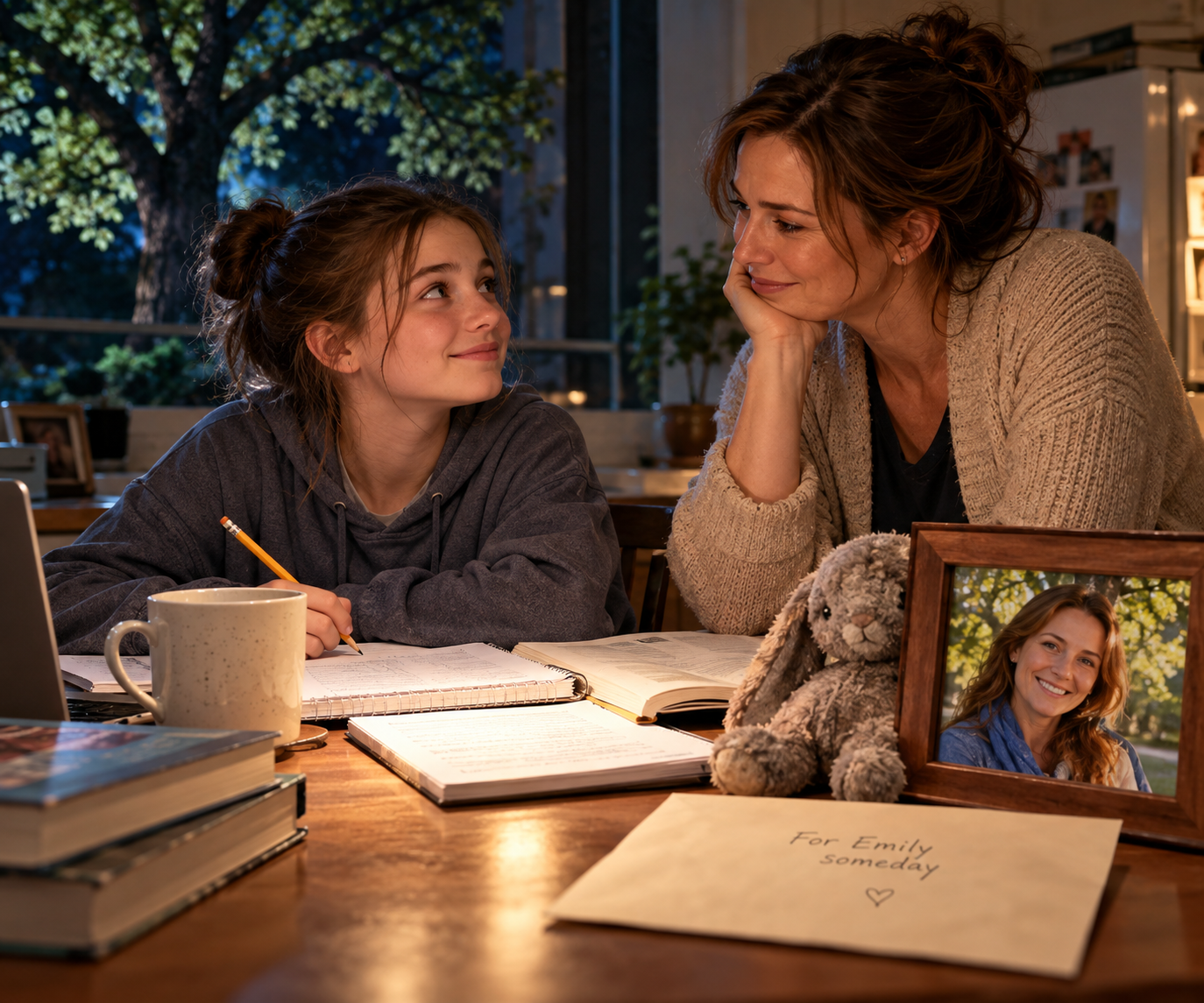
Laura’s photograph stood on the dresser.
Bunny lay beside her.
The red sweater rested folded in a drawer.
Nothing in the room had to be hidden.
Nothing had to be called by a secret name.
Nothing required permission from Thomas.
Jennifer started to leave.
“Aunt Jen?”
She turned.
“Yeah?”
Emily looked at the door.
“Tomorrow I might close it all the way.”
Jennifer smiled gently.
“You can.”
Emily thought.
“Or I might open it.”
“You can do that too.”
Emily nodded.
That was the point.
Not whether the door was open.
Not whether it was shut.
Who decided.
Jennifer left it exactly where Emily had placed it.
Across town, Thomas sat in custody preparing for a trial in which he would no longer control the doorway, the witness, or the story.
For the first time in years, every version would be placed beside the others.
And this time, the truth would not have to whisper alone.
Click here to continue reading: PART 21: The Trial Opened With Thomas’s Oldest Lie, but the First Witness Was the Dispatcher Who Heard Emily Before Anyone Else Could Reach Her
A Child Whispered About a Snake, but the Silence Behind Her Words Made the Dispatcher Hear Something Else
Part 20 of 35