
The question of Laura’s car refused to disappear.
Thomas had driven it to Pine Ridge.
Michael followed in Thomas’s truck.
That arrangement suggested the possibility that Laura’s car was meant to remain there.
If Thomas wanted people to believe Laura left voluntarily, abandoning her car in the woods made little sense.
But if he wanted to hide the vehicle after using it to transport her body, leaving it far from the house might initially have seemed useful.
Then he returned it.
Why?
Sarah asked Michael to reconstruct the drive again.
No accusations.
No new details shared.
Only his memory.
They met in a small interview room with his attorney present.
“What happened after Thomas came back from the trees?”
Michael rubbed his hands together.
“He told me to follow him.”
“Back to Maplewood?”
“Yes.”
“Did you stop anywhere?”
Michael frowned.
“I don’t think so.”
“Take your time.”
He closed his eyes.
“Maybe once.”
“Where?”
“Gas station.”
Sarah’s attention sharpened.
“Which one?”
“Old place on Route 18.”
“Who stopped?”
“Tom.”
“In Laura’s car?”
“Yes.”
“Did you stop too?”
“I pulled in behind him.”
“What did Thomas do?”
“Went inside.”
“Did he buy gas?”
“I don’t remember.”
“Anything else happen?”
Michael opened his eyes.
“He was mad.”
“About what?”
“The car.”
Sarah leaned forward.
“What specifically?”
“He said the warning light came on.”
“What warning light?”
“I don’t know. Engine maybe.”
Daniel asked, “Did he say anything else?”
Michael thought.
“He said, ‘This piece of junk can’t even make one trip.’”
Sarah wrote the quote carefully.
“Then what?”
“He bought something.”
“What?”
“I don’t know. He came back with a plastic bottle.”
“Oil?”
“Maybe.”
That gave them something concrete.
The old gas station had changed ownership but retained tax archives and some historical receipts in storage because of an audit dispute.
It took two days to search them.
One receipt matched.
1:14 a.m.
Engine oil.
Cash purchase.
No customer name.
No camera footage.
But the time fit the return trip.
Sarah stared at the faded paper.
“If the car had mechanical trouble, abandoning it at Pine Ridge might look suspicious or risk being found before he was ready.”
Daniel nodded.
“Or he worried it wouldn’t start later.”
They examined Laura’s vehicle.
Maintenance records showed chronic oil loss.
A mechanic had recommended repairs months before her death.
Laura had postponed them.
The car was unreliable.
That may have changed Thomas’s plan.
Perhaps he intended to leave it somewhere suggesting Laura had driven away.
Then the warning light appeared.
He chose instead to return it home where he could control who saw it.
Daniel leaned against the garage workbench.
“Which created another problem.”
“Her employer knew she owned the car.”
“And Jennifer probably did too.”
“So he covered it.”
The fitted car cover had been purchased two days after Laura vanished.
That receipt had survived in Thomas’s household records.
The defense could say covering a stored vehicle was ordinary.
But in context, the timing mattered.
The more Sarah reconstructed the days after Laura’s death, the more she saw Thomas solving problems one at a time.
Laura’s absence.
Her car.
Her job.
Jennifer.
Emily.
Michael.
Greg.
Each required a different story.
He told the employer Arizona.
He told police voluntary departure.
He told Jennifer Laura wanted no contact.
He told Emily abandonment.
He told Michael she was “gone.”
He told Greg enough to secure help, then tried to keep him silent.
The stories did not match perfectly because they were not designed for a single audience.
They were designed to keep each person from asking the next question.
The prosecution began identifying every contradiction.
They did not intend to flood a jury with minor inconsistencies.
Only those tied to meaningful facts.
Thomas claimed Laura left voluntarily.
Yet her packed escape bag was buried.
He claimed Emily slept.
Multiple independent sources placed her awake.
He claimed Laura moved away.
Her car remained at home.
He suggested nightmares explained Emily’s memory.
He had used that explanation before any outsider challenged him.
He later floated accident.
But his cleanup and disposal behavior began before he called Michael.
That last point mattered greatly.
If Laura’s death was accidental and Thomas simply panicked, why call Greg—a man known for discreet cleanup—before involving anyone else?
Why use a hidden stair route?
Why replace carpet?
Why conceal the lamp at another property?
Why manipulate a child witness?
Panic could explain some of those actions.
The prosecution would argue the pattern showed something more deliberate.
Still, Sarah wanted evidence from before the death itself.
Intent.
Control.
Escalation.
Laura’s digital archive had already shown threats.
Then one of her old coworkers produced something nobody knew existed.
A voicemail.
Not to Jennifer.
To the coworker.
Her name was Megan Brooks.
She had worked the dental clinic front desk beside Laura.
Megan had changed phones several times but saved old voicemails to a computer because one contained her late father’s voice.
While searching backups, she found Laura’s message.
The date was June seventeenth.
One day before Laura died.
Sarah listened.
Laura spoke quietly.
“Meg, I’m sorry to leave this on voicemail. If I’m not at work Monday, don’t believe Tom if he says I quit.”
Sarah felt Daniel shift beside her.
Laura continued.
“I’m taking Emily to my sister’s.”
A breath.
“He knows I’ve been documenting things.”
Another pause.
“He took my keys tonight and stood in front of the door.”
Laura’s voice dropped further.
“He said if I tried to leave with her, he’d stop me himself.”
The voicemail ended.
Megan covered her face.
“I forgot about this.”
Sarah turned off the recording.
“You didn’t know it would matter.”
“I should’ve done something.”
“What did you do at the time?”
“I texted her.”
“Do you still have it?”
Megan searched.
The message remained in an archived conversation.
Are you safe?
Laura replied:
For tonight.
Then:
Tomorrow I’m done.
Sarah documented both.
The voicemail strengthened the pre-death pattern.
Thomas physically blocked Laura from leaving the house the night before.
He threatened to stop her himself.
Laura believed enough danger existed to create records with other people.
This was not a spontaneous marital argument without history.
The conflict had been escalating.
At Jennifer’s house, Emily had started asking about the trial.
Not legal details.
Practical ones.
“Will Daddy be there?”
Naomi answered carefully.
“Probably, if you ever have to speak in court.”
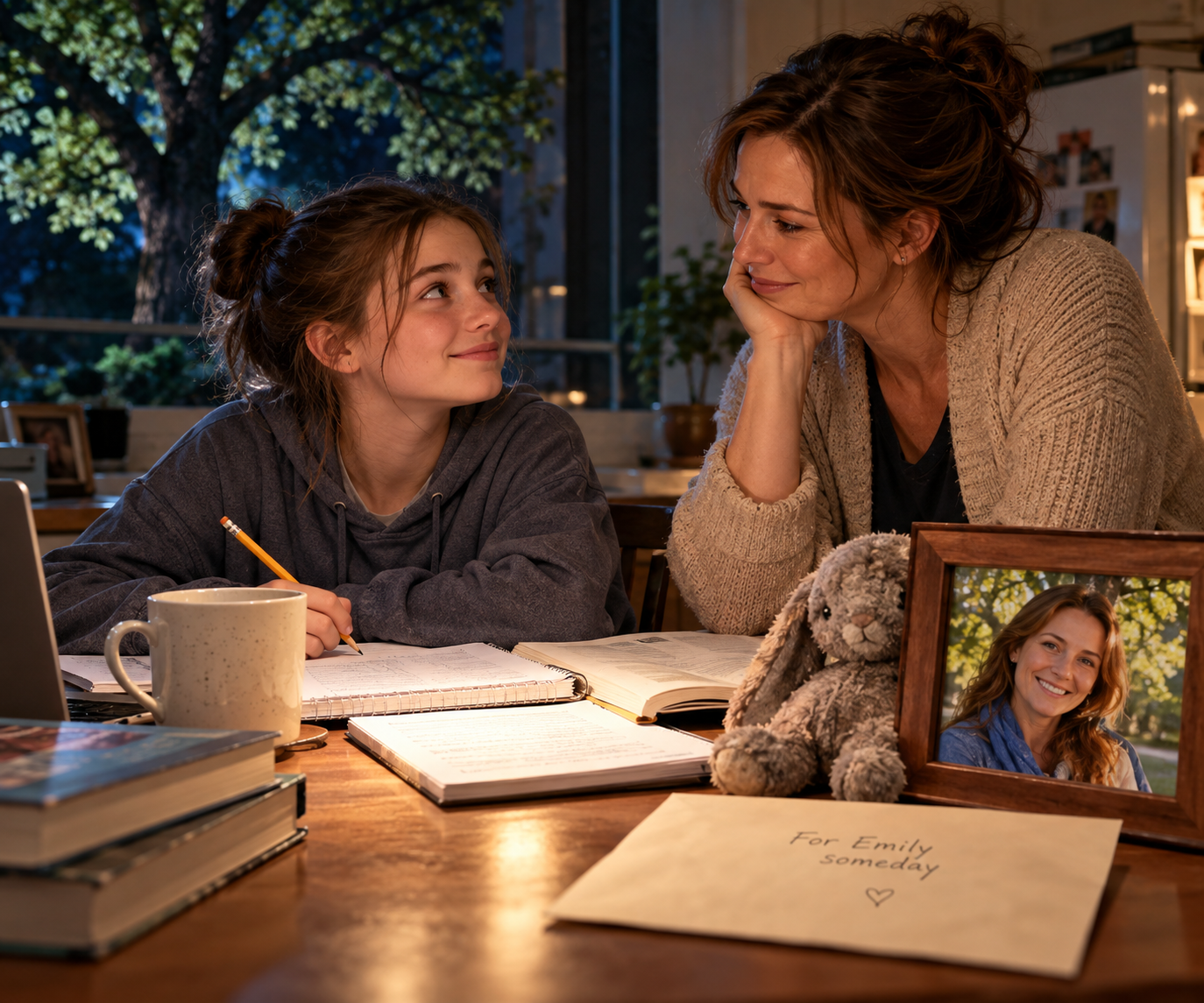
Emily’s fingers tightened around Bunny.
“Can he look at me?”
“That depends on how the court handles things.”
“Can I look somewhere else?”
“Yes.”
Emily nodded.
“Can I say I don’t remember?”
“If that’s true.”
“What if I remember but don’t want to say?”
Naomi did not lie.
“You may still be asked questions. But the adults responsible for the process should work to protect you as much as possible.”
Emily stared at the floor.
“I don’t want him thinking I ruined everything.”
Naomi leaned forward slightly.
“What do you think you ruined?”
“His life.”
“Who told you that?”
Emily did not answer.
Naomi waited.
Finally:
“He did.”
“When?”
“Before.”
“Before the 911 call?”
Emily nodded.
“What did he say?”
“That if people found out our secrets, he’d go away and it would be because of me.”
Naomi let the silence sit.
Emily whispered, “And then he did.”
The guilt was immediate and childlike.
A direct connection between speaking and losing a parent, even an abusive one.
Naomi said, “The adults decide what consequences follow from what adults do.”
Emily looked unconvinced.
Naomi continued.
“You did not create his choices.”
“But I called.”
“Yes.”
“I told.”
“Yes.”
“And now he’s gone.”
“Yes.”
Naomi did not deny the sequence.
She changed the meaning.
“Asking for help did not create the things you needed help from.”
Emily stared at Bunny.
That took longer.
Recovery often did.
At the station, Daniel received another update on Thomas’s financial behavior after Laura disappeared.
He had applied for sole control of a joint investment account six weeks later.
The supporting form stated:
Spouse abandoned household and cannot be located.
Sarah read the line.
“Couldn’t be located.”
“While her body was where he left it.”
Daniel’s voice carried anger.
Sarah looked at him.
“Keep the wording clean.”
He nodded.
The prosecution would say Thomas knew exactly why Laura could not be located.
The defense might argue the form merely repeated the cover story.
Either way, it showed Thomas financially benefited from the disappearance.
He gained sole control of funds.
Maintained custody of Emily.
Kept the house.
Eliminated the immediate threat of Laura taking Emily away.
That supplied another potential motive.
But Sarah remained cautious.
Financial benefit did not prove murder.
It supported context.
Then the bank records revealed something else.
The five-thousand-dollar withdrawal made three months after Laura’s death had not been signed by Thomas.
The signature looked like Laura’s.
Forensic document examination concluded it was likely forged.
Thomas had submitted the withdrawal slip in person using authorization from the joint account.
The signature imitation was crude but sufficient at the time.
Now the bank had archived a teller note.
Customer states wife is traveling indefinitely.
Sarah stared at the words.
Even months later, Thomas was actively maintaining Laura’s fictional life.
Not simply avoiding questions.
Using it.
Profiting from it.
Extending it.
The lie had become infrastructure.
Back at Maplewood, forensic specialists revisited the garage floor.
Old cleaning chemicals and years of use complicated testing.
But beneath a storage cabinet, a protected stain reacted to blood testing.
DNA came back as Laura.
The location sat near the rear access from the hidden stair route.
Now the movement path had three points.
Hallway.
Service stair.
Garage.
Laura’s blood marked each.
Greg’s van also contained her blood.
The sequence looked increasingly physical.
Daniel stood in the garage doorway.
“Greg may have helped move her from the hall to here.”
Sarah looked at the stain.
“Then possibly into his van.”
“But she ended up in Laura’s car later.”
Sarah nodded.
That could mean Greg transported Laura briefly.
Maybe out of the house.
Maybe to another location.
Then returned her.
Or perhaps Laura’s blood entered his van from contaminated materials rather than the body itself.
They needed more.
Greg’s widow remembered he had gone out again the following afternoon.
“Was that unusual?”
“No.”
“Did he say where?”
“He said he had to dump something.”
“What?”
“Carpet.”
Sarah went still.
“Did he say where?”
“A construction skip somewhere.”
The old hallway carpet.
Possibly.
Records from a demolition site Greg worked on that week showed an open debris container.
Long gone.
Nothing recoverable.
But the timing fit Thomas’s carpet replacement.
Again, Greg had helped erase the house.
Not the whole crime.
Pieces.
Sarah added it to the timeline.
Then she noticed a pattern.
Thomas had not asked one person to do everything.
Greg handled cleanup.
Michael handled transportation.
Emily was told she dreamed.
Jennifer was cut off.
Employers received a relocation story.
Police received voluntary disappearance.
Each person possessed only part of the truth.
That compartmentalization may have been the reason the story survived three years.
Nobody except Thomas could see the entire sequence.
Until Emily called 911.
That call did more than expose what was happening to her.
It reopened every locked compartment.
One frightened voice forced strangers to compare the stories Thomas had kept separated.
And the stories did not survive contact with one another.
Click here to continue reading: PART 19: Laura’s Last Voicemail Gave Prosecutors a Motive, but Emily’s Guilt Became the Hardest Damage Thomas Had Left Behind
A Child Whispered About a Snake, but the Silence Behind Her Words Made the Dispatcher Hear Something Else
Part 18 of 35


One Comment on “PART 18 – Thomas’s Pine Ridge Plan Changed Midway Through the Night, and a Forgotten Gas Receipt Explained Why He Brought Laura’s Car Back”