Sentencing came six weeks later.
The delay gave everyone time to prepare statements.
It did not make the task easier.
Jennifer received a packet explaining victim-impact procedures.
She read it once.
Then left it on the kitchen counter for two days.
The pages asked questions that seemed impossible.
How had Laura’s death affected her?
What had been lost?
What consequences continued?
How did she want the court to understand the harm?
Jennifer could have written hundreds of pages.
Instead she kept staring at the first blank line.
Emily was not required to make a statement.
Her therapist strongly emphasized that she did not owe the court one.
Naomi told her that directly.
“You testified already.”
Emily nodded.
“You don’t have to say anything at sentencing.”
“What happens if I don’t?”
“The judge still decides.”
“Will Daddy think I’m scared?”
Naomi answered carefully.
“You don’t control what he thinks.”
Emily frowned.
“I know.”
But the question still mattered to her.
Naomi waited.
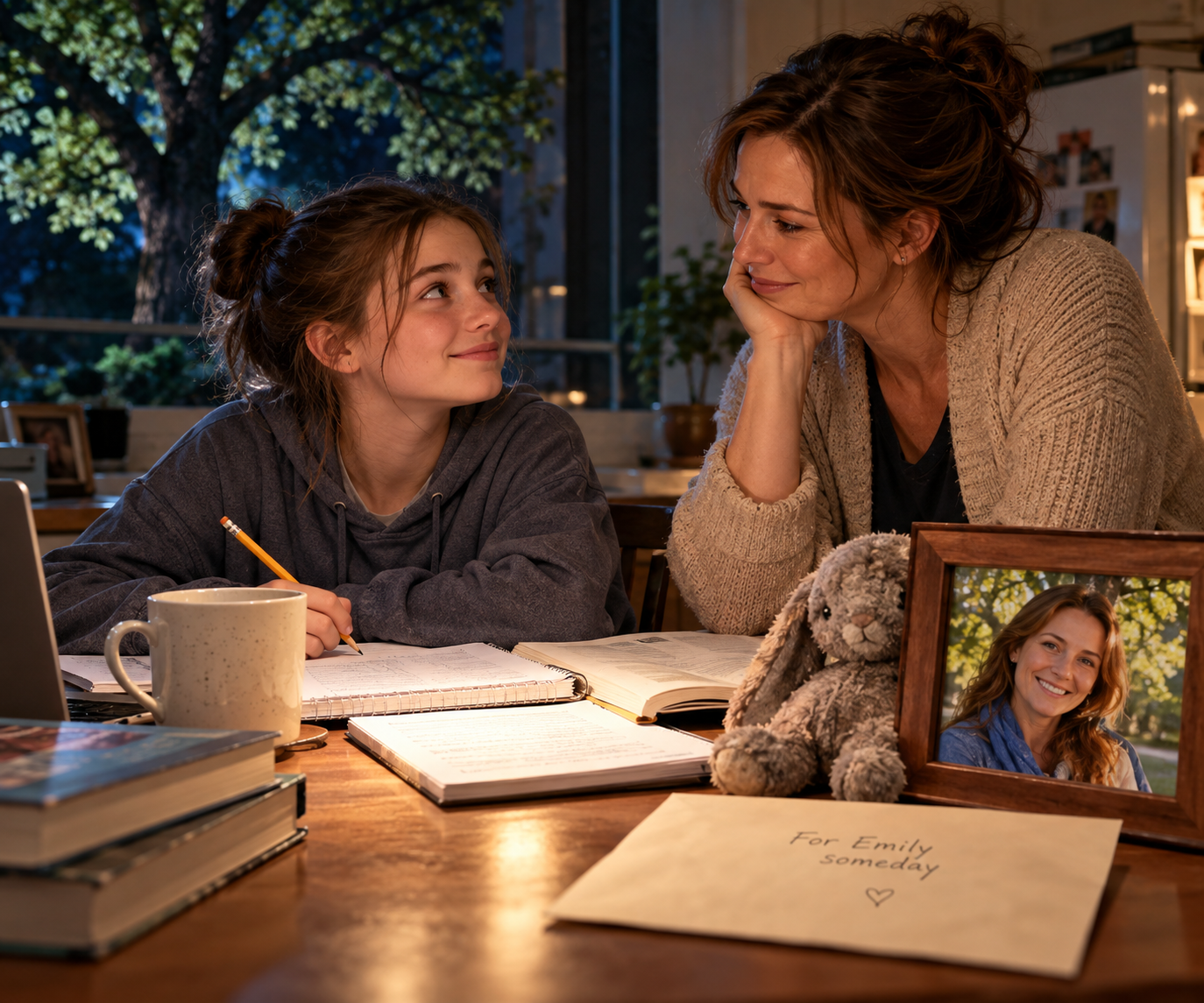
Emily picked at Bunny’s ear.
“What is a victim statement?”
“It lets someone explain how a crime affected them.”
Emily looked puzzled.
“Which crime?”
Naomi paused.
That was the problem.
Laura’s murder.
The years of lies.
The abuse allegations.
The manipulation.
The separation from Jennifer.
Emily’s life did not fit neatly into one case number.
“You could talk about whatever the court allows and whatever you want to say.”
Emily thought.
“Would Daddy hear it?”
“Yes.”
That changed her expression.
Naomi asked, “Does that make you want to do it or not do it?”
“I don’t know.”
“Then you don’t decide today.”
At home, Jennifer eventually began writing.
She avoided describing Thomas.
Instead she described Laura.
Her laugh.
Her habit of buying notebooks and using only half of each.
The way she cut sandwiches diagonally because Emily claimed squares tasted wrong.
Her dislike of the cream hallway lamp.
Jennifer stopped when she wrote that.
Then laughed through tears.
Laura really had hated that lamp.
The detail felt almost disrespectfully ordinary.
Then Jennifer realized ordinary was exactly what Thomas had stolen.
Not just Laura’s life.
All the unremarkable years she should have had.
School pickups.
Bad haircuts.
Arguments with teenage Emily.
Birthdays.
Bills.
Lazy Saturdays.
Things nobody noticed until they were gone.
Jennifer wrote that.
Then she wrote about the three years Thomas forced Laura’s family to wonder whether she had chosen silence.
“He didn’t only take her life,” Jennifer wrote. “He made us question the love she had already given us.”
She stopped again.
That sentence stayed.
Emily made her decision four days before sentencing.
She told Naomi she wanted to write something.
Not read it aloud.
Just write.
Naomi agreed.
“What do you want the judge to understand?”
Emily thought.
“That Daddy said Mommy left because of me.”
Naomi waited.
“And she didn’t.”
“Yes.”
Emily took a sheet of lined paper.
Her handwriting was careful.
My dad told me my mom left because she didn’t want us. I believed him sometimes and I felt bad at her.
She stopped.
Naomi did not correct grammar.
Emily continued.
Now I know she was trying to take me somewhere safe.
Another pause.
I want the judge to know I was scared a lot.
Then:
I don’t want to be scared about going back.
Emily looked at Naomi.
“Is that enough?”
“It’s enough if it says what you want.”
Emily read it again.
Then added one final sentence.
I want to live with Aunt Jennifer and go to school and not have secrets like that anymore.
She put down the pencil.
“That’s all.”
The statement was reviewed for admissibility and provided through the appropriate process.
Emily did not attend sentencing.
She went to school.
Science class.
Exactly as she wanted.
Jennifer did attend.
So did Sarah and Daniel.
Thomas entered in jail clothing this time.
No dark suit.
No attempt at ordinary professional appearance.
His legal team sat beside him.
Post-trial motions had been denied.
An appeal was expected later.
Sentencing still proceeded.
The prosecutor presented aggravating factors permitted under the law.
Laura’s vulnerability during the domestic conflict.
Concealment.
The extensive deception afterward.
Manipulation of circumstances surrounding the death.
The impact on Emily and family.
The defense presented mitigating arguments.
Thomas’s lack of prior serious convictions.
Employment history.
Letters from people who knew him outside the home.
The defense asked the judge not to treat allegations from separately pending matters as if already adjudicated.
The judge agreed with that legal boundary.
Sentencing would rest on the convictions before the court and properly established factors.
That distinction mattered.
Jennifer read her statement.
Her voice shook during the first paragraph.
Then steadied.
She described Laura alive.
Not the grave.
Not the autopsy.
Laura laughing in a grocery-store parking lot because Emily had secretly filled the cart with pudding cups.
Laura calling Jennifer late at night to complain about their mother.
Laura planning to start over.
The courtroom listened.
Then Jennifer described the lie.
“For three years, I wondered whether my sister hated us enough to disappear.”
She looked at Thomas.
“She did not.”
Thomas’s expression remained controlled.
Jennifer continued.
“You made her silence look voluntary.”
She looked back at the judge.
“That was another harm.”
Her voice almost broke.
“But I do not want my niece’s future to be measured only by what sentence he receives.”
Sarah looked up.
Jennifer continued.
“Emily needs a life that is larger than this courtroom.”
She finished without asking for a specific number of years.
That surprised some people.
Not Sarah.
Jennifer had never wanted vengeance to become another thing Thomas controlled.
The prosecutor then read Emily’s short statement with permission.
The courtroom changed at her words.
I want to live with Aunt Jennifer and go to school and not have secrets like that anymore.
Thomas looked down.
No one knew why.
The defense attorney later emphasized rehabilitation arguments and legal proportionality.
The prosecutor emphasized accountability and public safety.
Then the judge spoke.
He reviewed the evidence and convictions.
He described the killing as inseparable from the conduct that followed because Thomas had spent years concealing Laura’s fate and controlling the narrative around Emily.
He also stated clearly that punishment could not restore what was lost.
Then he imposed the sentence.
A lengthy prison term.
Sufficient, under the applicable law, to keep Thomas incarcerated for decades before any realistic possibility of release consideration, subject to appellate outcomes and other proceedings.
Jennifer heard the number.
She had expected it to feel enormous.
Instead it felt abstract.
Years.
Numbers.
Calendars Emily would grow through.
Thomas would become older behind walls.
Laura would remain the age she died.
After court, reporters asked Jennifer whether the sentence brought closure.
She stopped.
Sarah stood several feet away.
Jennifer answered:
“No.”
The reporters waited.
“It brings a sentence.”
Then she walked away.
Sarah almost smiled.
Not because the moment was happy.
Because it was accurate.
Closure had become one of those words people used when they wanted grief to behave like a door.
Jennifer knew better.
She drove home.
Emily came through the front door shortly after four.
“How many years?”
Jennifer told her in age-appropriate terms.
Emily tried to calculate.
“How old will I be?”
Jennifer interrupted gently.
“You don’t have to count your life against his sentence.”
Emily stopped.
“But if he gets out?”
“There are legal processes. And the protections around you are separate.”
Emily nodded.
She seemed relieved.
Then she asked, “Did they read my letter?”
“Yes.”
“Did Daddy hear it?”
“Yes.”
“What did he do?”
“Looked down.”
Emily thought.
“Maybe he was pretending.”
Jennifer did not speculate.
“Maybe.”
Emily dropped her backpack.
“Can Lily come over Saturday?”
Jennifer blinked.
“From school?”
“Yes.”
“She wants to see Bunny.”
Jennifer smiled.
“Sure.”
Emily grinned briefly.
Then ran upstairs.
The transition was so abrupt Jennifer almost laughed.
Sentencing.
Prison.
A friend visiting Saturday.
That was life insisting on becoming ordinary again.
Saturday arrived.
Lily came over carrying a board game.
Emily showed her the moon night-light.
The kitchen tree.
Bunny.
Not Laura’s case file.
Not court recordings.
Not the bedroom door history.
Children could be curious, but Lily knew only that Emily lived with her aunt and her mother had died.
That was enough.
They played on the living-room floor.
Jennifer made grilled cheese.
At one point Lily asked why Bunny’s ear bent.
Emily looked at it.
For years she had gripped that ear during fear.
Adults had offered to straighten it.
Emily had always refused.
She answered:
“It’s supposed to be like that.”
Lily shrugged.
“Cool.”
Then rolled the dice.
Jennifer turned away so Emily would not see her crying.
At the station, Sarah was completing the sentencing update when Claire’s card arrived through official channels.
Emily’s card.
Sarah did not open it.
It was addressed to Claire.
She walked it personally to dispatch.
Claire read it during a break.
Thank you for staying on the phone when I was scared.
I was telling the truth even when I used the wrong word.
Claire sat motionless.
Her coworker looked over.
“You okay?”
Claire nodded.
Then shook her head.
Then laughed softly.
“I don’t know.”
She read the card again.
Emergency dispatchers rarely learned what happened afterward.
Calls moved on.
Ambulances arrived.
Officers took over.
Another line rang.
The ending disappeared beyond the console.
This time, Claire knew.
She placed the card inside her locker.
Not as a trophy.
As a reminder.
Words from frightened people were not always precise.
The job was not to demand perfect language.
The job was to hear what the fear was trying to say.
Click here to continue reading: PART 31: Months After the Trial, Emily Returned to Maplewood for One Last Visit and Found the House Smaller Than the Memory She Carried
A Child Whispered About a Snake, but the Silence Behind Her Words Made the Dispatcher Hear Something Else
Part 30 of 35