Five years passed.
Not quickly.
Not neatly.
Time did not heal everything because time was not a person and could not make decisions.
People did.
Emily grew.
Jennifer stayed.
Naomi helped until therapy became occasional rather than weekly.
Claire kept answering emergency calls.
Sarah remained a detective.
Daniel returned to patrol for a time and later became a field-training officer.
María continued working cases involving children and became known among younger officers for one repeated instruction:
Do not make a frightened child tell the story faster than they can survive telling it.
Thomas remained incarcerated.
His later legal challenges did not undo the central conviction.
Court notices still arrived occasionally.
Jennifer read them first.
Emily decided how much she wanted to know.
Sometimes the answer was everything.
Sometimes none.
That choice mattered.
At thirteen, Emily no longer carried Bunny everywhere.
He remained on her bed.
Gray fur worn smooth.
One ear permanently folded.
She had stopped explaining it.
People who mattered accepted the rabbit exactly as he was.
Laura’s letter remained in a protective sleeve inside Emily’s desk.
She read it once or twice a year.
Not as scripture.
As her mother’s imperfect advice.
The line that mattered most changed as Emily grew.
At eight:
tell someone until somebody listens
At ten:
you are not responsible for keeping grown-up secrets that hurt you
At thirteen:
being your mom does not make me right all the time
Emily loved that one.
It made Laura feel human.
Not a saint created by tragedy.
A mother.
Funny.
Sometimes impatient.
Bad at voices.
Opinionated about sandwiches.
Hateful toward lemon cake.
Terrible taste in lamps, according to Emily.
Though Jennifer always reminded her Thomas had chosen the lamp.
That made Emily hate it more.
The Maplewood house sold.
A new family moved in.
Emily learned by accident.
She searched the address online during a school project about neighborhood property history.
Photographs showed a renovated kitchen.
Different carpet.
A nursery in what had once been her bedroom.
She stared at the listing for several minutes.
Then closed it.
Jennifer asked whether she was okay.
“Yeah.”
“Want to talk?”
“No.”
Then, two hours later:
“It’s weird that somebody has a baby in my room.”
Jennifer waited.
Emily continued.
“But it’s just a room.”
Exactly.
The house had become architecture again.
Not a container holding the past.
Pine Ridge changed too.
Laura’s burial site had been restored after the investigation.
The family eventually placed a small memorial bench near an accessible public trail, far from the exact recovery location.
Not because Emily wanted to honor where Laura had been hidden.
Because Jennifer wanted to reclaim the landscape from secrecy.
The plaque read only:
For Laura, who was trying to get home.
Emily chose the words.
At thirteen she visited the bench for the first time.
No Bunny.
No therapist.
Only Jennifer.
They sat beneath tall trees.
Wind moved through the leaves.
Birds sounded offensively cheerful.
Emily looked toward the trail.
“Is it near here?”
Jennifer understood.
“The exact place?”
“Yes.”
“Not very far.”
Emily nodded.
“Do you know where?”
“Yes.”
“Don’t show me.”
“I won’t.”
They sat.
Emily touched the edge of the plaque.
“For Laura, who was trying to get home.”
Jennifer said, “You came up with that.”
“I know.”
“You still like it?”
Emily considered.
“Yes.”
Then:
“Home wasn’t our house.”
Jennifer looked at her.
“No.”
Emily stared through the trees.
“I used to think home meant where your stuff was.”
“What does it mean now?”
Emily rolled her eyes.
“That sounds like a therapist question.”
Jennifer laughed.
“Fair.”
Emily kicked lightly at the gravel.
After a minute she answered anyway.
“Where you don’t have to lie to stay.”
Jennifer looked away because tears had arrived too quickly.
Emily noticed.
“You still cry at everything.”
“Apparently.”
They stayed until late afternoon.
Before leaving, Emily placed no flowers.
No symbolic object.
Nothing needed to remain in the woods.
Laura already had a grave.
A name.
A family.
A story restored from Thomas’s version.
The bench was enough.
That autumn, Emily’s school held a community-safety program.
Police officers.
Firefighters.
Paramedics.
A dispatcher.
When Emily saw the emergency communications booth, she stopped.
Jennifer, volunteering at another table, watched from a distance.
A younger dispatcher—not Claire—showed students how location information appeared during calls.
A boy asked whether 911 operators could always understand people.
The dispatcher said:
“No. Sometimes people are scared or can’t explain what’s happening very well.”
Emily looked toward the floor.
The dispatcher continued.
“We ask questions and do our best to listen.”
Emily stayed until the group moved on.
She did not introduce herself.
She did not tell the story.
She did not owe strangers the connection.
Later she texted Claire.
She had Claire’s number now, obtained years after the case through appropriate personal contact once Emily was older and boundaries had changed.
Saw a dispatcher at school. She said you don’t always understand the caller at first.
Claire replied:
True.
Emily typed:
Still weird that one wrong word started everything.
Claire answered:
Wasn’t the word. It was that you called.
Emily stared at the message.
Then wrote:
And you listened.
Claire replied:
That too.
Emily put the phone away.
The phrase that once defined her story was no longer Daddy’s snake.
That had been Thomas’s language.
His attempt to make harm difficult to name.
The story belonged instead to the act that defeated that language.
Emily called.
Someone listened.
Then other people kept listening.
Not perfectly.
The first welfare check had failed.
Adults missed signs at school.
Jennifer had been pushed away.
Michael had stayed silent.
Greg helped conceal what he should have reported.
Systems made mistakes.
People made mistakes.
Laura herself had waited longer than she wished before seeking outside help.
Nothing about the eventual outcome erased those failures.
But the final chain began when Emily reached beyond the person controlling the story.
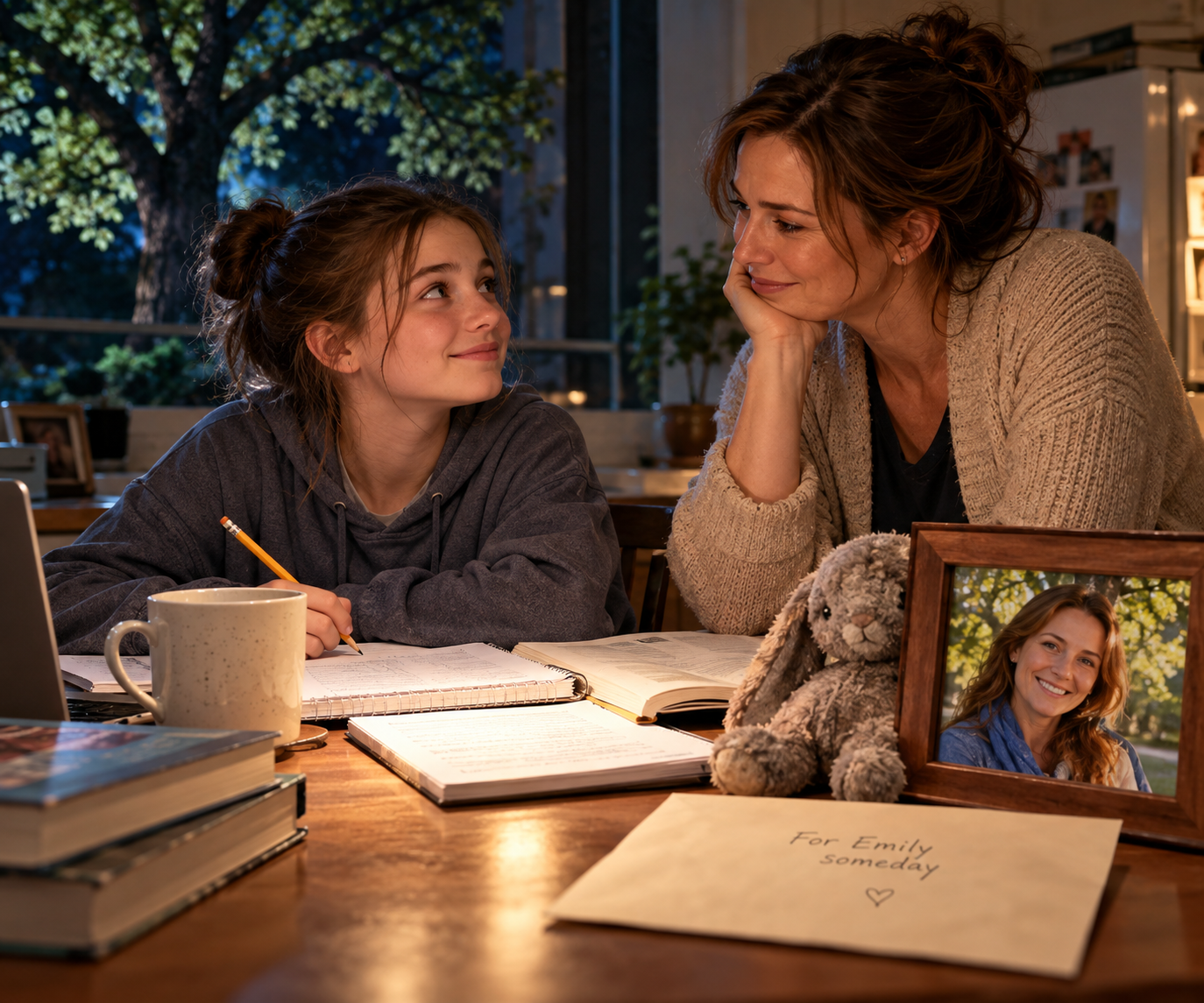
One night, years after the trial, Jennifer found Emily in the kitchen at nearly midnight.
She was studying.
High school entrance exams.
Coffee sat beside her even though Jennifer had repeatedly complained she was too young for it.
“You’re awake.”
Emily looked up.
“So are you.”
“I heard something.”
“Me dropping a book.”
Jennifer nodded toward the coffee.
“You’re going to regret that.”
Emily smiled.
“You sound old.”
“I am old.”
“No.”
“Go to bed.”
“In a minute.”
Jennifer started toward the hallway.
Emily called:
“Aunt Jen?”
Jennifer turned.
“Thank you.”
“For what?”
Emily shrugged.
“Everything.”
Jennifer leaned against the doorway.
“That’s suspiciously vague.”
Emily smiled.
“I was thinking about Mom.”
Jennifer waited.
“And the call.”
“Okay.”
“I used to think my life got divided that night.”
“Before and after?”
“Yes.”
Emily closed the textbook.
“But that’s not really true.”
“How so?”
“There were lots of afters.”
Jennifer listened.
“After the call. After I left the house. After they found Mom. After court. After the verdict. After the appeal.”
She tapped the pencil against the table.
“Then school. Lily. Therapy. The tree. Stuff.”
Jennifer smiled.
“Stuff is important.”
Emily laughed.
“You know what I mean.”
“I do.”
Emily looked toward the dark kitchen window.
“I thought everything after would always be about what happened.”
Jennifer sat across from her.
“And?”
“It isn’t.”
That was the ending no court could order.
No sentence could guarantee.
No investigator could document into existence.
The central conflict had been resolved legally years earlier.
Thomas killed Laura.
He concealed her body.
He built lies around her disappearance.
He manipulated Emily’s memories and fear.
The 911 call exposed the immediate danger and opened the path that eventually revealed Laura’s fate.
Those facts mattered.
But Emily’s life could not remain an epilogue to Thomas’s crimes.
She had classes.
Friends.
Arguments with Jennifer.
Bad coffee.
A driver’s permit she would later fail the first time because she rolled through a stop sign.
She would cry over things unrelated to trauma.
Laugh at things Laura never got to see.
Make choices Laura might have disagreed with.
That too belonged to the outcome.
Years earlier, Laura had written:
If I ever make you feel like you have to choose between loving me and telling the truth, choose the truth.
Emily eventually understood the sentence more broadly.
Love did not require silence.
Family did not require obedience to harm.
Truth did not belong only to adults with perfect vocabulary.
And asking for help was not betrayal.
Near one in the morning Jennifer pointed toward the stairs.
“Bed.”
Emily groaned.
“Five minutes.”
“Now.”
Emily smiled.
“Think carefully, Em.”
Jennifer froze.
The old phrase.
Thomas’s phrase.
For half a second the kitchen changed.
Emily saw it happen.
Her smile disappeared.
“I’m sorry.”
Jennifer shook her head.
“No.”
She sat back down.
“Don’t apologize for words he used.”
Emily looked uneasy.
“I didn’t mean—”
“I know.”
Jennifer thought.
Then said:
“But maybe we retire that sentence.”
Emily nodded.
“Yeah.”
They sat quietly.
The moment passed.
Not erased.
Passed.
That was another difference.
The past could enter a room without taking it over permanently.
Jennifer stood again.
“Go to bed.”
Emily pointed at her.
“Much better.”
Jennifer laughed.
Emily gathered her books.
At the staircase she stopped and looked toward the kitchen window.
Outside, Laura’s maple tree moved slightly in the wind.
It had grown enormously.
Branches reached above the roofline.
Emily remembered being five beneath it.
A photograph she had once forgotten existed.
Her mother behind the camera.
A safe afternoon before danger narrowed their lives.
Laura had later chosen this house as the place she wanted to bring Emily.
She never completed the trip.
Emily had.
That fact no longer made her feel only grief.
It made the house feel connected to Laura without belonging to the tragedy.
Upstairs, Emily entered her bedroom.
Bunny remained against the pillow.
Laura’s photograph sat on the desk.
The letter rested in its sleeve inside the drawer.
She closed the door.
All the way.
No test.
No milestone.
She wanted privacy.
That was enough.
On another night she might leave it open.
That would be enough too.
Downstairs Jennifer turned off the kitchen light.
The tree disappeared into darkness beyond the glass.
Across town, emergency calls continued to reach dispatch.
Some obvious.
Some confused.
Some silent.
Claire’s old headset had long since been replaced.
The system had been upgraded.
The console looked different from the one Emily once imagined as something enormous.
Yet the essential act had not changed.
Someone called.
Someone answered.
Years earlier, one of those callers had been an eight-year-old girl using a word that did not explain enough.
The dispatcher did not demand better language.
She listened.
Police came.
The closed house opened.
A hidden crime surfaced.
Laura came home to her family under her own name.
Thomas’s stories lost their power.
And Emily grew beyond the night she first reached for the phone.
The call had turned everything.
But it did not become everything.
That was the true outcome.
Not simply that a murderer was convicted.
Not simply that a missing mother was found.
Not simply that an abused child was believed.
The ending was that Emily’s future stopped belonging to the man who had tried to control her past.
And long after the recording went silent, that was the part of the story that continued.
The End
Read more original stories on Feel Every Story.
A Child Whispered About a Snake, but the Silence Behind Her Words Made the Dispatcher Hear Something Else
Part 35 of 35