The lockbox was not opened at Pine Ridge.
Sarah insisted on preserving it properly.
Photographs documented its position among the exposed roots. Soil samples were collected. The box was bagged and transported to the lab where it could be examined without sacrificing fingerprints, trace material, or anything trapped around the lock.
Daniel understood the impatience around him.
Everyone wanted to know what was inside.
But urgency had already cost Laura three years.
Another careless hour would not help her.
The search at Pine Ridge continued.
No human remains were found that morning.
No obvious burial site.
No weapon.
No single object that transformed suspicion into certainty.
The absence disappointed some members of the team.
Sarah did not let it.
“You don’t search to confirm what you hope is there.”
She said it quietly during the afternoon briefing.
“You search to document what actually exists.”
The duffel existed.
Laura’s possessions existed.
The lockbox existed.
Michael had independently directed investigators to the site.
Those facts were enough to move forward.
At the laboratory, a technician photographed every surface of the box before touching the lock.
The exterior showed corrosion and soil staining.
A few partial prints were recovered, though their quality was uncertain.
Trace testing would take time.
The lock itself was simple.
Once documentation was complete, technicians opened it.
Sarah and Daniel observed.
Inside were papers sealed in plastic sleeves.
A passport.
Social Security documents.
A certified copy of Laura’s birth certificate.
Emergency cash.
Several photographs of Emily.
And a handwritten notebook.
Sarah stared at the contents.
This was not random storage.
It resembled an escape kit.
A collection of documents someone might prepare if she planned to leave quickly.
The notebook began almost eighteen months before Laura disappeared.
Most entries were ordinary.
Bills.
Grocery lists.
Emily’s school appointments.
Phone numbers.
Then the tone changed.
Laura had begun recording incidents involving Thomas.
Not every day.
Not even every week.
Only certain moments.
April 3 — checked phone again. Angry about Jen texting.
April 19 — said if I ever tried to take Emily he’d make sure I never saw her again.
May 7 — hid keys. Said I was too emotional to drive.
May 29 — grabbed wrist. No mark next morning.
Sarah read without speaking.
Daniel stood beside her.
A later entry said:
June 12 — told Jen I’m leaving. Need copies of everything first.
Then:
June 16 — bag ready in trunk.
June 17 — he asked why I changed bank password. I lied.
The final dated entry was June 18.
The day Laura vanished.
I think he knows.
Sarah read the sentence twice.
Below it was another line.
If anything happens, call Jennifer. Do not believe—
The page ended there.
Not naturally.
A section had been torn out.
Daniel leaned closer.
“You see the edge?”
“Yes.”
The next page began with an unrelated grocery list dated weeks earlier, apparently inserted out of chronological order because Laura used the notebook from both ends.
Sarah studied the torn binding.
“How many pages missing?”
“Could be one. Could be several.”
The technician photographed it.
No one touched the torn fibers unnecessarily.
Daniel looked at the notebook.
“If Thomas found this box, he may have found the journal.”
“Maybe.”
“He could’ve removed something.”
“Maybe.”
Daniel accepted the correction.
They would test.
They would compare.
They would not build certainty out of possibility.
The cash inside the box totaled twenty-eight hundred dollars.
Jennifer had told investigators Laura planned to stay with her.
The documents, money, and duffel gave that plan physical form.
Laura had not simply spoken impulsively about leaving.
She had prepared.
Then those preparations ended up hidden in the woods.
Sarah called Jennifer to arrange another interview.
She did not describe every discovery over the phone.
Only enough to ask whether Laura had ever mentioned a lockbox or notebook.
Jennifer answered immediately.
“The silver box?”
“What did it look like?”
“Gray metal. Black handle. Cheap little thing.”
“Where did Laura keep it?”
“Bedroom closet.”
Sarah looked toward Daniel.
That matched.
“Did you know what was inside?”
“Documents, I think.”
“Did Laura ever mention a notebook?”
Jennifer paused.
“Yes.”
Sarah sat straighter.
“When?”
“Before she disappeared.”
“What did she say?”
“That she started writing things down.”
“What things?”
“What Thomas did.”
“Why?”
Jennifer’s voice grew strained.
“Because he’d deny conversations. He’d tell her she remembered things wrong.”
“Did she say she planned to use the notebook legally?”
“She talked about custody.”
Sarah wrote the word.
“Did she believe Thomas would fight her for Emily?”
“She believed he’d do anything to stop her leaving.”
“Did she ever tell you she feared he might kill her?”
Silence.
Then Jennifer said, “Not in those words.”
Sarah waited.
“She said, ‘If he realizes I’m serious, I don’t know what he’ll do.’”
Sarah documented the distinction.
Fear was not prediction.
Still, the notebook now corroborated Jennifer’s account that Laura was preparing to leave.
At the temporary placement facility, Emily was told that Aunt Jennifer was coming.
Her reaction surprised Rachel.
Emily did not become excited.
She became frightened.
“Daddy said she hates me.”
Rachel sat nearby.
“Your aunt?”
Emily nodded.
“What did he say?”
“That she didn’t want to see us anymore.”
Rachel resisted saying Thomas had lied.
Even when adults believed a statement was false, directly forcing that conclusion on Emily could complicate her emotional processing and future testimony.
Instead she said, “Jennifer asked to see you.”
Emily looked up.
“She did?”
“Yes.”
“Today?”
“If you want.”
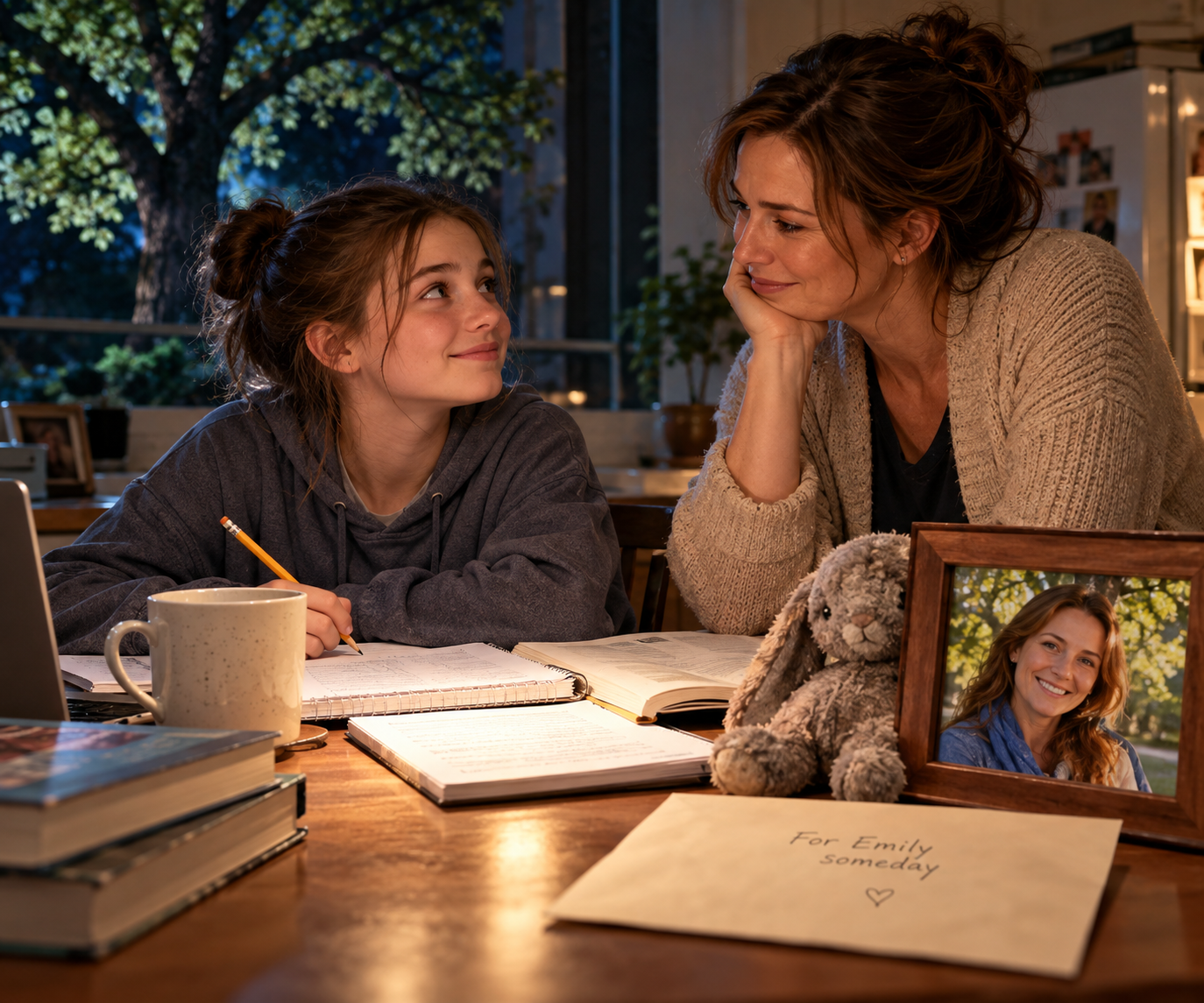
Emily hugged Bunny.
“Can I say no?”
“Yes.”
The answer came immediately.
Emily thought for nearly a minute.
Then she whispered, “I want to see her.”
Jennifer entered slowly.
She did not run toward Emily.
She did not cry dramatically even though her eyes filled the instant she saw her niece.
“Hi, Em.”
Emily stared.
Jennifer stopped several feet away.
“You got tall.”
Emily looked at Bunny.
Jennifer smiled through tears.
“You still have him.”
Emily looked up.
“You remember Bunny?”
“I gave him to you.”
The girl’s face changed.
“You did?”
Jennifer nodded.
“For your fifth birthday. Your mom said you carried him everywhere.”
Emily looked at the rabbit as though seeing an object from a different life.
“Daddy said Grandma gave him.”
Jennifer froze.
Rachel watched carefully.
Jennifer caught herself.
“Maybe I’m remembering wrong.”
She was not, but Rachel appreciated the restraint.
Emily studied her aunt.
Then she asked, “Do you hate me?”
Jennifer’s composure broke.
Not loudly.
Her mouth trembled.
She shook her head.
“No.”
Emily waited.
Jennifer crouched.
“I never hated you.”
“Daddy said you stopped calling.”
Jennifer looked briefly toward Rachel.
Rachel gave no direction.
Jennifer chose the simplest truthful answer she could.
“I tried to stay in touch.”
Emily’s eyes narrowed.
“Then why didn’t you?”
“Sometimes the messages didn’t reach you.”
That was enough.
Emily did not need the entire history in one afternoon.
Jennifer opened her bag.
“I brought something, but you don’t have to look at it.”
“What?”
“A picture.”
Emily hesitated.
“Of Mommy?”
“Yes.”
Emily stared at Bunny.
Then nodded.
Jennifer removed a photograph.
Laura sat at a picnic table with Emily on her lap.
Emily was missing a front tooth.
Both were laughing.
The child took the photo.
For several seconds she did not react.
Then she touched Laura’s face with one fingertip.
“I remember her shirt.”
Jennifer inhaled sharply.
“What do you remember?”
Rachel intervened gently.
“Let’s not ask memory questions right now.”
Jennifer nodded immediately.
“Sorry.”
Emily continued staring at the photograph.
“She didn’t leave because of me, did she?”
No one answered too quickly.
Jennifer looked at Rachel.
Rachel spoke.
“The adults are still trying to understand exactly what happened.”
Emily’s lower lip trembled.
“Daddy said she left because I cried too much.”
Jennifer closed her eyes.
Rachel moved closer.
“What your mom chose or what happened to her was not caused by you crying.”
Emily whispered, “I cried when they yelled.”
“That makes sense.”
“He said she got tired of us.”
Rachel remained steady.
“You were a little child. You were not responsible for an adult leaving or disappearing.”
Emily looked at Jennifer.
“My mommy wanted me?”
Jennifer could answer that from direct knowledge.
“Yes.”
Emily’s face crumpled.
She did not scream.
She simply folded over the photograph and cried with the small, contained grief of a child who had spent years believing she had been deliberately abandoned.
Jennifer waited before touching her.
“Can I hug you?”
Emily nodded.
Jennifer crossed the distance.
For several minutes nobody spoke.
At the station, Sarah received the first update from forensic examination of Laura’s car.
The vehicle had been cleaned thoroughly at some point.
Not recently.
Years earlier.
That alone meant little.
Most cars were cleaned.
But certain interior panels contained trace material requiring further testing.
Sarah refused to speculate until the lab finished.
Then Daniel entered holding an older police record.
“I found Jennifer’s call.”
Sarah took it.
Three years earlier, Jennifer had contacted law enforcement requesting a welfare check for Laura.
An officer had gone to Maplewood Drive.
Thomas answered.
He said Laura had left voluntarily after an argument.
He claimed she contacted him from Arizona.
The officer requested a phone number.
Thomas said Laura had changed it.
The report noted no signs of disturbance visible from the doorway.
No formal missing-person investigation followed.
Sarah kept reading.
At the bottom was a sentence that made her stop.
Child present in residence. Father states child asleep.
Daniel saw her expression.
“Same phrase.”
Sarah read it again.
Three years earlier, when police came asking about Laura, Thomas said Emily was asleep.
Three years later, when police arrived because Emily called for help, Thomas again said Emily was asleep.
That repetition could be coincidence.
It could also reveal a habit: when outside adults arrived, Thomas tried to remove Emily from the conversation.
Sarah turned the page.
There was an addendum.
The responding officer had written that while leaving the property, he noticed movement behind an upstairs curtain.
Child possibly awake.
No further contact.
Sarah stared at the line.
Michael had described seeing Emily at the same upstairs window on the night Laura vanished.
Emily might have witnessed more than anyone knew.
But Sarah would not rush her.
The investigation had to respect what the child could bear as much as what detectives wanted to know.
That evening, search teams returned to Pine Ridge with expanded maps.
They traced drainage patterns, old paths, soil disturbances, and likely routes from the service road.
A canine team moved farther downhill than before.
Near a dry creek bed, the dog alerted.
Searchers marked the area.
The forensic anthropologist knelt and began removing soil carefully.
A curved pale object emerged beneath compacted leaves.
Everyone behind the perimeter went silent.
The anthropologist examined it.
Then looked toward Sarah.
“Bone.”
Sarah’s stomach tightened.
“Human?”
“I need to expose more before I confirm.”
The work slowed further.
Another fragment appeared.
Then another.
By dusk, the anthropologist stood.
“We have human remains.”
No one celebrated.
No one moved casually.
The entire area became a controlled scene.
Sarah looked back uphill toward the service road where Michael said Thomas had carried Laura’s belongings into the woods.
Three years of uncertainty had narrowed to this patch of earth.
Identification would require scientific confirmation.
Dental records.
DNA.
Possibly other methods.
Until then, Sarah would not call Jennifer.
She would not tell Emily.
She would not name the remains.
But beside the skeletal fragments, searchers recovered one additional object.
A thin gold chain.
Attached to it was a small oval pendant.
Daniel recognized the initials engraved on the back from Laura’s old photographs.
L.M.
Sarah closed her eyes for one second.
Then opened them.
“Photograph it where it is.”
The technician nodded.
Sarah stepped away from the grave.
The investigation was no longer asking only whether Laura had disappeared voluntarily.
Someone had hidden human remains in the same stretch of woods where Thomas had taken her packed belongings.
And if DNA confirmed the identity everyone feared, Emily’s story would contain a terrible second truth.
Her mother had not abandoned her.
Someone had made sure Laura never came back.
Click here to continue reading: PART 9: The Bones at Pine Ridge Confirmed Laura Never Left, and One Injury Forced Detectives to Reconsider Emily’s Final Memory of Her Mother
A Child Whispered About a Snake, but the Silence Behind Her Words Made the Dispatcher Hear Something Else
Part 8 of 35