Thomas stood beside his attorneys while the foreperson unfolded the verdict form.
Jennifer sat behind the prosecution table with both hands clasped so tightly her knuckles had gone pale.
Sarah kept her eyes on the clerk.
Daniel looked toward the jury.
No one in the room moved unnecessarily.
The clerk asked whether the jury had reached unanimous verdicts.
The foreperson answered yes.
Thomas stared straight ahead.
On the homicide charge, the verdict was read first.
Guilty.
Jennifer’s breath left her in one sharp exhale.
She did not cry immediately.
She did not smile.
She simply lowered her head.
Thomas’s shoulders stiffened.
One of his attorneys placed a hand near his arm but did not touch him.
The courtroom remained controlled.
The judge warned against outbursts.
The clerk continued through the remaining counts connected to concealment and related conduct.
More guilty verdicts followed where charged and submitted.
Not every allegation had been tried in this same proceeding.
Some matters involving Emily remained subject to separate legal handling and sentencing considerations.
But the central question surrounding Laura’s death had been answered.
The jury had rejected the accident explanation.
They had concluded beyond a reasonable doubt that Thomas was criminally responsible for Laura’s killing under the charge presented.
Sarah looked at Jennifer.
Jennifer was staring at the empty witness chair.
Not at Thomas.
The place where Laura could never sit.
The judge polled the jury individually.
Each juror confirmed the verdict.
Yes.
Yes.
Yes.
One after another.
Thomas finally looked toward the gallery.
Jennifer met his eyes.
He seemed to expect something.
Anger.
Victory.
Relief.
She gave him nothing.
The verdict did not return Laura.
It did not erase what Emily had endured.
It did not make three lost years disappear.
It established one thing in the language the legal system could provide.
Laura had not abandoned her daughter.
Thomas had killed her.
The judge remanded Thomas pending sentencing.
His attorney immediately preserved objections and indicated post-trial motions would follow.
That too was part of the process.
No verdict ended the legal system’s machinery instantly.
Thomas turned toward the deputies.
For one moment he glanced back.
Jennifer remained seated.
Then he was taken through the side door.
Only after he disappeared did her hands begin shaking.
Sarah crossed the short distance between them.
“It’s over for today.”
Jennifer laughed weakly.
“For today.”
Daniel joined them.
Jennifer wiped beneath her eyes.
“What happens now?”
“Sentencing later,” Sarah said. “Post-trial motions. Possible appeal.”
Jennifer closed her eyes.
“So not over.”
“No.”
Sarah chose her next words carefully.
“But the jury has made its decision.”
Jennifer nodded.
“What about Emily?”
“That part hasn’t changed. She remains protected.”
That mattered more than anything else in the moment.
Jennifer took out her phone.
The caseworker had stayed with Emily after school.
Jennifer had deliberately asked that no one tell her the verdict before Jennifer could get home.
She did not want Emily learning through television, a notification, or an adult blurting words in excitement.
Outside the courthouse, reporters waited behind barriers.
The prosecutor gave a brief statement.
He thanked jurors.
Recognized investigators.
Acknowledged Laura’s family.
He did not call the verdict justice completed.
He said the verdict held Thomas accountable under the law.
The distinction mattered.
No court could repair everything.
The defense attorney stated that Thomas maintained his position regarding the circumstances of Laura’s death and would pursue available legal remedies.
Again, expected.
Sarah avoided the cameras.
So did Jennifer.
Daniel walked her to her car through a quieter exit.
Before getting in, Jennifer asked, “Do you ever feel happy after something like this?”
Daniel leaned against the door frame.
“Sometimes.”
“Do you?”
“Not exactly.”
“What do you feel?”
He thought.
“Like something stopped moving.”
Jennifer understood.
For months everything had been moving toward this point.
Interviews.
Searches.
Hearings.
Court dates.
Evidence.
Fear.
Now one part had stopped.
The facts no longer depended on Thomas’s explanation.
Jennifer drove home.
The road felt strangely ordinary.
People waited at intersections.
A delivery truck blocked one lane.
A man walked a dog near a gas station.
No one outside the courthouse seemed aware that the largest question in Emily’s life had just been answered.
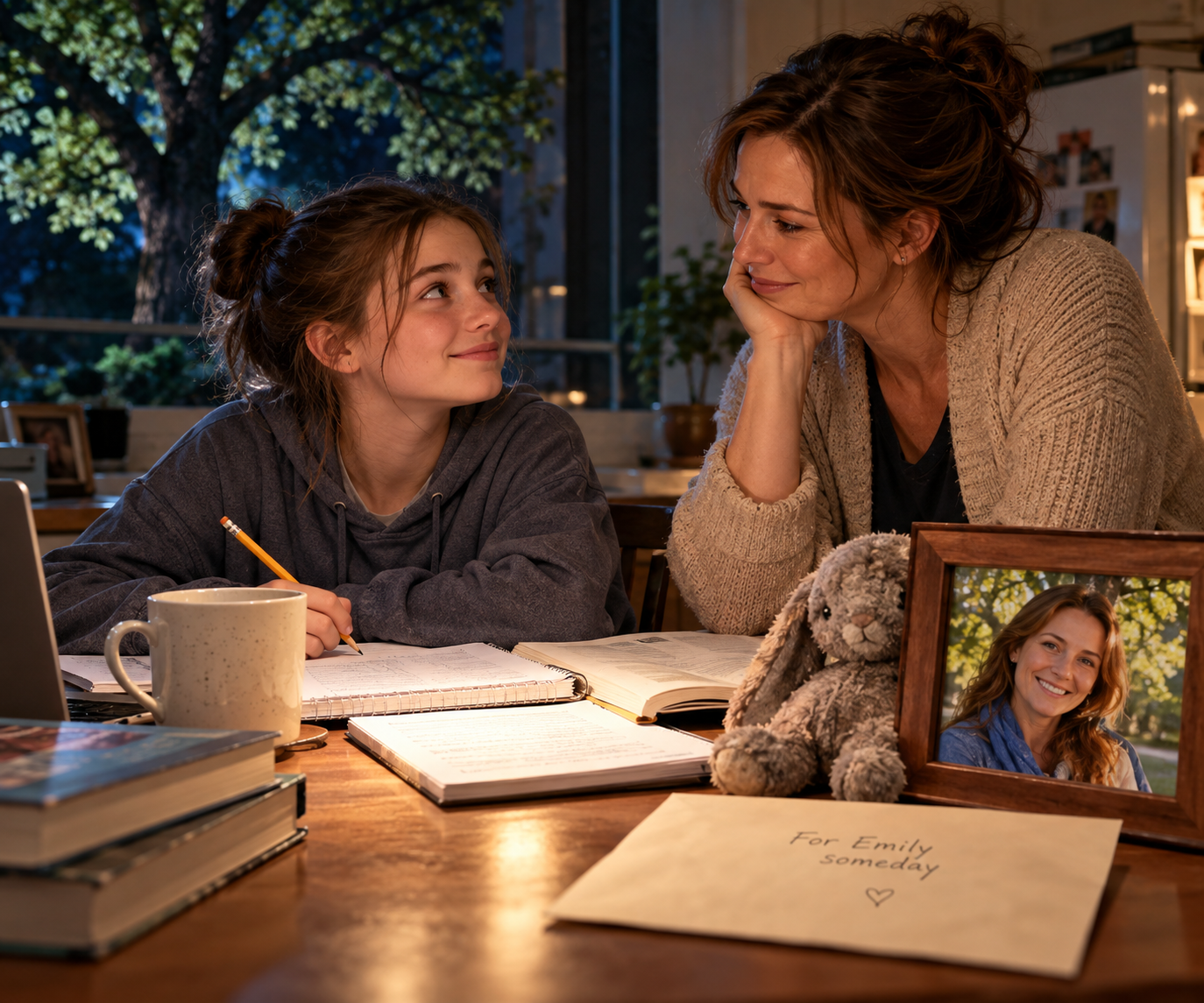
When Jennifer reached the house, Emily was at the kitchen table.
Bunny sat beside a math worksheet.
The caseworker looked toward Jennifer.
Jennifer nodded once.
The woman gathered her bag.
“I’ll give you two some space.”
Emily watched her leave.
Then looked at Jennifer.
“Did they decide?”
“Yes.”
Emily put down her pencil.
Jennifer sat across from her.
“The jury found your dad guilty of killing your mom.”
Emily’s face did not change immediately.
She looked toward the refrigerator.
Her drawing of the house and Jennifer’s tree still hung there.
“Guilty means they believe he did it?”
“In court, it means they decided the evidence proved the charge beyond a reasonable doubt.”
Emily frowned.
“So yes?”
“Yes.”
Emily stared at Bunny.
Jennifer waited.
The question she expected did not come.
Emily did not ask how many years Thomas would get.
She did not ask whether the jurors believed her.
She did not ask whether her father cried.
Instead she asked:
“Do I still have school tomorrow?”
Jennifer blinked.
“Yes.”
Emily nodded.
“Okay.”
The simplicity hurt.
After months in which every adult appointment could disrupt her life, school had become something stable enough to matter.
Jennifer said, “You can stay home if you want.”
Emily shook her head.
“I have science.”
“All right.”
She picked up her pencil.
Then stopped.
“Aunt Jen?”
“Yes?”
“Does Daddy know?”
Jennifer swallowed.
“He was there when the verdict was read.”
Emily absorbed that.
“What did he do?”
“Not much.”
“Was he mad?”
“I don’t know.”
Emily looked suspicious.
“You saw him.”
“I saw his face. I don’t know what he felt.”
That answer seemed to satisfy her.
She returned to the math problem.
Seven minutes passed.
Then she said, “Did the jury hear Claire?”
“Yes.”
“The phone call?”
“Yes.”
Emily’s pencil stopped again.
“All of it?”
“The parts the judge allowed.”
Emily nodded.
“Did they hear him say I was asleep?”
“Yes.”
Another pause.
“I wasn’t.”
“I know.”
Emily looked directly at Jennifer.
“So now everybody knows.”
Not everybody.
But enough.
Jennifer answered:
“People in that courtroom know.”
Emily breathed out slowly.
Something eased.
Not joy.
Release.
After dinner, she asked to call Claire.
Jennifer did not have Claire’s personal number and would not seek it casually.
She explained that.
Emily thought.
“Can I write her something?”
“Yes.”
They found a card.
Emily sat at the kitchen table.
For a long time she could not decide what to write.
Then she printed carefully:
Thank you for staying on the phone when I was scared.
She stared at the sentence.
Jennifer said nothing.
Emily added:
I was telling the truth even when I used the wrong word.
Jennifer’s throat tightened.
Emily looked up.
“Is that okay?”
“It’s your card.”
“I want her to know.”
“Then write it.”
Emily signed only her first name.
The card would be delivered through appropriate channels later.
That night, Jennifer expected sleep to be difficult.
Instead Emily prepared as usual.
Brush teeth.
Choose pajamas.
Check Bunny.
Look at Laura’s photograph.
When Jennifer reached the bedroom door, she waited.
“How far?”
Emily stood beside her.
For several weeks the answer had varied.
Open.
Halfway.
Almost shut.
Emily put one hand on the door.
Then closed it completely.
The latch clicked softly.
Jennifer stared.
Emily opened it again immediately.
Just a crack.
“I wanted to see if I could.”
Jennifer nodded.
“How was it?”
Emily considered.
“Fine.”
“Want it closed?”
Emily looked at the dark gap behind the door.
“No.”
“How do you want it?”
She pushed it until only a hand’s width remained.
“There.”
Jennifer left it.
Before she walked away, Emily said, “Aunt Jen?”
“Yes?”
“Guilty doesn’t mean Mommy comes back.”
“No.”
Emily looked at the photograph on the dresser.
“Then why does everybody care so much?”
Jennifer leaned against the door frame.
Because adults needed names for wrongdoing.
Because Laura deserved the truth.
Because Thomas had controlled the story for years.
Because the legal system could not resurrect anyone but could prevent a lie from becoming the official version forever.
Those were adult answers.
Jennifer chose something simpler.
“Because what happened to your mom mattered.”
Emily looked at her.
“And what happened to you mattered.”
The girl stared at Bunny.
Then nodded.
“Okay.”
Jennifer said goodnight.
She walked down the hall.
Five minutes later, she heard the bedroom door move.
Her body tensed automatically.
Then Emily called:
“I’m opening it more.”
Jennifer smiled from the kitchen.
“Okay.”
The door moved.
That was all.
No footsteps followed.
No angry voice.
No command.
No one pushed it shut again.
At the station the next morning, Sarah found a small stack of case files waiting.
Other families.
Other calls.
Other unfinished stories.
Daniel stood in her doorway.
“Feels strange.”
“What does?”
“Coming to work.”
Sarah looked at the files.
“The world didn’t stop.”
“No.”
He pointed to the Miller folder.
“What happens with that?”
“Sentencing prep. Appeal preservation. Child case coordination.”
Daniel nodded.
“So still not done.”
Sarah thought of Jennifer’s exact words.
“No.”
Then she closed the homicide evidence binder.
For the first time, she placed it on the completed side of her desk.
Not because every consequence was resolved.
Because the central lie was.
Laura Miller had not vanished.
She had not left Emily.
She had been killed.
And the person who spent three years replacing that truth with stories had finally heard twelve strangers refuse to believe him.
Click here to continue reading: PART 30: Sentencing Forced Jennifer and Emily to Decide What They Wanted Thomas to Hear, but Neither Wanted Their Future Built Around His Punishment
A Child Whispered About a Snake, but the Silence Behind Her Words Made the Dispatcher Hear Something Else
Part 29 of 35