The homicide case was becoming stronger.
Emily was becoming quieter.
Jennifer noticed first.
For several days after the new school routine began, Emily had talked more.
Not about Thomas.
About ordinary things.
A classmate named Lily.
A science worksheet.
A boy who traded his crackers for apple slices.
Then the conversation thinned again.
She ate dinner.
Did homework.
Brushed her teeth.
But everything took place behind a careful expression Jennifer recognized from the first week.
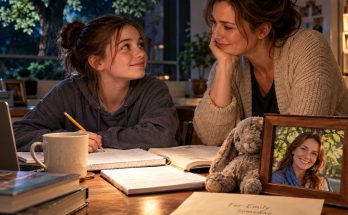
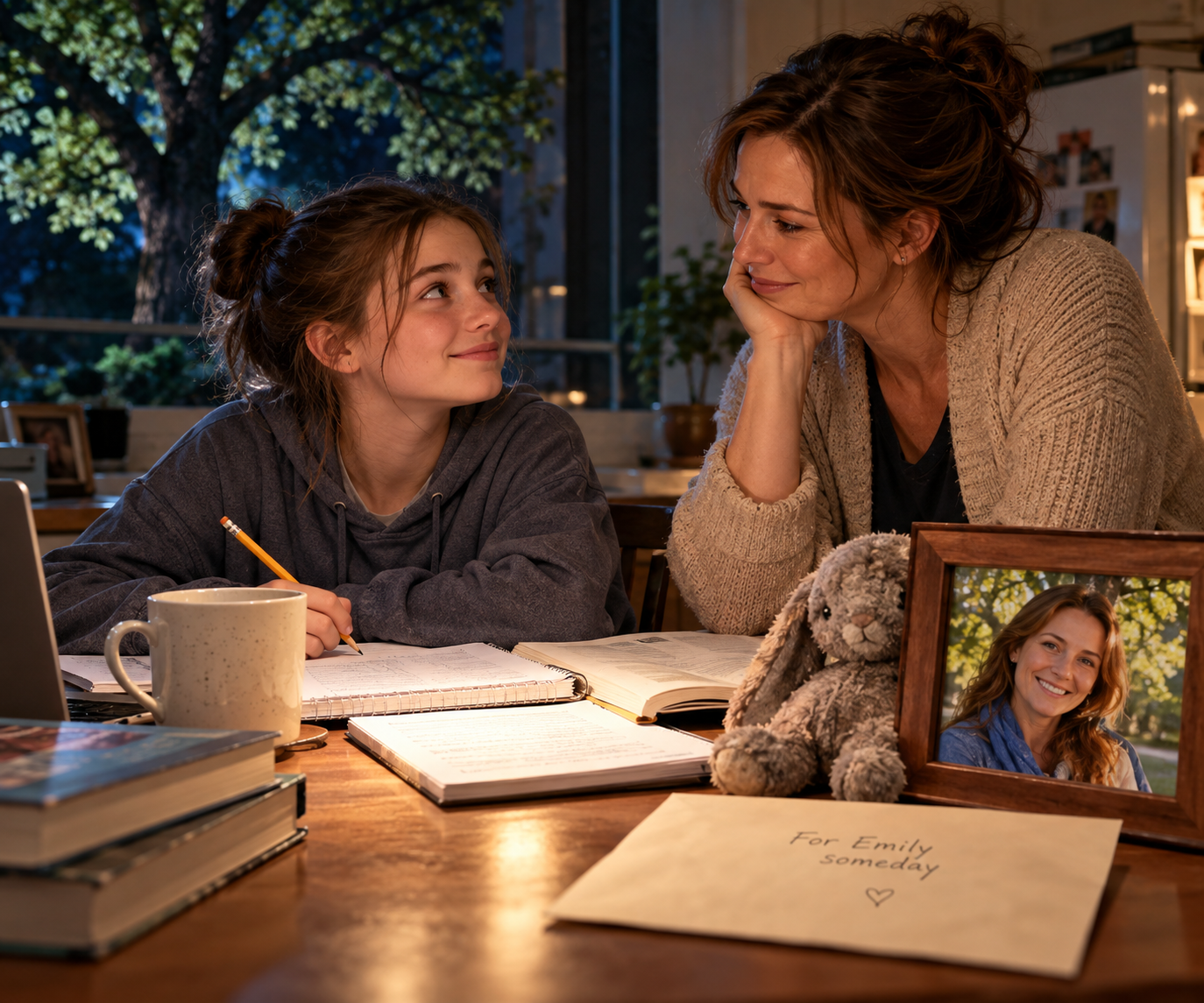
One evening Jennifer found Emily sitting beneath the kitchen table.
Not crying.
Just sitting with Bunny.
Jennifer lowered herself to the floor several feet away.
“Want company?”
Emily shrugged.
Jennifer stayed.
After a while Emily asked, “Is Daddy in jail because of me?”
There it was.
Jennifer had known the question was coming.
She answered carefully.
“He’s there because adults believe there is evidence he did serious things.”
“But if I didn’t call, they wouldn’t know.”
“Maybe not yet.”
Emily looked at her.
“So it is because of me.”
Jennifer took a breath.
“Your call helped people find out what happened.”
Emily’s face tightened.
“That’s the same thing.”
Jennifer knew she could not talk the child out of guilt with clever wording.
“You can help reveal something without causing it.”
Emily stared at the floor.
“Daddy said I’d destroy the family.”
Jennifer’s hands curled against her knees.
She kept her voice steady.
“Your family was already being hurt.”
Emily looked up.
“By him?”
Jennifer could not discuss unproven allegations casually.
But she could speak to what Emily had personally experienced.
“You were scared enough to call 911.”
Emily nodded.
“That fear existed before the call.”
The girl looked at Bunny.
Jennifer added, “And what happened to your mom happened years before you called.”
Emily’s eyes filled.
“I didn’t save her.”
The sentence landed harder than Jennifer expected.
“You were five.”
“I was awake.”
“You were five.”
“I saw Daddy.”
“You were five.”
Emily covered her face.
Jennifer moved closer but stopped.
“Can I sit beside you?”
A nod.
She slid under the table.
They sat shoulder to shoulder.
Emily whispered, “I should’ve called then.”
Jennifer closed her eyes.
“You were a little kid who had just been told your mom left.”
“I knew something was wrong.”
“Knowing something feels wrong is not the same as knowing how to fix it.”
Emily’s shoulders shook.
Jennifer waited.
Eventually the child leaned against her.
“You called when you were able to.”
Emily did not answer.
Sometimes comfort could not erase arithmetic a traumatized child had been doing for years.
If I had spoken sooner.
If I had understood.
If I had been braver.
Thomas had built those equations into her.
Naomi addressed them directly in therapy.
She drew three circles on paper.
One labeled THOMAS’S CHOICES.
One labeled ADULT RESPONSIBILITIES.
One labeled EMILY’S CHOICES.
Emily looked at them.
“What goes in mine?”
Naomi said, “Things you actually controlled.”
Emily thought.
“Calling 911.”
“Yes.”
“Keeping the phone on.”
“Yes.”
“Telling Claire.”
“Yes.”
“What goes in Daddy’s?”
Naomi did not write allegations for her.
“What do you think?”
Emily looked down.
“The bad things.”
Naomi waited.
Emily added quietly, “Lying about Mommy.”
“That is something you’ve learned he did.”
Naomi wrote it.
Emily stared at the page.
“What about Mommy dying?”
“That is being decided through the legal case. You do not have to decide it here.”
Emily nodded.
“What goes in adult responsibilities?”
“Protecting children. Investigating. Telling the truth in court. Making legal decisions.”
Emily pointed to her circle.
“So court isn’t mine?”
“Not the outcome.”
“What if I talk?”
“Your job would only be to answer truthfully.”
“And if they don’t believe me?”
“That decision still isn’t yours to control.”
Emily looked at the circles for a long time.
The exercise did not cure anything.
But it gave shape to responsibility.
At the prosecutor’s office, Sarah and Daniel participated in trial-preparation meetings.
Not testimony coaching.
Evidence organization.
The homicide case and child-abuse case might proceed separately or with overlapping evidentiary hearings depending on legal rulings.
The prosecution wanted to avoid making Emily the center of the homicide case.
They had enough independent evidence to reduce that burden.
Laura’s remains.
The lamp.
Blood in the house, car, and Greg’s van.
Michael.
Greg’s notebook.
Phone records.
Digital files.
Laura’s messages.
The voicemail.
The Pine Ridge evidence.
The case could stand even if Emily testified only about limited observations.
That was important.
The child had already carried too much.
One prosecutor asked Sarah, “What is the most defensible motive theory?”
Sarah answered cautiously.
“Control of Emily.”
“Expand.”
“Laura intended to leave with her. Thomas had threatened to stop that. Laura documented concerns about his treatment of Emily. She planned to involve police. Thomas stood to lose household control, custody, money, and possibly face investigation.”
The prosecutor nodded.
“Do we say he killed Laura to silence abuse allegations?”
“We say the evidence supports that as part of the confrontation. We should not claim more specific intent than we can prove.”
Daniel added, “The final-day journal says Thomas asked whether Laura told anyone what he did to Emily.”
“That’s strong.”
“Yes.”
“But the exact conduct referenced is not specified.”
Sarah looked at him.
“Correct.”
The prosecution agreed.
Precision protected the case.
They would not ask the jury to believe more than the evidence established.
Then the defense filed a motion challenging Laura’s voice memos and written statements as hearsay.
Expected.
Legal arguments intensified.
Some statements might be admissible for state of mind.
Some for other permitted purposes.
Some perhaps excluded.
The judge would decide.
Sarah began preparing two versions of the case.
One with all potentially admissible evidence.
One relying only on the strongest physical and independently corroborated material.
The second version remained substantial.
That reassured her.
A case should not collapse because one emotional piece of evidence disappeared.
Then another physical result arrived.
The dark synthetic fibers near Laura’s remains were compared against archived manufacturer data and material recovered from the hidden service stair.
They were consistent with an older moving blanket sold through a specific hardware chain.
Thomas had purchased two such blankets six months before Laura died.
The receipt remained in a business-expense folder because he used the account for rental-property repairs.
One moving blanket was found at Birch Road.
The other was missing.
The Birch Road blanket was dark charcoal.
Fibers matched the same general composition as those recovered at Pine Ridge and the hidden stair.
Again, class characteristics only.
Not individual identification.
But one item of a purchased pair was gone.
Its fiber type appeared along the path Laura’s body likely traveled.
Sarah put the receipt into evidence.
Daniel looked at the remaining blanket.
“You think he used the second one.”
“I think that’s a reasonable theory.”
“Strong enough to say?”
“Strong enough to investigate.”
They examined the surviving blanket under microscopy.
No Laura DNA.
No meaningful stains.
That was expected if it was not the one used.
At Jennifer’s house, Emily asked to visit Laura’s grave once burial arrangements were complete.
Jennifer was unsure.
Naomi helped them plan.
“No pressure.”
Emily said, “I want to.”
The cemetery was quiet on the morning they went.
The sky was gray.
No rain.
Jennifer carried flowers.
Emily carried Bunny.
Laura’s remains had finally been released after forensic examination and returned to the family.
The service had been private.
Emily had not attended the larger gathering.
Too many adults.
Too many emotions.
This visit was only Jennifer, Emily, and Naomi nearby.
Emily stood in front of the temporary grave marker.
She said nothing for a long time.
Then she placed Bunny on the grass.
Jennifer looked at her.
Emily immediately picked him back up.
“No.”
Jennifer did not ask.
Emily held the rabbit to her chest.
“I thought I could leave him.”
“You don’t have to.”
Emily nodded.
She touched the grass instead.
“Mommy liked yellow flowers.”
Jennifer set down the small bouquet.
“She did.”
Emily looked at the marker.
“Did she know I loved her?”
Jennifer answered without hesitation.
“Yes.”
“How?”
“Because you were her daughter and because she talked about you constantly.”
Emily sniffed.
“I was mad.”
“She knew children get mad.”
“I said bad things.”
“She knew children say things when they’re hurt.”
Emily stared at the name.
Laura Miller.
Finally given a place.
No longer somewhere vaguely “away.”
No longer trapped inside Thomas’s explanation.
Emily whispered, “I’m sorry I believed him.”
Jennifer’s face crumpled.
She knelt.
“You had no reason to know he was lying.”
Emily looked at her.
“I knew some.”
“Knowing pieces isn’t the same as knowing the whole thing.”
That sentence could have described the entire investigation.
Everyone had known pieces.
Mrs. Patel knew Emily did not want to go home.
Jennifer knew Laura planned to leave.
Michael knew Thomas moved belongings at night.
Greg knew there was a cleanup.
The old officer knew a child might be awake.
Claire knew an eight-year-old was afraid.
No one had the whole thing.
Thomas survived inside the gaps.
Emily’s call forced the gaps to close.
At the grave, Emily took one yellow flower from the bouquet.
She held it for several seconds.
Then placed it on the marker.
“I called.”
Jennifer’s throat tightened.
Emily continued.
“I called this time.”
It was not triumph.
It was grief mixed with the beginning of something stronger.
Recognition.
She could not go backward and become the five-year-old who saved Laura.
No child should have been expected to.
But she had become the eight-year-old who finally reached beyond the house.
And that mattered.
Click here to continue reading: PART 20: As Trial Approached, the Case No Longer Depended on Emily Alone, and Thomas Lost the One Advantage He Had Always Counted On
A Child Whispered About a Snake, but the Silence Behind Her Words Made the Dispatcher Hear Something Else
Part 19 of 35