The second morning began with Jennifer on the witness stand.
She had dreaded it for months.
Not because she feared questions about Thomas.
Because she feared talking about Laura in the past tense while strangers watched.
The prosecutor started gently.
“How would you describe your relationship with your sister?”
“Close.”
“Always?”
Jennifer gave a small, sad smile.
“No.”
A few jurors smiled too.
The tension softened.
“We fought when we were teenagers. We got better at being sisters when we stopped living in the same house.”
The prosecutor asked about Laura’s marriage.
Jennifer resisted exaggeration.
She did not claim to witness every argument.
She did not call Thomas names.
She described changes.
Laura calling less.
Thomas often nearby during conversations.
Cancelled visits.
Money becoming a source of tension.
Laura eventually saying Thomas checked her phone.
The prosecutor asked about the morning of June eighteenth.
Jennifer’s hands tightened.
“She called me.”
“What did she say?”
“She was leaving him.”
“Did she sound uncertain?”
“No.”
“Did she ask permission?”
“No.”
“What did she ask?”
“If she and Emily could stay with me.”
Jennifer looked toward the jury.
“I told her yes.”
“Did she say when she planned to come?”
“That night.”
“What happened?”
“They never came.”
The prosecutor displayed the preserved messages.
I’ll explain everything when I get there. Don’t call the house.
Then:
If he knows before I’m ready, it will get worse.
Jennifer identified them.
The defense objected to portions under prior rulings.
The judge allowed only the parts previously approved.
The prosecution moved carefully.
Jennifer testified about waiting.
Calling.
Getting no answer.
Contacting Thomas.
“What did he tell you?”
“That Laura left.”
“With Emily?”
“No.”
“What was your reaction?”
“I didn’t believe him.”
“Why?”
“Because Laura had called me hours earlier to arrange bringing Emily to my house.”
The defense objected to speculation beyond that point.
Sustained.
Jennifer continued with facts.
She called police.
A welfare check occurred.
Thomas later said Laura contacted him from Arizona.
Jennifer received no direct message from Laura.
Birthday cards to Emily were returned.
Calls were restricted.
Years passed.
The prosecutor showed the stack of unopened envelopes.
Jennifer identified her handwriting.
The jury saw dates.
Three birthdays.
Christmas.
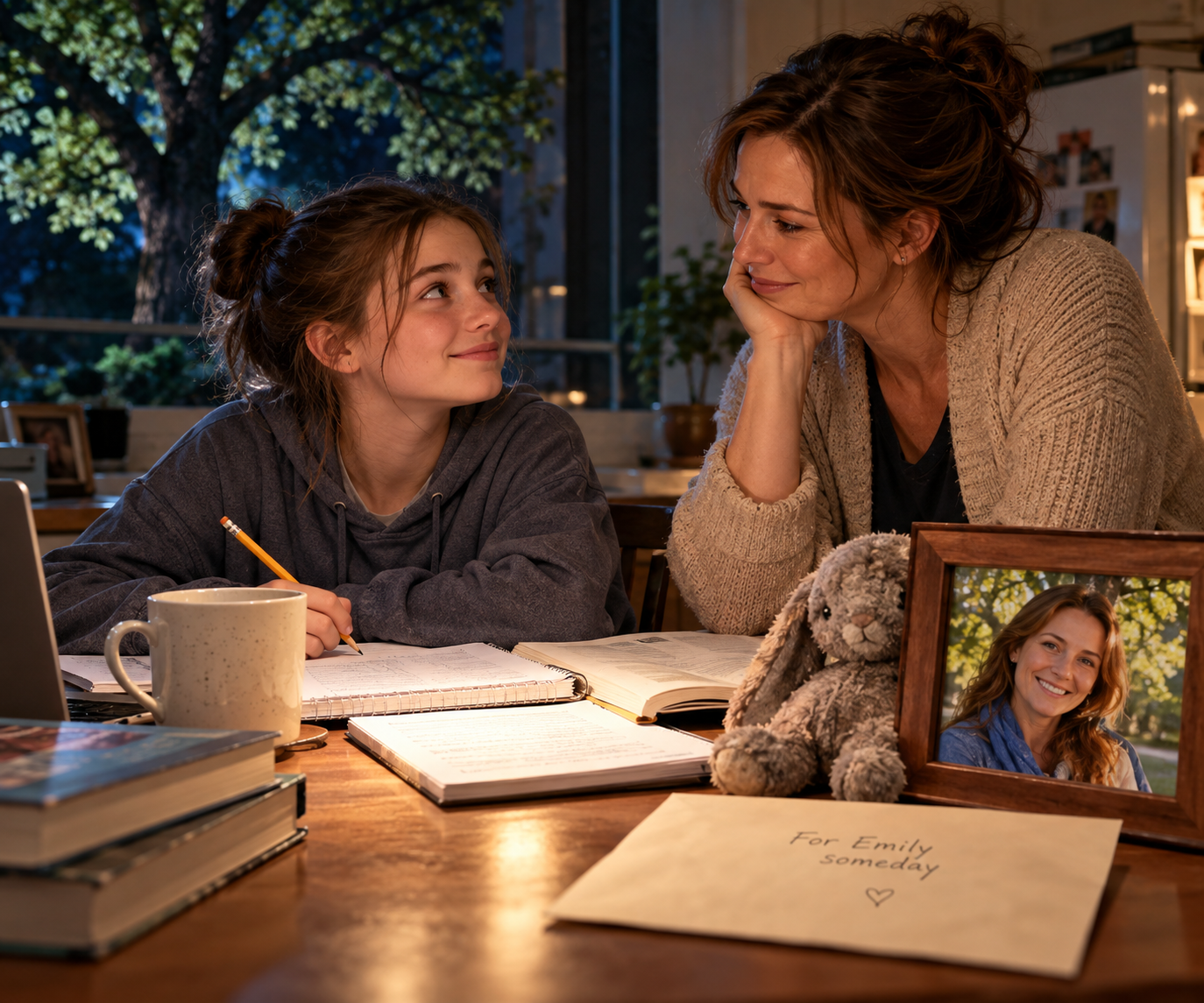
One card addressed only:
For Emily, whenever you’re allowed to read this.
Jennifer’s voice failed briefly.
The judge permitted a pause.
Thomas looked at the defense table.
Not at her.
Cross-examination began.
The defense attorney emphasized conflict.
“You disliked Mr. Miller.”
“Yes.”
“You believed he isolated your sister.”
“Yes.”
“You suspected him before police found Laura’s remains.”
“Yes.”
“You were angry with him.”
“Yes.”
“Still are?”
Jennifer looked at the attorney.
“Yes.”
The defense paused.
Her honesty removed the trap.
“So you have a bias.”
“I loved my sister.”
The attorney objected to responsiveness.
The judge told Jennifer to answer only the question.
She nodded.
The defense continued.
“You wanted investigators to believe Thomas harmed Laura.”
“I wanted them to find out what happened.”
“You told police you never believed Laura left.”
“That’s right.”
“Even though adults sometimes leave marriages without telling family members where they go.”
“Yes.”
“So your disbelief was emotional.”
“Partly.”
“Not evidence.”
Jennifer looked at him.
“At the time, no.”
That answer helped more than defensiveness would have.
The prosecutor did not redirect much.
One question.
“Did you know where Laura was when you first accused Thomas of lying?”
“No.”
“Do you know now?”
Jennifer’s eyes moved toward Thomas.
“Yes.”
No further questions.
The next witness was Megan Brooks from the dental clinic.
She testified about Laura’s work attendance.
Laura disappearing after June eighteenth.
Thomas telling the clinic she moved away.
Then came the preserved voicemail from June seventeenth.
The courtroom heard Laura’s voice for the first time.
Jennifer gripped the bench.
Laura sounded exactly as she remembered.
Tired.
Controlled.
Trying not to sound frightened.
If I’m not at work Monday, don’t believe Tom if he says I quit.
The jury listened.
I’m taking Emily to my sister’s.
Then:
He knows I’ve been documenting things.
The defense had succeeded in excluding portions of the voicemail considered too prejudicial or legally problematic.
But enough remained.
The prosecutor asked Megan:
“Did Laura come to work Monday?”
“No.”
“Did she ever return?”
“No.”
“Did she collect her belongings?”
“No.”
“Final paycheck?”
“No.”
“Did you ever hear her say she intended to abandon Emily?”
“Never.”
The defense objected to the last question’s framing.
The judge gave a limiting instruction.
Then came the video recovered from Laura’s camera.
Thirty-seven seconds.
Laura in her car.
I’m leaving tonight.
Jennifer knows we’re coming.
The most important thing is getting her out.
No one moved.
The prosecutor did not pause dramatically afterward.
That restraint made the moment stronger.
He called the digital-forensics analyst.
Metadata.
Timestamp.
Original file structure.
No evidence of alteration.
Created June eighteenth.
Morning.
Hours before Laura died.
The defense challenged whether Laura might have later changed her plans.
The analyst agreed that digital evidence could not prove her thoughts hours later.
Correct.
But the file proved what Laura intended when she recorded it.
The prosecution then introduced the photograph of the blue duffel and lockbox inside Laura’s trunk.
Timestamp 7:42 a.m.
Same morning.
Later those objects were recovered at Pine Ridge.
The jury now had a before-and-after image.
Before: packed to leave.
After: buried near Laura’s remains.
Sarah watched jurors take notes.
The prosecution moved to Laura’s notebook.
Only admissible portions.
Entries about money.
Keys.
Threats tied to custody.
June 18 — He found out about the money.
Then:
Said I’m not taking Emily anywhere.
The defense attorney objected again.
The judge reminded the jury of the limited purpose for which the statements were admitted.
State of mind.
Intent.
Context.
Not automatic proof that every accusation inside the notebook was true.
Sarah appreciated the instruction.
This trial had to remain disciplined.
Then the prosecution introduced the damaged journal fragment recovered from the blue duffel.
The document examiner explained the restoration process.
Infrared imaging.
Water damage.
Partial text.
No reconstruction beyond legible surviving material.
The jury saw enlarged photographs.
copies with Jen
Thomas saw the photos
Then:
Tonight he asked if I’ve told anyone what he did to Emily.
The courtroom tightened.
Thomas leaned toward his attorney.
The prosecutor did not ask what “what he did” meant.
The document did not say.
Instead he asked:
“Can you determine who wrote this?”
The examiner answered that handwriting characteristics were consistent with Laura’s verified samples.
“Can you determine exactly what conduct the writer referred to regarding Emily?”
“No.”
That answer mattered.
The prosecution was not allowed to turn ambiguity into certainty.
Next came the hidden cloud folder.
Photographs of Laura’s injuries.
Damage in the house.
The cracked lamp.
A small bruise on Emily.
The judge excluded the file names for some images where their wording risked asserting facts beyond what the photograph showed.
Again, the evidence narrowed.
Again, the case survived.
Then came the eighteen-second video.
Thomas’s voice.
You take her away, you’ll regret it.
Laura:
Stop threatening me.
Thomas:
You think Jennifer’s going to protect you?
Laura:
You’re scaring Emily.
Thomas:
She belongs here.
The defense attorney watched the jury.
The words were damaging.
But he had a counterargument ready.
On cross-examination of the digital analyst, he established that the video captured only eighteen seconds.
No beginning.
No ending.
No full context.
Correct.
Then he asked whether couples in custody disputes sometimes say angry things they do not intend literally.
The analyst said she could not speak to that.
Correct again.
The defense would argue later that threats spoken during conflict were not proof of murder.
The prosecutor did not need to win every point immediately.
The case was accumulating.
After lunch came the bank evidence.
Hidden funds.
The joint account.
Thomas’s later forged-looking withdrawal.
The form claiming Laura had abandoned the household.
The defense objected strongly to implications of financial fraud.
The judge allowed limited testimony for evidence of Thomas maintaining a false story regarding Laura’s continued voluntary absence.
The teller note appeared:
Customer states wife is traveling indefinitely.
Three months after Laura’s death.
The prosecution asked the bank custodian:
“Was Laura traveling?”
The defense objected before the answer.
Sustained.
The jury already knew where Laura had been.
Buried at Pine Ridge.
No rhetorical question was needed.
Then Sarah testified.
Not about everything.
Only the investigative sequence she personally handled.
When the case widened from Emily’s disclosure to Laura’s disappearance.
Records showing no divorce.
No custody action.
Laura’s car found in the garage.
The lockbox missing from the closet.
The blue duffel recovered at Pine Ridge.
Human remains found downhill.
The defense challenged her for confirmation bias.
“You suspected Mr. Miller quickly.”
“I considered him a person requiring investigation quickly.”
“Is that different?”
“Yes.”
“How?”
“Suspicion is not proof.”
“You believed he killed Laura before finding the lamp pieces.”
“I believed the disappearance required investigation.”
“Did you believe he was responsible?”
“I considered that possibility.”
The attorney pressed.
“You built your investigation around him.”
“No.”
“You searched his property.”
“With warrants.”
“You interviewed people from his life.”
“Yes.”
“You examined his financial history.”
“Yes.”
“His phone.”
“Yes.”
“His storage properties.”
“Yes.”
“So the investigation focused on him.”
“Because evidence repeatedly led to him.”
A pause.
The defense attorney changed direction.
“You also investigated Michael Reeves.”
“Yes.”
“Why?”
“Because he was at Pine Ridge.”
“Could Michael have killed Laura?”
“We investigated that possibility.”
“And?”
“No evidence placed him in the Miller house during the fatal confrontation.”
“No evidence does not mean impossible.”
“Correct.”
“Could Greg Walsh have killed Laura?”
“We investigated his role.”
“Could he have?”
“Anything is theoretically possible.”
The defense attorney nodded.
“That’s all.”
The prosecutor rose for redirect.
“Detective Bennett, did Michael’s phone place him at home during the later 4:40 a.m. Pine Ridge trip?”
“Yes.”
“Whose phone connected near Pine Ridge then?”
“Thomas Miller’s.”
“Did Greg’s surviving records place him at Maplewood before Michael arrived?”
“Yes.”
“Did the investigation find Laura’s blood in Greg’s van?”
“Yes.”
“Did you hide those facts because they complicated your theory?”
“No.”
“Why not?”
“Because the goal was to determine what happened, not protect a theory.”
Sarah stepped down.
Outside the courtroom at the end of the day, Jennifer sat alone on a bench.
Daniel approached.
“You okay?”
She laughed once.
“No.”
He nodded.
Fair answer.
She looked at him.
“Hearing Laura…”
Daniel waited.
“It was like she came back for thirty-seven seconds.”
He sat beside her.
“She knew she was leaving.”
“Yes.”
“She knew Emily mattered most.”
Jennifer looked toward the courtroom door.
“That’s what I wanted Emily to know.”
“She does.”
Jennifer wiped her eyes.
“She heard the recording.”
“I know.”
For a moment neither spoke.
Then Jennifer said, “Thomas spent three years telling everyone what Laura wanted.”
Daniel looked at the closed doors.
“Now she got to tell them herself.”
The trial day ended there.
But the next morning would move away from Laura’s voice and into the woods.
Pine Ridge.
The duffel.
The grave.
The lamp.
And the physical evidence Thomas could not cross-examine into forgetting.
Click here to continue reading: PART 23: Pine Ridge Brought the Jury From Laura’s Packed Bag to Her Grave, and the Broken Lamp Left Thomas With Fewer Places to Hide
A Child Whispered About a Snake, but the Silence Behind Her Words Made the Dispatcher Hear Something Else
Part 22 of 35