Almost a year after the trial, Emily asked a question nobody expected.
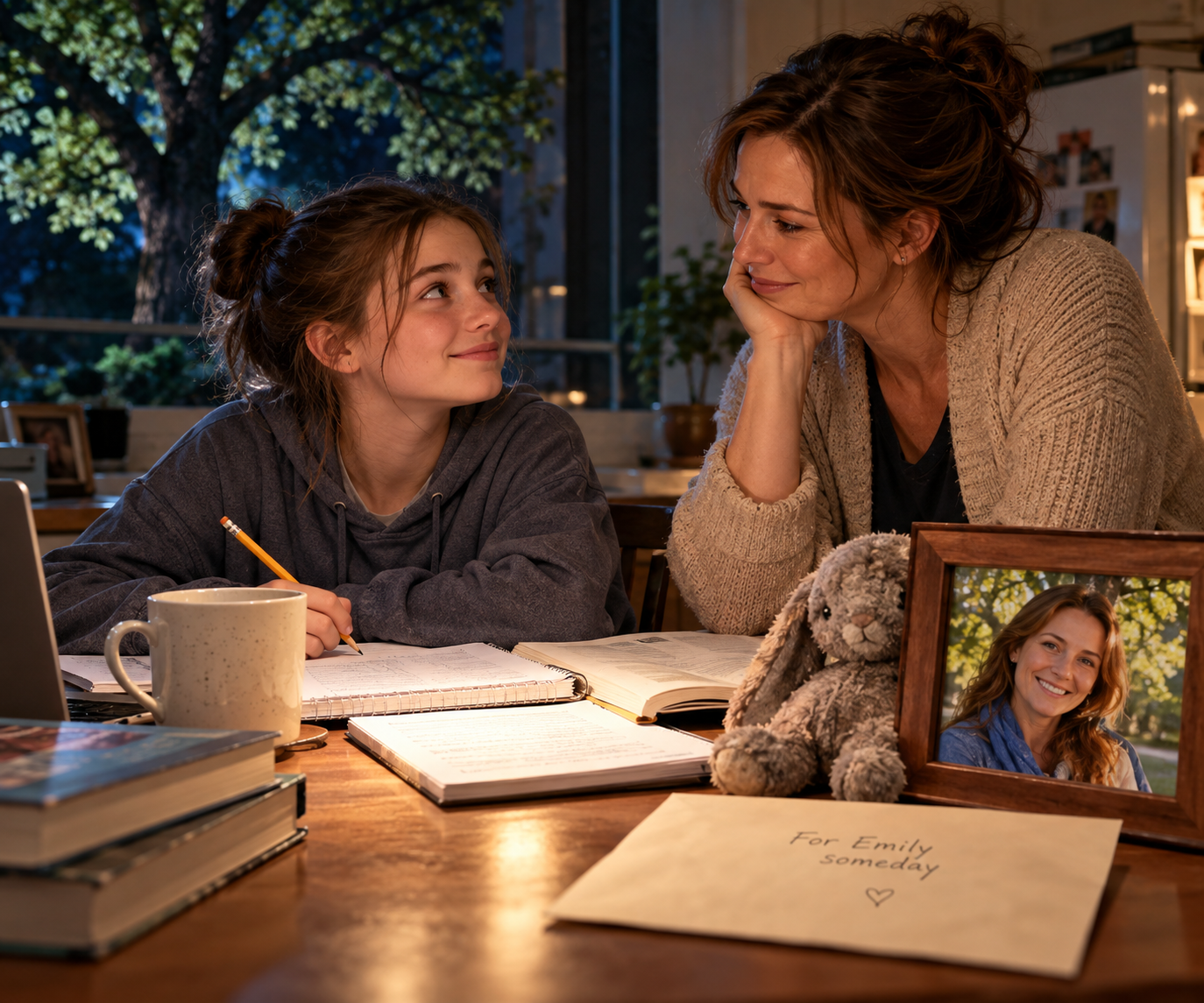
She was sitting at Jennifer’s kitchen table doing fractions.
Bunny lay on the chair beside her.
Outside, the maple tree Laura once liked had begun growing new leaves.
Emily erased the same number three times.
Then she said, “Does the 911 call still exist?”
Jennifer looked up from a stack of mail.
“Yes.”
Emily stopped erasing.
“Forever?”
“I don’t know about forever.”
“Where is it?”
Jennifer understood that Emily did not mean the physical location of a computer server.
“You mean who has it?”
Emily nodded.
“The police. The court records. Emergency services probably have records too.”
Emily stared at the worksheet.
“Can people hear it?”
“Not just anybody.”
“Did Claire keep it?”
“I don’t think Claire personally keeps emergency recordings.”
Emily thought.
“Then how did the court get it?”
Jennifer explained as simply as she could.
The call had been preserved as evidence.
Claire had flagged it.
Investigators requested it.
Lawyers used the admitted portions at trial.
Emily listened carefully.
“So if she didn’t save it, maybe nobody believed me?”
Jennifer put the mail aside.
“They still might have believed you.”
“But it helped.”
“Yes.”
Emily nodded.
Then returned to the fraction problem.
Jennifer waited.
The conversation felt unfinished.
After a minute Emily said, “I want to ask Claire.”
“Ask her what?”
“Why she kept listening.”
Jennifer looked at her.
“You already sent her a card.”
“I know.”
“You want to meet her?”
Emily shrugged.
“Maybe.”
Jennifer did not promise.
Claire worked in emergency communications.
There were privacy rules.
Professional boundaries.
A meeting might not be appropriate simply because the desire was understandable.
Jennifer contacted Sarah instead of reaching out directly.
Sarah spoke with the dispatch supervisor.
After several conversations, a limited visit was approved.
Not a tour of active emergency calls.
Not access to recordings or confidential systems.
A short meeting in a conference room.
Claire agreed immediately.
Emily spent the week pretending she was not nervous.
She asked Jennifer whether Claire would remember her voice.
“Probably.”
“What if she doesn’t remember me?”
“She kept your card.”
“How do you know?”
“Sarah told me.”
That seemed to matter.
The dispatch center looked disappointingly normal to Emily from the outside.
A low building.
Parking spaces.
A security entrance.
No flashing signs announcing that frightened people called there.
Claire met them in a small conference room away from the active floor.
Emily recognized her voice before anything else.
“Hi, Emily.”
Emily froze.
Claire stopped several feet away.
No hug.
No assumption.
“Hi.”
Jennifer sat near the wall.
Sarah had joined them only long enough to make introductions and then stepped outside.
Claire held nothing except a cup of coffee.
Emily looked at her for several seconds.
“You sound the same.”
Claire smiled.
“So do you, only taller.”
Emily almost smiled back.
They sat.
For a while neither knew what to say.
Claire had answered thousands of calls.
Emily had spent months imagining the person on the other side of one.
Finally Emily asked, “Did you think I was lying?”
“No.”
The answer came quickly.
Emily narrowed her eyes.
“Even when I said snake?”
“I didn’t know what you meant.”
“That’s different.”
“It is.”
Claire leaned back slightly.
“At first I thought you might mean a real snake.”
Emily nodded.
“I know.”
“You heard that?”
“I could tell.”
Claire smiled.
“Then you knew more about my thinking than I realized.”
Emily looked down.
“When did you know it wasn’t?”
“I didn’t know exactly what it was for a while.”
“But when did you know something was bad?”
Claire thought.
“When you said your dad told you not to tell.”
Emily’s fingers went to Bunny’s ear.
She had brought him.
Claire noticed but did not comment.
“You got quieter after that.”
“I was thinking.”
“Were you scared?”
Claire considered the question.
“Yes.”
Emily looked surprised.
“You sounded normal.”
“That was my job.”
“So you were pretending?”
“Not exactly. I was trying to stay calm because you needed someone calm.”
Emily absorbed that.
“I thought grown-ups weren’t scared.”
Claire laughed softly.
“Oh, we are.”
Jennifer smiled from the wall.
Emily ignored her.
“Why didn’t you tell me to run?”
“Because I couldn’t see the house.”
“Why didn’t you tell me to lock the door?”
“I didn’t know whether that would make you safer.”
“Why didn’t you tell me to scream?”
“Same reason.”
Claire kept her voice gentle.
“My job was not to make you do something dramatic. My job was to keep you connected and get help to you.”
Emily looked toward the conference-room door.
“I thought if I hung up, they wouldn’t come.”
“They still would have.”
Emily looked back.
“Really?”
“Yes.”
“You already sent them?”
“Yes.”
“When?”
“Before your dad came upstairs.”
Emily stared at her.
That detail changed something.
For years, Emily remembered herself as balancing everything on the phone staying hidden.
One mistake.
One sound.
One disconnected call.
Now Claire was telling her the wheels had already begun turning.
“I didn’t have to keep talking?”
“No.”
“Then why did you stay?”
“Because you were still there.”
Emily frowned.
“That’s not an answer.”
Claire smiled.
“It kind of is.”
She tried again.
“You called because you needed help. Until someone reached you, I wanted you to know there was still another person on the line.”
Emily looked at Bunny.
“I thought you might leave.”
“I remember.”
“Because Daddy came in.”
“I remember that too.”
“You heard him.”
“Yes.”
Emily asked quietly, “Did he sound scary?”
Claire paused.
She refused to rewrite the past through emotion.
“He sounded controlling to me in the context of what you had already told me.”
Emily nodded.
Not exactly the answer she expected.
Probably a better one.
“Did you know my mom was dead?”
“No.”
“Did anybody?”
“Not then.”
Emily looked toward Jennifer.
“My call found her.”
Jennifer started to answer.
Claire did first.
“Your call started something.”
Emily turned back.
“What?”
“It got people inside your house who listened to you.”
“That found Mommy.”
“Eventually.”
Emily pressed.
“So my call found her.”
Claire understood that Emily wanted a clean line between action and consequence.
Life rarely gave those.
“Your call helped open the investigation that led to finding her.”
Emily seemed satisfied with that precision.
Then she asked, “Do you still hear it?”
Claire knew what she meant.
Not the recording.
The memory.
“Sometimes.”
Emily’s eyes widened.
“Why?”
“Some calls stay with you.”
“Mine?”
“Yes.”
“Is that bad?”
Claire shook her head.
“No.”
Emily picked at the bent ear.
“I don’t like hearing my voice from then.”
“I understand.”
“I sound little.”
“You were little.”
“I was eight.”
Claire smiled faintly.
“That is little.”
Emily gave her an annoyed look.
Jennifer laughed.
Emily ignored that too.
She asked, “When the jury listened again, were you there?”
“No.”
“Did you know?”
“Later.”
“Were you happy?”
Claire considered.
“I was glad the call could help them understand what happened.”
“Not happy?”
“Not about the reason it existed.”
Emily nodded.
That made sense.
For several minutes they talked about dispatch work.
Claire explained that callers often used strange words because they were panicked, young, injured, unfamiliar with emergency systems, or simply unable to describe what was happening.
“Do people say wrong things a lot?”
“Yes.”
“Then how do you know what they mean?”
“Sometimes we don’t.”
Emily looked worried.
Claire continued.
“We ask careful questions. We listen to background sounds. We send help when there is enough concern.”
“What if you guess wrong?”
“That can happen.”
“What then?”
“We try to correct quickly.”
Emily looked at the table.
“I thought if I used the wrong word, nobody would understand.”
Claire leaned forward slightly.
“You used the word you had.”
Emily looked up.
“And it was enough.”
“It was enough to keep listening.”
That sentence mattered more than Claire intended.
Emily sat very still.
Then she asked whether she could see where Claire had been sitting.
The active dispatch floor was restricted, but supervisors had arranged for Emily to look through an interior observation window.
Claire walked with her.
Behind the glass, operators wore headsets at rows of screens.
No dramatic darkness.
No giant map with flashing red dots.
People typing.
Talking.
Listening.
Emily stared.
“Which desk?”
Claire pointed.
“That section. Different equipment now.”
“So you were just sitting there?”
“Yes.”
“When I called?”
“Yes.”
Emily looked almost offended.
“I thought it would look bigger.”
Claire laughed.
“A lot of important things happen in boring-looking rooms.”
Emily watched another dispatcher answer a call.
She could not hear the conversation.
Claire said, “We should go. That call belongs to whoever is making it.”
Emily nodded immediately.
Privacy.
She understood secrets differently now.
Some secrets protected wrongdoing.
Others protected people’s dignity.
They returned to the conference room.
Before leaving, Emily reached into her backpack.
“I brought something.”
Claire waited.
Emily pulled out a drawing.
A phone.
A small house.
A line connecting them.
At the far end, two stick-figure officers stood near the door.
Above the phone Emily had written:
STAY ON THE LINE.
Claire looked at it.
“For me?”
“Yes.”
“Thank you.”
Emily shrugged as if it did not matter.
Claire knew better.
She would not put it on the dispatch floor where someone might connect it with a real caller.
She would keep it privately.
Jennifer stood.
Emily did too.
Claire said, “You don’t owe emergency services anything, by the way.”
Emily frowned.
“What do you mean?”
“You already said thank you in the card. You didn’t need to come here to thank me again.”
“I know.”
“Okay.”
“I came because I wanted to know why you stayed.”
Claire smiled.
“Did you get an answer?”
Emily considered.
“You stayed because I was still there.”
“Yes.”
Emily nodded.
Then, unexpectedly:
“I stayed too.”
Claire’s throat tightened.
“Yes.”
Emily put on her backpack.
They said goodbye.
No dramatic hug.
At the doorway Emily stopped.
“Claire?”
“Yes?”
“If a kid calls and uses a weird word…”
Claire waited.
“Don’t hang up.”
“I won’t.”
Emily nodded.
Then left.
In the car, Jennifer expected questions.
Instead Emily leaned her forehead against the window.
After ten minutes she said, “She was scared.”
“Claire?”
“Yes.”
“But she stayed calm.”
“Yes.”
Emily smiled faintly.
“I did too.”
Jennifer looked at her in the mirror.
“You did.”
This time Emily accepted the compliment.
That evening she put the fraction worksheet back on the table.
The same problem still waited.
She solved it on the first try.
The 911 recording would remain part of the legal record.
Claire would continue answering other frightened voices.
Sarah would investigate other cases.
The machinery that had once felt enormous to Emily had become understandable.
Not magical.
Not perfect.
People.
Headsets.
Reports.
Choices made minute by minute.
The call that changed her life had begun because one frightened child believed a confusing emergency was still an emergency.
Years later, Emily finally understood something else.
She had not needed the perfect word.
She had needed someone willing to keep listening after the imperfect one.
Click here to continue reading: PART 34: Laura’s Belongings Came Home at Last, and Emily Found One Final Message Her Mother Had Written Before the Night Everything Changed
A Child Whispered About a Snake, but the Silence Behind Her Words Made the Dispatcher Hear Something Else
Part 33 of 35