The reunion committee had met several times before the event.
I had agreed to attend because an old classmate called and asked me personally.
Her name was Eleanor, and she had always been kinder than most of the people I remembered from school.
She told me that many former students were coming.
She said it would be good to see familiar faces.
I almost declined.
Fifty-five years was a long time to carry memories of people who had barely known you.
Still, I agreed.
I told myself that I had reached an age when the past should no longer frighten me.
I bought a gray dress for the occasion.
It was simple, comfortable, and well made. I chose it because I liked the way it fit, not because I thought anyone would approve of it.
That was what I told myself, anyway.
I spent the afternoon getting ready without much excitement.
My husband would have teased me for taking so long to choose earrings.
He had been dead for several years by then, but I still found myself imagining what he might say when I stood in front of the mirror.
He had never understood why I cared so much about what people thought of me.
He used to say that I could run a business meeting without blinking, then spend half an hour worrying about an unkind remark made by someone who didn't matter.
He was right.
I hated that he was right.
After he died, I became more independent in ways I had never expected. I handled things I once assumed we would handle together.
There were days when the loneliness seemed almost physical.
But I learned to keep moving.
I raised our son. I continued working. I made decisions that could not wait for me to feel ready.
Eventually, I discovered that grief did not always announce itself.
Sometimes it appeared when I reached for two cups instead of one.
Sometimes it appeared when I heard a familiar song.
And sometimes it appeared as an old classmate holding an apron.
Before I arrived at the reunion, I had imagined several possible encounters.
I might speak with Eleanor.
I might meet someone who remembered a teacher I had forgotten.
Perhaps a few people would ask about my family or my work.
I did not imagine Brenda.
I should have.
Her name had been on the committee list.
I had seen it while reviewing the invitation.
I had even paused when I read it.
Then I folded the invitation and placed it on the kitchen counter.
I told myself that the girl who had humiliated me at school was no longer relevant to the woman I had become.
That was a reasonable thought.
It was also incomplete.
Some memories do not remain powerful because the people involved are important.
They remain powerful because we have never fully understood why we allowed them to hurt us.
I had spent years telling myself that Brenda was simply a cruel teenager.
That explanation was convenient.
It allowed me to dismiss her without examining the effect she had on me.
But the truth was that her cruelty had helped shape the way I saw myself.
I had become cautious about displaying success.
I rarely discussed money unless a business decision required it.
I disliked being praised in public.
Whenever someone called me impressive, I usually changed the subject.
I had confused humility with hiding.
No one had forced me to do that.
I had done it myself.
The realization came slowly, and even then I did not know what to do with it.
By the time I reached the hotel that evening, I had nearly convinced myself that the reunion would be pleasant.
The entrance was crowded with guests arriving in small groups.
Some greeted one another with delighted shouts.
Others stood awkwardly beside the registration table, trying to recognize faces that had changed over half a century.
I gave my name to a volunteer and received a badge.
Martha.
Just Martha.
The printed letters looked strangely official.
I pinned it to my dress and entered the ballroom.
Eleanor spotted me first.
She came over with a broad smile and took both my hands.
“You came.”
“I said I would.”
“I know, but I wasn't sure you'd enjoy it.”
“Neither am I.”
She laughed.
That helped.
For a few minutes, the evening felt almost easy.
We talked about old teachers, the school building, and how strange it was that so many years had passed.
Eleanor had kept in touch with several classmates. She knew who had moved away, who had retired, and who had grandchildren old enough to drive.
I listened more than I spoke.
There was something comforting about hearing the names of people who had once seemed permanently fixed in my world.
Then Eleanor mentioned Brenda.
“She has been organizing nearly everything,” she said. “You know how she is.”
I did.
Eleanor must have seen something change in my expression.
“She hasn't changed much,” she added.
I looked across the room.
Brenda stood near the center tables, speaking to two women while a hotel employee adjusted the place settings behind her.
She looked confident.
She always had.
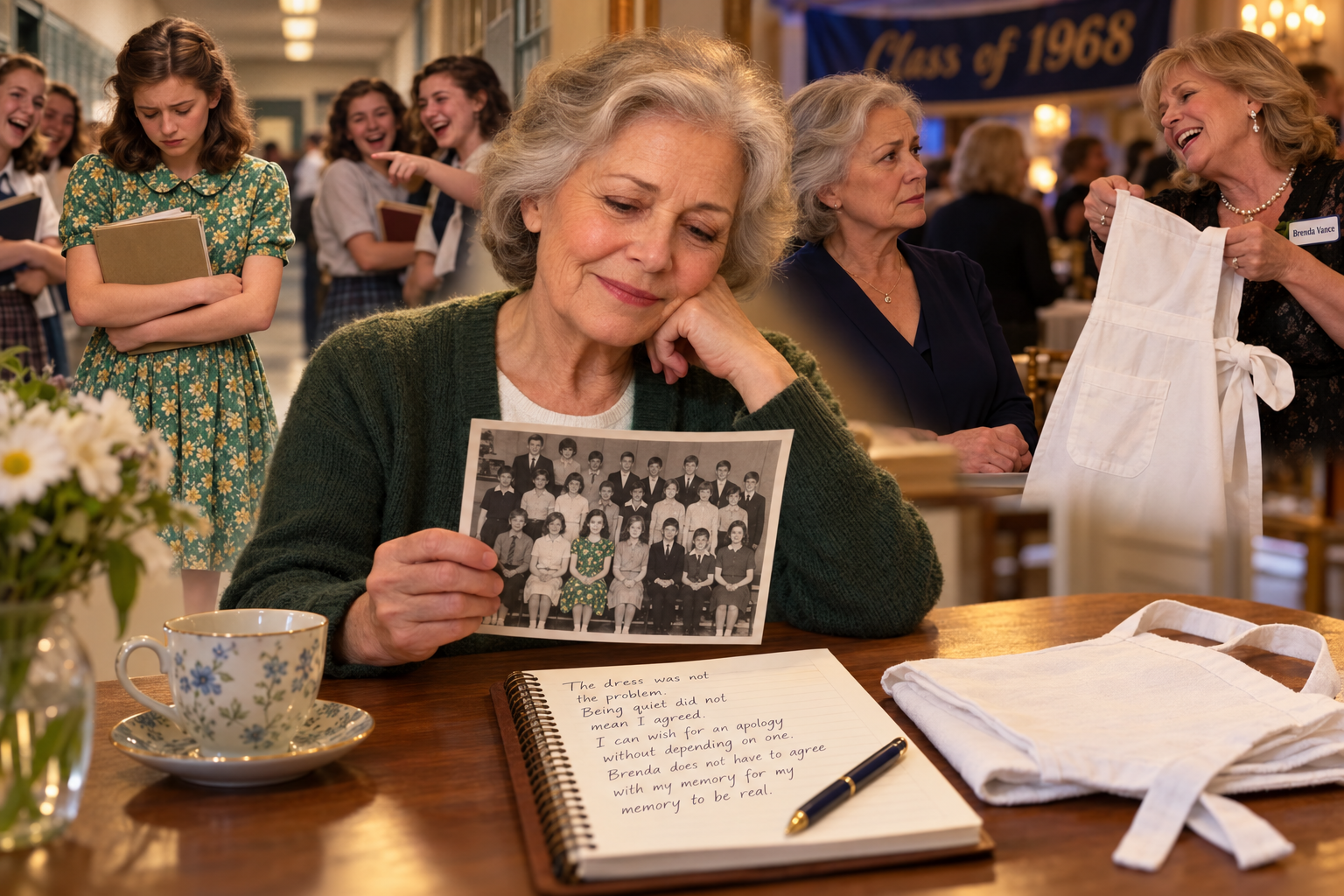
I wondered whether she remembered the green floral dress.
I wondered whether she remembered the hallway.
Then I felt foolish for wondering.
People who humiliate others often forget the details.
The person being humiliated does not have that luxury.
Brenda eventually noticed me.
Her eyes moved over my face, and she hesitated for a moment.
Then she approached.
“Martha Bennett?”
“Hello, Brenda.”
She leaned forward and kissed the air beside my cheek.
“I can't believe you're here.”
“I received an invitation.”
She laughed as if I had made a joke.
“You always were the quiet one.”
I had heard that description many times in my life.
Quiet.
It was a word people used when they did not know what else to call someone who had learned not to speak unless necessary.
“I suppose I was,” I said.
Brenda glanced at my name badge.
Then she looked at my dress.
“You look well.”
“Thank you.”
She told me about the committee, the hotel, the menu, and the difficulties of getting everyone to respond to invitations.
I listened politely.
She did not ask about my husband.
She did not ask about my son.
She did not ask what I had been doing for the past fifty-five years.
Instead, she spoke as if we had seen each other last week and had merely misplaced a few details.
It was strange.
I had imagined that seeing her again might bring anger.
What I felt at first was disappointment.
I had carried a version of Brenda in my memory for decades, and the real woman seemed almost ordinary.
Then she made a comment about my quiet nature again.
This time, she said it in front of other guests.
“Martha was always so modest. You could hardly get a word out of her.”
Several people smiled.
I smiled too.
That was my mistake.
I had spent so long smoothing over uncomfortable moments that the response came automatically.
Brenda seemed encouraged.
She moved on to another conversation, leaving me beside the table.
I told myself it did not matter.
I had a good life.
I had people who loved me.
I had done work that mattered to me.
Why should a woman from my teenage years be able to disturb any of that?
I spent the next hour speaking with former classmates.
Some remembered me kindly.
Others seemed unable to remember much about me at all.
I found that oddly reassuring.
Perhaps I had been more invisible than I realized.
Perhaps the hallway incident had mattered far more to me than it had to anyone else.
I wanted that to be true.
Then the dinner service began.
Guests settled into their seats.
The hotel staff carried trays through the room, placing dishes before the guests and clearing empty glasses.
The conversations grew louder.
I was seated at a table not far from Brenda's.
She moved between guests, checking arrangements and making comments about the service.
At one point, she complained that the vegetables had arrived later than expected.
A hotel employee apologized.
Brenda waved him away.
I watched the exchange and felt a familiar discomfort.
The employee had done nothing wrong.
He had apologized anyway.
I recognized the behavior because I had once lived inside it.
When you expect someone to criticize you, you begin apologizing before you know whether you have made a mistake.
It takes time to stop.
I had spent years trying to stop.
By the time the evening reached its busiest point, I had almost relaxed.
I was speaking with a former classmate about my son when Brenda approached with the apron.
She did not ask whether I was willing to help.
She did not explain that someone had requested assistance.
She simply held the apron toward me and smiled.
For a second, I thought she might be joking.
Then she mentioned the kitchen.
Then she made her remark about my being suited to work behind the scenes.
The laughter followed.
And the hallway returned.
I stood there with my hands empty, looking at a garment I had never worn and a woman who had never understood me.
I wanted to tell her that I had built something of my own.
I wanted to ask whether she had ever considered how much damage a careless remark could do.
But those words remained inside me.
Not because I had nothing to say.
Because I had not yet decided whether she deserved to hear it.
Click here to continue reading: PART 3: The White Apron Reminded Me of the Girl I Had Been, and I Finally Began to Understand Why I Had Never Forgotten Her
The Woman Who Once Made Me Ashamed of My Clothes Had No Idea What My Life Had Become
Part 2 of 20