The next morning, I woke before the alarm I no longer needed.
The house was quiet.
I made tea and sat near the kitchen window, watching the light spread slowly across the street.
For a while, I thought about nothing in particular.
Then I remembered the reunion.
I could see the banquet room, the tables, and the folded white apron.
I could see Brenda Vance holding it out to me.
For a moment, the old embarrassment returned.
I did not try to push it away.
I let myself remember the scene as it had happened.
Brenda had offered the apron.
She had made her joke.
I had felt hurt.
I had refused.
The memory did not need to become more complicated than that.
I had spent weeks examining every part of the incident, trying to determine whether I had misunderstood something or reacted too strongly.
I had tried to imagine what Brenda intended.
I had wondered what the other guests thought.
I had asked myself why a woman of seventy-three could still be affected by something that happened when she was a teenager.
I no longer needed to keep asking.
I had been hurt by an old classmate.
The joke had touched a memory I had carried for decades.
My feelings made sense.
I could accept that without making the event larger than it was.
I could also accept that the memory might return from time to time.
That did not mean I had failed.
It meant I had lived through something that mattered to me.
I finished my tea and washed the cup.
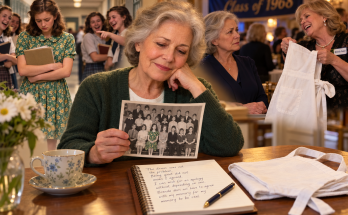
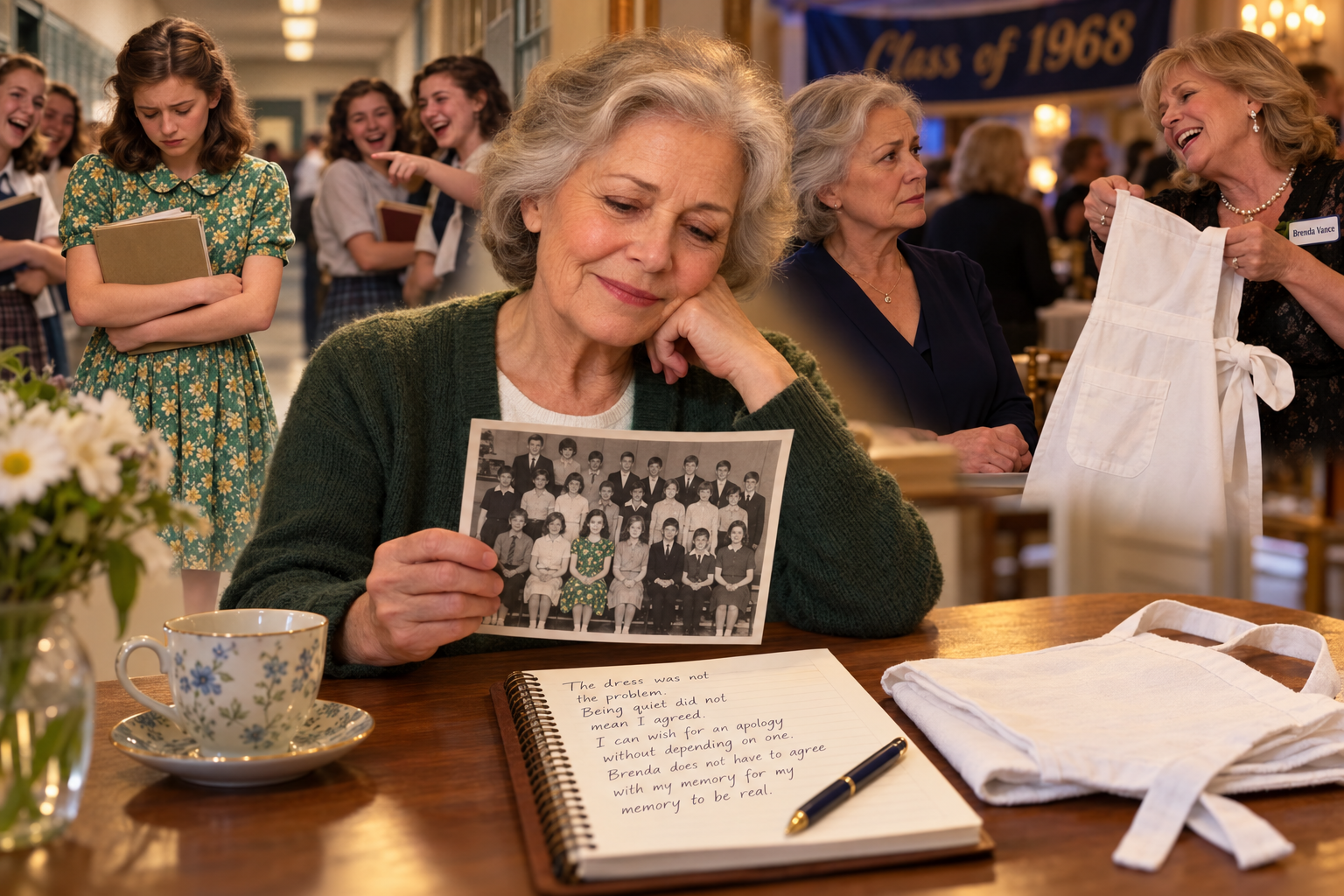
Then I went to the shelf and took down the school photograph.
I sat at the table with it in my hands.
The girl in the green floral dress looked out from the back row.
I studied her face.
I could not tell whether she was shy or simply tired of standing still.
I could not know what she had been thinking when the photograph was taken.
I had once believed that I needed to reconstruct every detail to understand what happened to her.
Now I understood that I could not recover everything.
I did not need to.
I knew enough.
She had been a girl with four school dresses.
She had worn the green floral one more than once.
Brenda had mocked her for it.
The girl had felt embarrassed.
And she had continued with her life.
That was the story I could tell without blaming her.
I placed the photograph on the table and opened my notebook.
The pages were filled with the thoughts I had written since the reunion.
I read a few of them.
The dress was not the problem.
Being quiet did not mean I agreed.
I can be kind without making myself disappear.
I can wish for an apology without depending on one.
I smiled at the last sentence.
I had needed all those words.
Not because I was weak.
Because I had spent years believing the opposite.
I had thought kindness required silence.
I had thought dignity meant pretending nothing hurt.
I had thought growing older would automatically make old humiliations lose their power.
None of those beliefs had been entirely true.
Kindness could include honesty.
Dignity could include saying no.
And old memories could remain painful without controlling every part of the present.
I turned to a clean page.
For a long time, I held the pen above it.
Then I wrote a letter to the girl in the photograph.
I did not write it to Brenda.
I did not write it to the classmates who had watched the hallway scene.
I wrote it to myself.
I told the girl that she had not been foolish for wearing a dress she liked.
I told her she had not deserved to be laughed at.
I told her that owning less did not make her less worthy.
I told her that being quiet did not mean she had agreed with the cruelty.
I told her she would grow up and learn to speak for herself.
And I told her that even when she could not find the right words, she would still deserve respect.
I paused before the final sentence.
Then I wrote:
You do not have to carry this shame for the rest of your life.
I read the letter once.
My eyes stung, but I did not cry.
I folded the page and placed it inside the notebook.
I did not tear it up.
I did not hide it.
I let it remain there with the other words I had written.
After breakfast, I went about my day.
I answered a telephone call.
I watered the plants.
I put away the laundry.
I made lunch and cleaned the kitchen.
The work was ordinary, and I was grateful for it.
I had once believed that a meaningful change would arrive with a dramatic feeling.
I thought I would wake one morning and discover that the memory no longer mattered.
But the change had come quietly.
It had come when I stopped blaming myself for the dress.
It had come when I said no to the apron.
It had come when I told Eleanor the truth instead of pretending I was unaffected.
It had come when I allowed my son to hear that something had hurt me.
It had come when I looked at the school photograph and saw a girl rather than a failure.
None of those moments erased the others.
Together, they had helped me see my own life more clearly.
That afternoon, I put the notebook away.
I returned the photograph to the shelf, straightened the frame, and stepped back.
It stood beside the other pictures.
There was no special light around it.
No music played.
No one applauded.
The room looked exactly as it had before.
But I felt different standing in it.
The girl in the green floral dress no longer seemed trapped in the hallway.
She was part of a photograph from a long-ago school day.
She was part of my history.
She was not waiting for Brenda to release her.
She was not waiting for the classmates who had laughed to apologize.
She was not waiting for me to discover the perfect sentence that would make the past fair.
I had finally stopped asking her to wait.
I could not go back and stand beside her when Brenda mocked her.
I could not give her a different dress or a different school day.
I could not prevent her from feeling embarrassed.
But I could stop treating her embarrassment as proof that she had done something wrong.
I could stop repeating the insult inside my own mind.
I could let her remember the dress without hating it.
I could let her grow older without carrying the same burden into every room.
I could give her the kindness I had wanted someone to offer her then.
That was what I wanted to do.
I turned away from the shelf and walked into the kitchen.
The white apron remained in the drawer.
I knew where it was.
I did not need to take it out.
I did not need to throw it away.
It was a household object, and I was free to use it whenever I chose.
Brenda's gesture could not decide its meaning forever.
The same was true of the dress.
The same was true of the hallway.
The same was true of me.
That evening, I sat by the window with a cup of tea.
The sky changed slowly from pale blue to gray.
I watched the lights come on in the neighboring houses.
I thought about Brenda once more.
I did not know whether she had thought about me since the reunion.
I did not know whether she regretted the joke or believed it had been harmless.
I did not know whether she would ever offer an apology.
For the first time, I could leave those questions unanswered without feeling that my life was on hold.
If I saw her again, I would be polite if I wished to be.
I would speak honestly if the moment called for it.
I would not pretend that I had found her joke funny.
I would not use the past to hurt her in return.
And I would not accept being made small simply because someone expected me to laugh.
I could do all of that without hating her.
I could also do it without excusing what she had done.
Those truths could exist together.
The room grew darker.
I finished my tea and set the cup on the table.
Then I looked at the photograph one last time before turning out the light.
The girl in the green floral dress stood in the back row.
She looked young.
She looked serious.
She looked like someone who had a long life ahead of her.
I wanted to believe she had always deserved that life without shame.
I wanted to believe I deserved the years that remained to me without carrying the old insult as a measure of my worth.
I had not forgotten the hallway.
I had not forgotten the laughter.
But I no longer believed that the laughter had the final word.
The final word belonged to the life I had lived afterward.
It belonged to the choices I had made, the people I had cared for, the days I had endured, and the moments when I had found the courage to speak.
It belonged to the woman I had become.
And it belonged to the girl who had worn the dress because it was hers.
Fifty-five years after I left that school in shame, Brenda Vance had placed an apron back into my hands.
For a moment, I had felt seventeen again.
Then I had said no.
That answer had been small, but it had opened a door I had kept closed for too long.
I walked through it slowly.
I did not need to turn back to see whether Brenda was watching.
I did not need to ask anyone whether I had earned the right to leave the old shame behind.
I simply let myself go.
The End
Read more original stories on Feel Every Story.
The Woman Who Once Made Me Ashamed of My Clothes Had No Idea What My Life Had Become
Part 20 of 20