Several weeks passed before I thought seriously about the reunion again.
The memory no longer followed me through every room.
It appeared at unexpected moments, then faded.
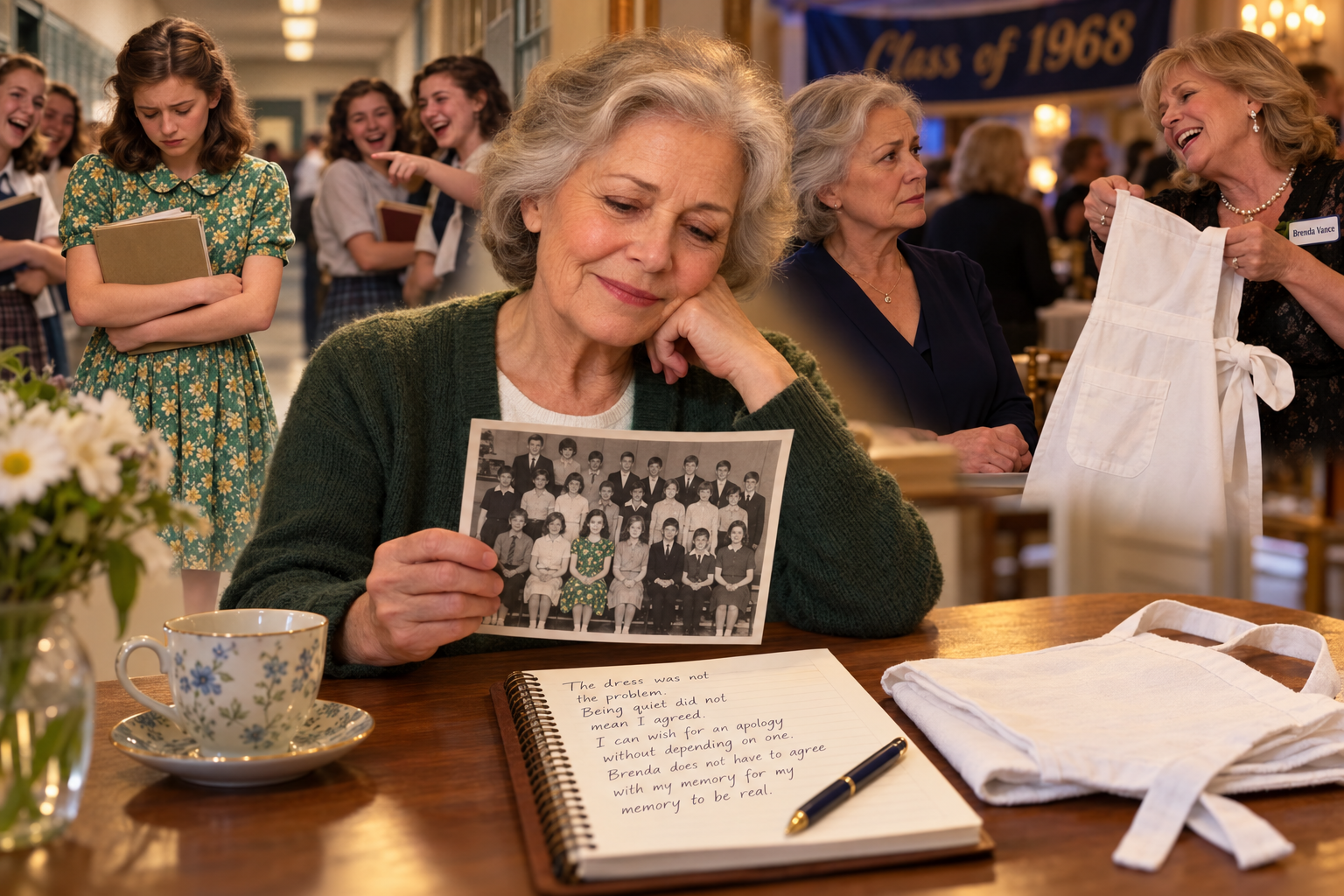
Sometimes I remembered the apron.
Sometimes I remembered the school photograph.
Sometimes I thought about the young woman at the grocery store, counting the money in her purse.
The memories had begun to separate from one another.
That helped.
I could look at each one without feeling that it proved something terrible about me.
One Saturday morning, I cleaned out a drawer in the living room.
It held old envelopes, spare batteries, instruction manuals, and several photographs that had been moved from one place to another over the years.
I found a picture of my husband and me standing outside our first home.
We looked young and uncertain.
The house was small.
The yard was unfinished.
I remembered the day the photograph was taken because we had argued that morning about whether we could afford the repairs.
Neither of us had wanted to admit how worried we were.
Yet we had stood outside and smiled for the camera.
Looking at the picture, I realized how often I had confused appearances with reality.
Brenda had appeared confident when we were teenagers.
That did not mean she had understood everything.
I had appeared quiet.
That did not mean I had nothing to say.
At the reunion, she had appeared amused by the apron.
That did not mean her behavior was harmless.
Appearances could tell part of a story.
They rarely told all of it.
I placed the photograph beside the school picture on the table.
For a moment, the two images seemed to belong to different lives.
In one, I was a teenager who wanted to avoid being noticed.
In the other, I was a young woman building a home with someone I loved.
Between those photographs lay years of work, decisions, mistakes, and ordinary days.
I had not become the person I was by defeating Brenda Vance.
I had become that person by living.
The thought brought a kind of peace I had not expected.
I put the photographs into separate envelopes and labeled them with the dates I remembered.
Then I returned the envelopes to the drawer.
I was not ready to throw away the past.
I simply wanted to keep it in its proper place.
That afternoon, I went for a walk.
The weather was mild, and the streets were quiet.
I passed houses where people were working in their gardens.
A child rode a bicycle along the sidewalk while an adult followed at a careful distance.
I watched them for a moment.
The child wobbled, corrected the handlebars, and kept going.
No one laughed.
No one told the child that being unsteady meant being incapable.
I continued walking.
I thought about how long it had taken me to understand that a person could be uncertain without being inferior.
I had been uncertain at seventeen.
I had been uncertain when I started my business.
I had been uncertain when my husband became ill.
I had been uncertain after he died.
Uncertainty had accompanied nearly every important part of my life.
It had never prevented me from moving forward.
So why had I treated it as something shameful?
I did not have a complete answer.
Perhaps I had learned too early that people judged what they could see.
Perhaps I had decided that if I worked hard enough, no one would ever have a reason to look down on me.
Perhaps both were true.
By the time I returned home, I had stopped trying to find a single explanation.
Some habits were formed from many small experiences.
They did not always have one clear beginning.
That evening, I made a simple dinner and ate at the kitchen table.
I left the television off.
I wanted the quiet.
Afterward, I washed the dishes and wiped the counter.
The house smelled faintly of soap and coffee.
I stood by the sink and looked out the window.
The glass reflected the kitchen light.
For a moment, I could see my own face in it.
I looked older than the woman in the photographs.
My hair had changed.
The lines around my eyes had deepened.
My hands were marked by years of work.
I had spent much of my youth wishing I could become someone other people would admire.
Now I was old enough to understand that admiration was an unreliable foundation for a life.
Some people would admire what I had accomplished.
Others would dismiss it.
Some would remember me kindly.
Others might remember almost nothing.
I could not manage all those opinions.
I could only decide how I wanted to treat the people I encountered.
That included myself.
I returned to the living room and opened the notebook where I had written about the reunion.
The sentence about being angry with myself was still on the page.
I read it again.
Then I turned to a fresh page.
I wrote that I did not want my memories of Brenda to become the measure of my remaining years.
I wrote that I could remember what happened without allowing it to define every room I entered.
I wrote that the girl in the green floral dress had deserved kindness.
Then I stopped.
I had nothing more to add that evening.
I closed the notebook and placed it beside the school photograph.
For the first time, I did not feel the need to hide either one.
A few days later, I received a message from Eleanor.
She was checking in after the reunion and asking whether I would like to meet for coffee sometime.
I replied that I would.
We chose a day and a time.
After sending the message, I looked at the phone for a moment.
It occurred to me that I had been avoiding the idea of seeing people from school again.
I had told myself I was simply busy.
That was partly true.
But another part of me had been waiting for the next uncomfortable encounter.
I did not want to spend the rest of my life preparing for people who might never say another unkind word to me.
I wanted to see Eleanor because I enjoyed her company.
That was enough.
I did not need to prove that I had moved on.
I did not need to demonstrate that I was unaffected.
I could simply meet a friend for coffee.
The realization was almost embarrassingly ordinary.
Perhaps that was why it mattered.
The next time I thought about Brenda, I tried to imagine what I would do if I saw her again.
I could not predict how she would behave.
She might greet me warmly.
She might make another careless remark.
She might never mention the apron.
I decided that I did not need to rehearse every possibility.
If she spoke to me, I would answer honestly.
If she crossed a line, I would say so.
If she did not, I would not invent a conflict simply because I had once been hurt.
I wanted to give the present a fair chance.
That was all.
I placed the notebook in the drawer beside the photographs.
Then I turned off the living room light.
As I walked toward the stairs, I glanced once at the framed school picture.
The girl in the back row still looked serious.
She still looked guarded.
But I no longer saw her as someone who had failed to defend herself.
I saw a young person doing the best she could with what she understood at the time.
I wished I had been kinder to her sooner.
I could not change that.
I could be kinder now.
And that was a decision I could make without Brenda's permission.
Click here to continue reading: PART 9: The Coffee Shop Where I Finally Spoke About the Girl I Had Been
The Woman Who Once Made Me Ashamed of My Clothes Had No Idea What My Life Had Become
Part 8 of 20