I had spent most of my life believing that humiliation lost its power when you grew old enough to understand it.
I was wrong.
At seventy-three, I discovered that a single smile from the wrong person could bring back a girl I had worked very hard to leave behind.
It happened at my fifty-fifth high school reunion.
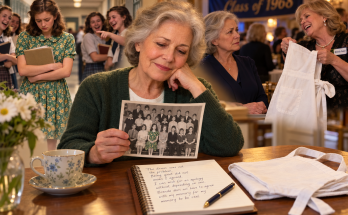
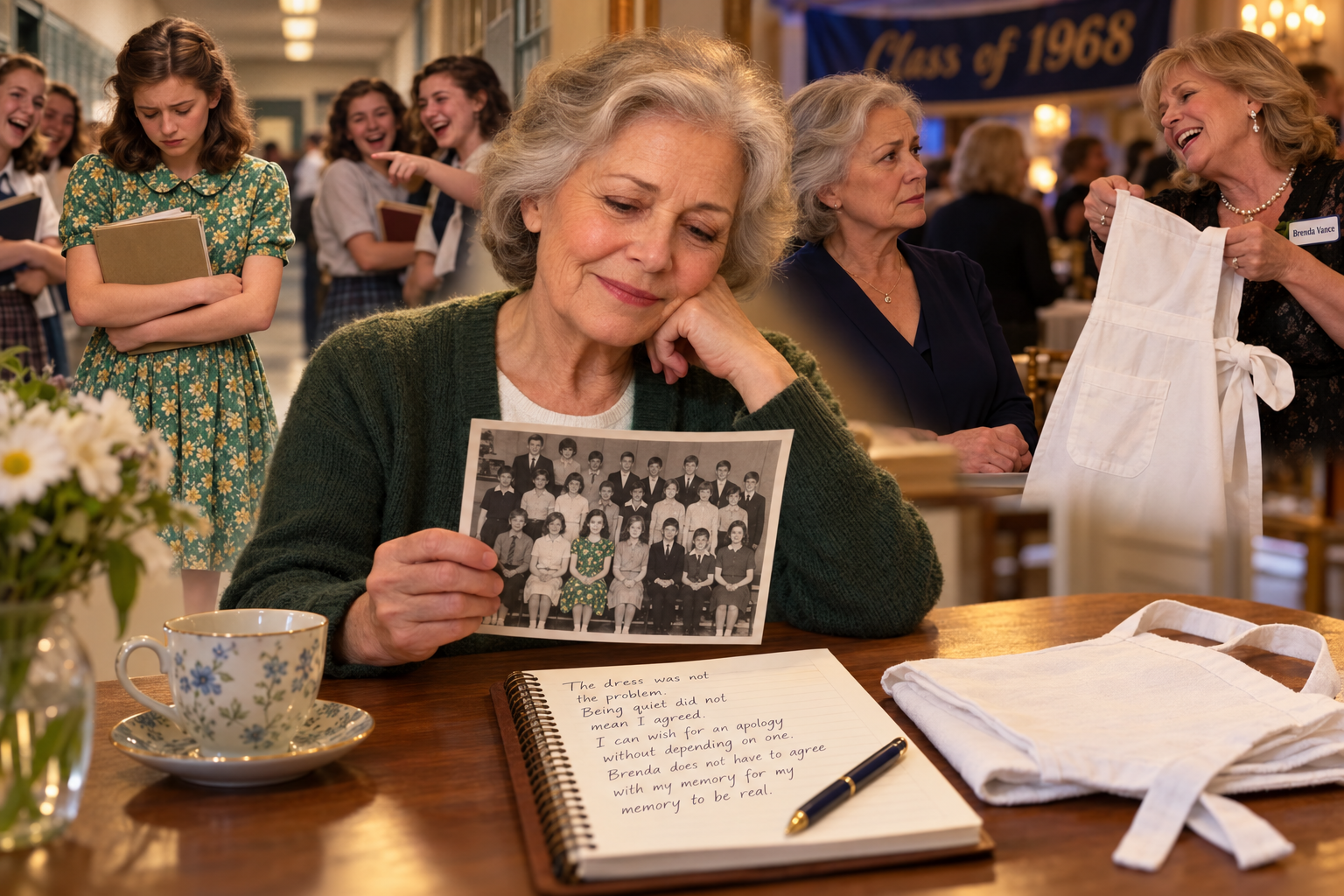
At 7:50 that evening, Brenda Vance stood beside a banquet table and extended a white apron toward me.
She held it by the straps, pinching the fabric between two fingers.
I stared at the apron.
For a moment, neither of us spoke.
The ballroom was full of people I had not seen in decades. Some had grown heavier. Others had lost their hair or acquired glasses that hung low on their noses. A few looked surprisingly unchanged, which I thought was unfair.
The chandeliers cast a soft yellow glow across the tables.
Glasses stood beside neatly arranged silverware. White napkins had been folded into shapes that looked too complicated to unfold. Beyond a movable partition, hotel workers moved between the kitchen and the service area.
I could hear dishes clattering.
Someone called for more vegetables.
The air carried the smell of roasted chicken, coffee, perfume, and flowers.
Brenda had insisted on the flowers.
I remembered hearing her complain about the cost during one of the reunion committee meetings. She had said the arrangements were essential, then spent fifteen minutes explaining how the florist had overcharged her.
That was Brenda.
She could make an expense sound like a personal insult.
Now she was standing in front of me with an apron.
“You can take this, Martha,” she said.
Her voice was light enough to make the insult seem accidental.
It wasn't.
She glanced toward the hotel kitchen, then back at me.
“They could probably use another pair of hands back there.”
Several women sitting near her turned to look.
Brenda smiled.
“You always did seem better suited to working behind the scenes.”
Someone gave a small laugh.
Then another person joined in.
I looked at the apron again.
White cotton. A narrow waistband. Two long ties.
Nothing remarkable about it.
Yet my fingers had gone cold.
I had buried my husband. I had raised a son. I had built a business from a modest beginning and kept it alive through years when I sometimes wondered whether the next payroll would be possible.
I had negotiated with hospital administrators who thought they could intimidate me.
I had sat across from bankers who spoke slowly whenever they assumed I didn't understand the numbers.
I had signed checks that paid the wages of people who depended on me.
And I had done all of it without Brenda Vance's approval.
Still, there I stood, unable to answer a woman who had last mattered to me when we were teenagers.
That was the part I hated most.
Not the apron.
Not the laughter.
The silence inside me.
Because I knew exactly where that silence came from.
Oakridge High School.
Fifty-five years earlier.
I could see the lockers, the polished floor, and the narrow hallway where Brenda had once made an ordinary school morning feel like a public trial.
I could hear her bracelets clicking together as she moved her hands.
I could almost feel the weight of the books pressed against my chest.
I had been seventeen.
Brenda had been seventeen too, but we had lived in different worlds.
Her father owned two car dealerships. Her mother replaced furniture whenever she grew tired of a room's appearance. Brenda wore new sweaters so frequently that I sometimes wondered whether she ever repeated one.
Her shoes were always clean.
Mine weren't.
Winter in our town left salt marks along the sidewalks, and the walk from my house to school was long enough for the stains to appear before I reached the front doors.
I owned four dresses suitable for school.
One had originally been bought for me.
The others had come to our family through circumstances I did not discuss with classmates.
I washed them carefully and wore them in rotation.
I knew which stains would come out and which ones would remain no matter how hard I scrubbed. I knew how to mend a loose hem so that the stitches would not show from a distance.
At seventeen, I considered those skills ordinary.
I didn't understand that other girls could afford not to learn them.
Brenda understood the difference between us perfectly.
She had noticed my green floral dress almost immediately.
I had worn it to school on a Monday morning because it was clean, comfortable, and one of the few things I owned that made me feel presentable.
I remember checking its buttons before leaving home.
I remember smoothing the skirt with both hands.
I remember thinking that if I kept my head down and finished my assignments, the day would pass without trouble.
That was how I approached most days then.
Keep quiet.
Do the work.
Don't give anyone a reason to notice you.
Brenda noticed me anyway.
She was standing beside a row of lockers with several classmates when I walked past.
Her bracelets made a faint metallic sound.
She looked me over, then raised her eyebrows.
“Didn't you wear that dress last week?”
I stopped.
I should have kept walking.
I knew that even then.
But I was seventeen, and some foolish part of me believed that if I answered calmly, she might leave me alone.
“Yes,” I said.
Brenda turned toward the others.
“Martha has found a way to make one dress last forever.”
The students around her laughed.
My face burned.
I tightened my arms around my books.
She could have stopped there.
Instead, she looked at the dress again, studying it as if she were examining something she had found in a bargain bin.
“Maybe it looks different after a wash.”
More laughter.
I remember a boy near the drinking fountain looking away.
That small movement stayed with me longer than the laughter did.
He had heard her.
He knew what she was doing.
He simply wanted no part of it.
I understood him, even while I wished he had said something.
Brenda had a way of making cruelty seem like entertainment. If anyone objected, she could act wounded and claim she had only been joking.
That morning, I said nothing.
I walked away with my books pressed against my chest.
I told myself I was stronger than she was.
I told myself I did not care what she thought.
I told myself several things that were not true.
By lunchtime, other students had heard about the dress.
Someone asked whether I owned another one.
Someone else wanted to know if my family had fallen on hard times.
I answered as little as possible.
At home, I did not mention any of it.
There was no point.
My family had enough worries without adding the behavior of a spoiled girl to the list.
Besides, I was ashamed.
Looking back, that word makes me sad.
I had done nothing wrong, yet I felt as though I had been caught doing something disgraceful.
I had worn a clean dress.
That was all.
But when you are young, other people's judgments can become your own before you have learned to question them.
For a long time, I let Brenda's opinion stand in for mine.
I stopped wearing the green floral dress whenever I could avoid it.
I became careful about where I stood, what I said, and how long I looked at anyone who might be watching me.
I thought I was protecting myself.
Mostly, I was making myself smaller.
That evening at the reunion, all those old habits returned before I could stop them.
My shoulders drew inward.
My hands stayed at my sides.
I looked at the apron and wondered whether everyone in the room was watching.
Then I realized something that embarrassed me even more.
I was waiting for Brenda to tell me what to do.
At seventy-three.
I was still waiting.
The woman standing before me had no idea what I had built after leaving Oakridge. She did not know how many difficult decisions I had made or how many times I had been forced to stand my ground when giving in would have been easier.
She saw the girl from the hallway.
Or perhaps she saw someone she believed had never become anything else.
I could have told her about my business.
I could have mentioned the employees who had worked for me for years, the contracts I had secured, or the times I had refused to accept terms that would have put other people at risk.
But I knew Brenda well enough to understand that a list of accomplishments would not change the way she treated me.
She was not asking a question.
She was making a point.
And the apron was the point.
“Come on,” she said, giving the garment another little shake. “It's only helping out.”
The woman seated closest to her studied her napkin.
Another guest lifted his glass but did not drink.
I noticed those things.
I noticed everything.
Brenda's smile remained fixed.
I finally lifted my eyes from the apron and looked directly at her.
For the first time that evening, I saw the woman in front of me rather than the girl in my memory.
Her hair was carefully arranged. Her jewelry was expensive-looking. Her dress fit her well.
She had aged, as we all had.
But the expression was familiar.
It was the same expression she had worn in the school hallway when she discovered that she could make me uncomfortable without suffering any consequences herself.
I took a breath.
I still did not know what I would say.
But I knew I could no longer pretend that the apron was an innocent offer.
Click here to continue reading: PART 2: I Had Spent Decades Building a Life of My Own, Yet One Familiar Voice Made Me Question Every Step I Had Taken
The Woman Who Once Made Me Ashamed of My Clothes Had No Idea What My Life Had Become
Part 1 of 20