When I met Eleanor for coffee again, I brought no photograph and no notebook.
I wanted to spend an afternoon with a friend without turning every conversation toward the past.
We chose the same table near the window.
The weather had cooled, and people outside were wearing heavier coats.
Eleanor arrived carrying two scarves, one wrapped around her neck and the other draped over her arm.
“I couldn't decide which one to wear,” she said.
“So you wore both?”
“I thought that was the most sensible solution.”
I laughed.
We ordered coffee and talked about ordinary things.
She told me about a neighbor who had become determined to rearrange her entire living room.
I told her about a cupboard I had cleaned out and the things I had discovered behind the bowls.
For a while, the reunion did not come up.
I was grateful for that.
I had been thinking about it almost every day, and I wanted to prove to myself that I could let the subject rest without pretending it did not matter.
Eventually, Eleanor asked how I was feeling.
“Better,” I said.
She tilted her head.
“Better in what way?”
I thought before answering.
“I don't feel as though I need to solve it anymore.”
She waited.
“I used to think I needed to understand why Brenda did what she did. I thought if I could work out what she meant, I could decide whether I had a right to be upset.”
“And now?”
“Now I think I know enough.”
Eleanor nodded.
I stirred my coffee, though I had added nothing to it.
“Maybe she thought she was being funny. Maybe she didn't think about the old days at all. Maybe she expected me to laugh because that's what I used to do.”
“Any of those things could be true,” Eleanor said.
“Yes.”
“But none of them changes what happened.”
I looked at her.
“No. It doesn't.”
I had heard the idea before, but it was beginning to feel less like advice and more like something I could live by.
I did not have to settle every question about Brenda's intentions.
I did not have to decide whether she was cruel, careless, thoughtless, or simply accustomed to being the person who made the jokes.
I could acknowledge the action without claiming to know everything behind it.
She had offered me the apron in a way that made me feel small.
I had refused it.
I had told her I did not find the joke funny.
Those facts were enough.
“I think I've been waiting for the past to give me permission to stop feeling bad,” I said.
Eleanor looked thoughtful.
“The past isn't very good at giving permission.”
I smiled.
“No. It seems determined to keep bringing up old business.”
We both laughed.
Then I became quiet again.
“I've also been angry with myself,” I admitted. “Not only because I felt hurt. Because I still felt hurt after all these years.”
Eleanor put her cup down.
“Why should the number of years make the memory meaningless?”
I had no answer.
She continued gently.
“Something can happen when you're young and stay with you. That doesn't mean you've failed to grow.”
I looked toward the window.
A man was trying to fold an umbrella while holding a shopping bag.
The umbrella kept springing open.
He finally gave up and carried it under his arm.
I smiled at the sight.
“I think I expected to be above all this by now,” I said.
“Above what?”
“Being affected by someone else's opinion.”
Eleanor shook her head.
“We all care what people think sometimes.”
“I know.”
“And sometimes the opinions that stay with us are the ones we never had a chance to answer.”
That struck me.
At school, I had been embarrassed and surprised.
I had not found the words to defend myself.
At the reunion, I had been older, but the memory had arrived before my thoughts could catch up.
I had been given another chance to respond.
This time, I had spoken.
Not perfectly.
Not with the eloquence I might have imagined afterward.
But honestly.
Perhaps that was why I had been thinking about it so much.
The reunion had brought back the old hurt, but it had also allowed me to act differently.
I had not laughed along.
I had not accepted the apron to avoid making Brenda uncomfortable.
I had not told myself that my feelings were too foolish to mention.
I had said no.
I had left.
I had talked about it afterward.
Those were new memories, too.
They deserved a place beside the old ones.
When we finished our coffee, Eleanor offered to drive me home.
I thanked her but told her I wanted to walk a little longer.
She accepted that without argument.
As we parted, she touched my arm.
“You don't have to turn this into a lesson,” she said.
I looked at her.
“What do you mean?”
“You can simply have been hurt. You don't need to make something impressive out of it.”
I stood still for a moment.
Then I nodded.
She was right.
I had a habit of looking for the useful part of every difficult experience.
I wanted pain to teach me something, strengthen me, or make me wiser.
Sometimes that search helped.
Sometimes it became another demand.
I had been hurt by Brenda.
I did not need to make the incident meaningful enough to justify the pain.
I could simply admit that it had hurt.
That afternoon, I walked home slowly.
The air was cool, and the streets were quieter than they had been earlier.
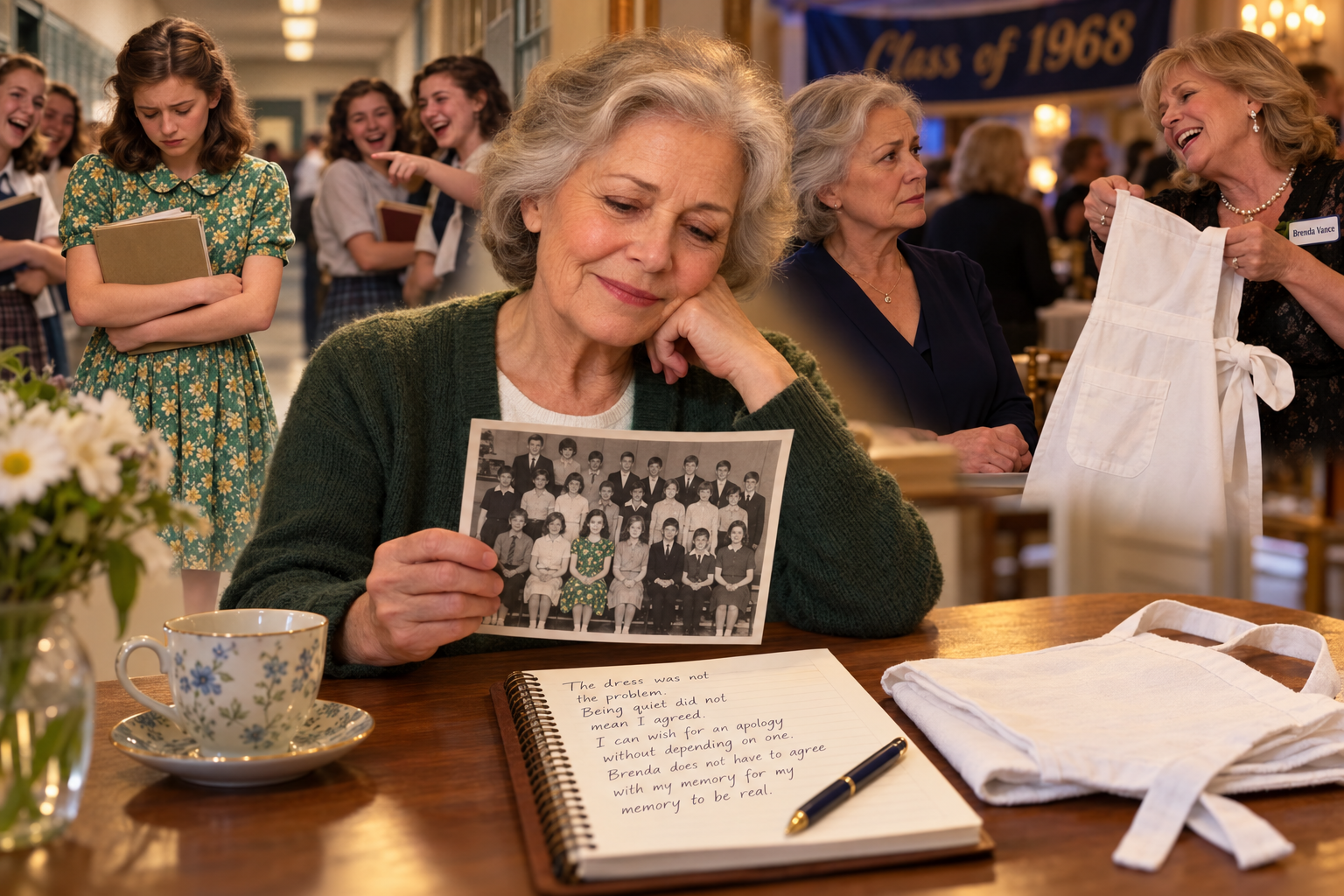
I thought about the school photograph, the notebook, and the apron in my drawer.
They were only objects.
They could remind me of something, but they could not tell me what I had to feel.
I could decide how much space each memory deserved.
At home, I made tea and sat down.
I opened the notebook to a new page.
For once, I did not write about Brenda.
I wrote about the walk, the weather, and a funny thing Eleanor had said.
I wrote about the man struggling with his umbrella.
The page filled with ordinary details.
When I finished, I realized how long it had been since I had written anything that did not lead back to the reunion.
I felt relieved.
My life had not stopped when Brenda handed me the apron.
It had continued while I remembered the incident, while I talked about it, and while I learned to see it differently.
I wanted to give that continuing life more attention.
I closed the notebook and placed it beside the photograph.
The past could remain where it belonged.
It did not have to apologize before I moved on.
And I did not have to apologize for remembering it.
Click here to continue reading: PART 16: I Kept the Photograph Where I Could See It and Let the Girl in the Green Dress Belong to Me Again
The Woman Who Once Made Me Ashamed of My Clothes Had No Idea What My Life Had Become
Part 15 of 20