
Eleanor chose a little coffee shop near the old town square.
I arrived ten minutes early and took a table beside the window.
The glass was cold when I rested my fingers against it.
Outside, people hurried past with shopping bags and paper cups, each carrying a day that had nothing to do with mine.
I liked that.
For most of my life, I had believed that if something hurt me, I ought to keep it private.
I had treated silence as good manners.
I had mistaken swallowing my feelings for being strong.
At seventy-three, I was beginning to wonder how much of that strength had simply been fear.
Eleanor came in wearing a blue coat and carrying a handbag that looked almost as old as our friendship.
She spotted me and smiled.
“I'm glad you came.”
“So am I.”
She sat down and removed her gloves.
For a moment, neither of us spoke.
Then she looked toward the counter.
“Coffee first?”
“Coffee first.”
She returned with two cups and a small plate of biscuits.
The cups were white, with thin brown lines around the rims.
I wrapped both hands around mine.
Eleanor watched me over the steam.
“You've been thinking about that night.”
It wasn't a question.
“I have.”
“More than you expected?”
“Much more.”
She nodded without telling me I should forget it.
That was one reason I had always liked her.
She didn't rush to fill every silence.
“I keep thinking about how quickly I became that girl again,” I said.
“The girl at school?”
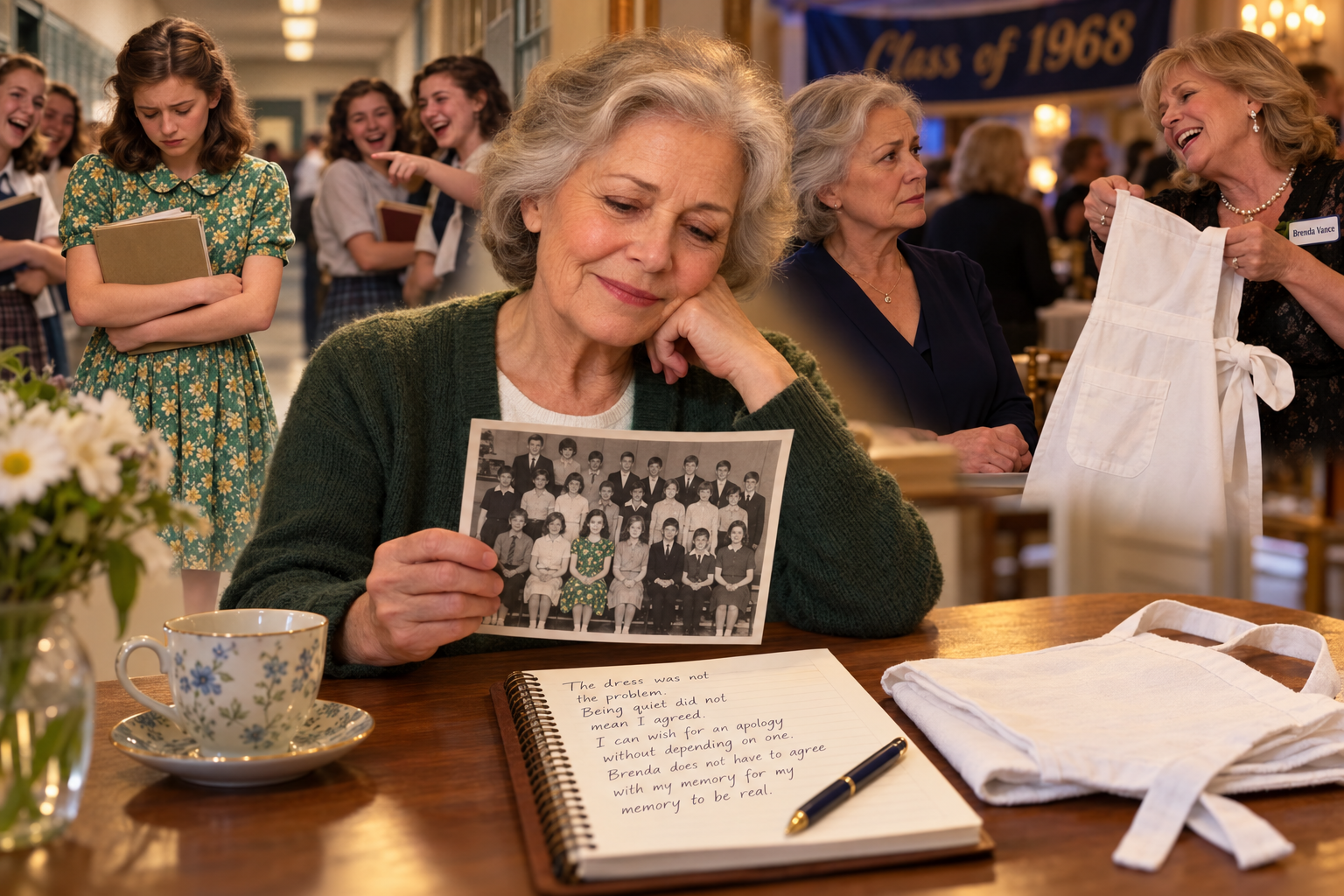
“The girl in the green dress.”
I looked down at my coffee.
“I hadn't thought about that dress in years. Not properly. I remembered wearing it, of course, but I hadn't remembered how it felt to walk into a room knowing somebody might notice.”
Eleanor rested her hands on the table.
“I remember the dress.”
I looked up.
“You do?”
“Yes.”
Her answer surprised me.
“I remember the flowers. Little yellow ones, weren't they?”
“Yellow and white.”
“And green leaves.”
I stared at her.
The details were so ordinary.
Still, hearing someone else remember them made something inside me loosen.
“I wore it because I liked it,” I said.
“There's nothing wrong with that.”
“I know that now.”
The words came out more sharply than I intended.
Eleanor didn't flinch.
I took a breath.
“I'm sorry. I didn't mean to sound angry with you.”
“You don't need to apologize for being angry.”
I looked at her for a long moment.
People had said kind things to me before.
I had usually found a way to dismiss them.
That morning, I tried not to.
“When Brenda made that joke, I didn't only hear what she said at the reunion,” I continued. “I heard the hallway at Oakridge High. I heard the laughter. I remembered looking down at my dress as if there might be something wrong with it.”
Eleanor lowered her eyes.
“I wish I had done more back then.”
“You were there?”
“Not right beside you. But I remember what happened.”
I had never known that.
Or perhaps I had known and forgotten because it was easier to believe nobody had noticed.
“What could you have done?” I asked.
“I could have said something.”
“So could a lot of people.”
The bitterness surprised me.
For years, I had directed it only at Brenda.
Now I could see how much the silence of everyone else had contributed to my embarrassment.
But I also knew that a school hallway full of teenagers wasn't a simple place.
People were afraid of becoming the next target.
Some were cruel.
Some were frightened.
Some watched and pretended they hadn't seen anything.
I had spent decades wondering which kind of person I had been.
“I never told anybody how much it bothered me,” I said.
Eleanor gave me a small, sad smile.
“You shouldn't have had to explain that it hurt.”
I turned my cup slowly.
“No. But I didn't know how to say it.”
I had been a girl who counted dresses before deciding what to wear.
A girl who knew which seams had been let out and which buttons had been replaced.
A girl who could tell when a hem had been repaired because she had done the repairing herself.
There was nothing shameful about any of that.
At the time, I hadn't understood that.
I had thought everyone else possessed some invisible knowledge about how to belong.
I had thought the right clothes could keep a person from being laughed at.
Then Brenda had shown me that no dress could protect me from somebody determined to make me feel small.
“I remember going home that day,” I said. “I changed out of the dress as soon as I could.”
Eleanor listened.
“I folded it carefully. I remember that part. I folded it as if I could make the whole day smaller by putting it away neatly.”
My voice had grown quiet.
“I didn't throw it out. I wore it again. But I never looked at it the same way.”
Eleanor reached for a biscuit and broke it in half.
“That's what shame does,” she said. “It convinces you that the thing someone did to you was something you should have prevented.”
I watched the crumbs gather on her plate.
I had spent years believing I should have worn something different.
I had wondered whether I had walked too slowly, spoken too softly, or given Brenda an opening.
I had replayed a moment in which the fault had never belonged to me.
“I wish I could go back and tell that girl something,” I said.
“What would you tell her?”
I didn't answer immediately.
The coffee shop was warm, and a radio played softly behind the counter.
A man near the door laughed at something on his phone.
The world continued around us.
“I'd tell her the dress was fine,” I said at last. “I'd tell her she didn't need to be embarrassed about wearing it again.”
Eleanor nodded.
“And I'd tell her Brenda didn't get to decide what kind of person she was.”
The words sounded simple.
They had taken me fifty-five years to say.
Eleanor looked at me carefully.
“Perhaps you can still tell her.”
I almost laughed.
“She's seventy-three, Eleanor.”
“She was still you.”
I looked back through the window.
For the first time, I understood what Eleanor meant.
The girl in that hallway had not disappeared when the bell rang.
She had followed me into adulthood.
She had stood beside me in rooms where I was afraid of being judged.
She had reminded me to keep my opinions to myself.
She had encouraged me to laugh along when somebody made me uncomfortable.
And she had been sitting beside me at the reunion when Brenda placed that white apron in my hands.
“I don't want to spend the rest of my life arguing with memories,” I said.
“Then don't argue with them.”
“What should I do instead?”
“Tell the truth about them.”
I looked at her.
She shrugged gently.
“You were poor enough that you had to make your clothes last. Brenda used that fact to embarrass you. You were hurt. None of those things makes you foolish.”
I let the words settle.
Outside, a woman helped a little boy zip his jacket.
He was impatient and kept turning away from her.
She laughed, caught his shoulders, and finished the zipper.
It was such a small scene.
It made me think about all the ordinary kindnesses that had been missing from the hallway at Oakridge.
I finished my coffee.
When we stood to leave, Eleanor reached for her coat.
“Will you be all right?” she asked.
“I think so.”
“And if you aren't?”
“I'll say so.”
She smiled.
“That would be a change.”
“It would.”
We walked to the door together.
Before we parted, Eleanor squeezed my arm.
I drove home with the windows closed and the heater running.
The old school photograph was still on my table when I entered the house.
I had left it there deliberately.
I no longer wanted to hide it.
I picked it up and looked at my younger face.
The girl in the green dress was not smiling.
But she was looking straight ahead.
For the first time, I wondered whether that mattered more than I had ever realized.
Click here to continue reading: PART 10: The Green Dress I Had Remembered as a Wound Was Still Part of My Life
The Woman Who Once Made Me Ashamed of My Clothes Had No Idea What My Life Had Become
Part 9 of 20

One Comment on “PART 9 – The Coffee Shop Where I Finally Spoke About the Girl I Had Been”