I finished most of my dinner.
That might sound unimportant, but I had been so distracted earlier that I had barely tasted anything.
Eleanor stayed beside me for a while.
We talked about our families and the strange ways time changed a person's priorities.
She told me about her grandchildren.
I told her a little about my son.
For several minutes, I felt like an ordinary woman attending an ordinary reunion.
Then Brenda approached our table again.
She was carrying a glass of water.
Her expression suggested that she had come to settle something.
“Martha, may I speak to you?”
Eleanor looked at me.
I nodded.
She rose and moved a few steps away, giving us privacy without leaving the area.
Brenda placed her glass on the table.
“I hope you didn't take that the wrong way.”
I looked at her.
“What way?”
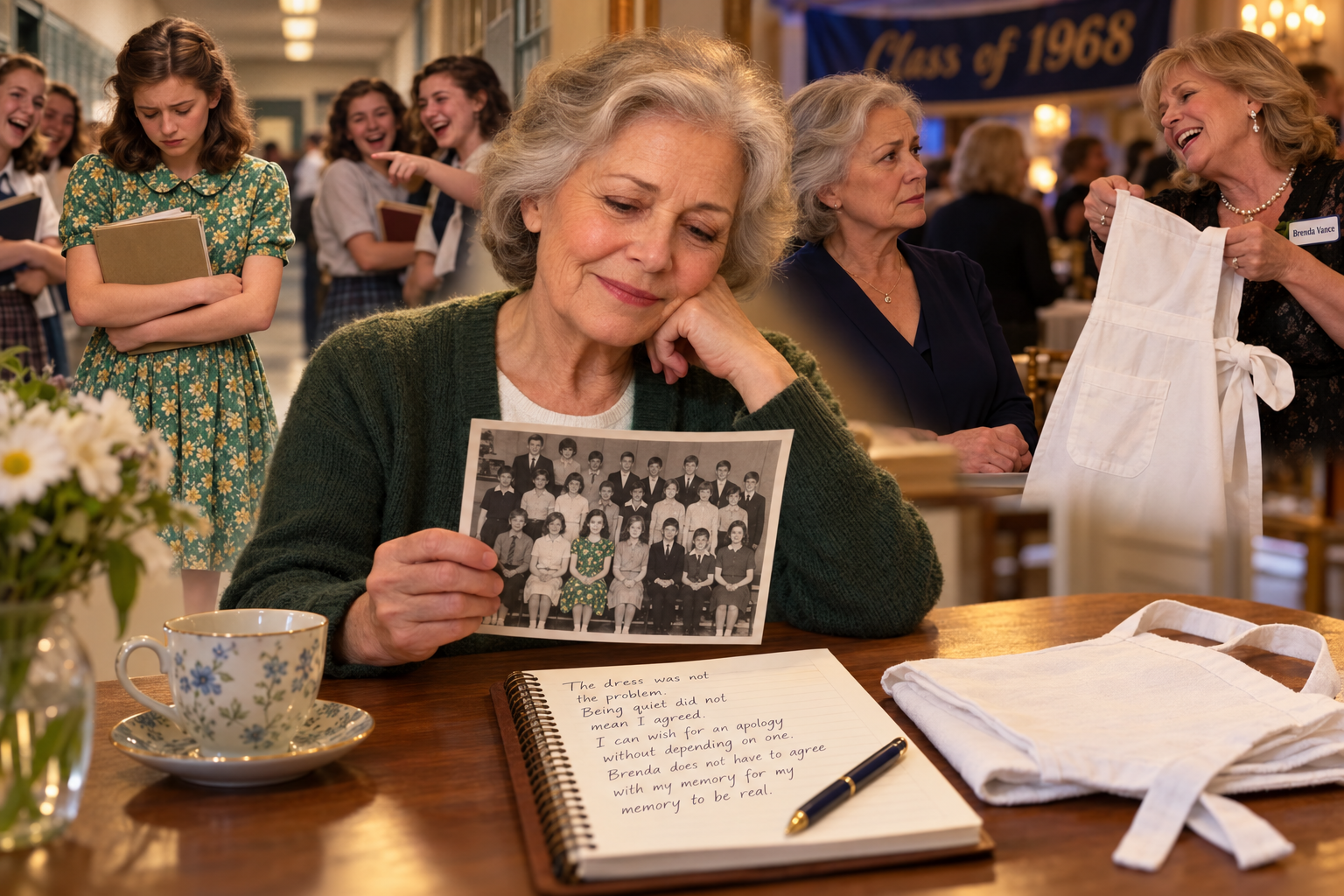
“The apron.”
She glanced toward the chair where she had left it.
“I was joking.”
I had expected an apology.
Instead, she was explaining why I should not have been offended.
I recognized the pattern immediately.
When I was seventeen, Brenda had treated my embarrassment as evidence that I lacked a sense of humor.
Now she was doing the same thing at seventy-three.
I could have accepted her explanation.
I could have smiled and told her it was fine.
That would have allowed us both to return to the evening without discomfort.
It was what I had done most of my life.
But I was tired of making other people comfortable at my own expense.
“I understood that you were joking,” I said.
Brenda seemed relieved.
Then I continued.
“I just didn't find it funny.”
Her expression changed.
Only a little.
But enough.
She took a sip of water.
“Well, I certainly didn't mean to upset you.”
“I believe you may not have thought about it.”
She looked at me more carefully.
I had not raised my voice.
I had not insulted her.
I had simply refused to take responsibility for an intention I could not know.
Brenda adjusted the bracelet on her wrist.
“I think we're all a little sensitive about getting older.”
I nearly laughed.
There she was again, changing the subject until the problem belonged to me.
I could have argued.
I could have reminded her of the hallway at Oakridge High and the green floral dress.
I could have told her that I had spent years remembering things she might not even recall.
But I decided not to.
Not yet.
Instead, I looked at the empty place beside me.
“Would you like to sit down?”
The question seemed to surprise her.
She glanced at the chair, then at the people standing nearby.
“No, I should check on the arrangements.”
“Of course.”
She picked up her glass.
For a moment, I thought she might say something else.
She did not.
She walked away.
I watched her go and realized that I had been expecting something from her for more than half a century.
An acknowledgment.
A sign that she understood.
Perhaps even an apology.
I had never admitted that to myself because it sounded childish.
I was a grown woman with a family, a business, and a life that had been full of real responsibilities.
Why should I care whether Brenda Vance remembered a cruel remark from high school?
The answer was uncomfortable.
Because part of me still wanted proof that the girl in the green dress had not deserved what happened.
I wanted Brenda to say that she had been wrong.
I wanted her to recognize that I had been more than the clothes I wore or the money my family lacked.
But I was beginning to see that my worth could not depend on whether she acknowledged it.
That did not mean her behavior was acceptable.
It meant I had to stop waiting for her to give me permission to feel differently about myself.
The distinction mattered.
I looked around the ballroom.
People were moving between tables, greeting old friends, and taking photographs.
Some couples stood close together.
Others sat side by side with the ease of people who had shared a long life.
I thought about my husband.
He had never known Brenda well.
I had mentioned her once or twice, usually when an old memory surfaced unexpectedly.
He listened, then asked why I gave so much importance to someone who had not been part of my life for decades.
I had never answered him properly.
At the time, I thought he simply did not understand.
Now I wondered whether he had understood more than I wanted to admit.
He had known that I carried certain memories like objects in a pocket.
I did not look at them every day.
But I never put them down.
After his death, I had become accustomed to having conversations with him in my head.
I imagined what he might say when I faced a difficult choice.
Sometimes the imagined advice was practical.
Sometimes it was nothing more than the sound of his familiar voice telling me to stop worrying.
That evening, I pictured him looking at the apron.
I knew exactly what he would have said.
He would have asked why I was standing there letting Brenda decide how the night would go.
Then he would have taken my hand.
I missed him.
The feeling came suddenly, without warning.
For a moment, the ballroom blurred around the edges.
I blinked and looked down at my plate.
Grief had a way of finding its own path.
It could enter through an old insult and lead me somewhere entirely different.
I had lost the man who knew me best.
Yet I was still allowing the opinion of a girl who barely knew me to determine how I felt about myself.
That seemed wrong.
Not because I needed to become fearless.
I had stopped believing in that kind of transformation years ago.
But because I wanted to spend the time I had left with less unnecessary shame.
I wanted to stop rehearsing old arguments.
I wanted to stop explaining myself to people who had already decided what they thought.
And I wanted to remember the girl I had been without feeling embarrassed by her.
Those desires were modest.
They were also overdue.
Later in the evening, Eleanor returned to her seat.
She asked whether I planned to stay until the end.
“I think so.”
“Good.”
She smiled.
“You shouldn't let one person ruin the night.”
I considered that.
“I won't.”
This time, I meant it.
The music changed, and several guests moved toward the open space near the band.
A few people began dancing.
Others gathered for photographs.
I watched Brenda from across the room.
She was speaking with two classmates and gesturing toward the banquet tables.
She seemed to have recovered completely from our exchange.
I did not know whether she had thought about it again.
I decided that I did not need to know.
For the rest of the evening, I spoke to people I remembered and people I had nearly forgotten.
Some conversations were pleasant.
Some were awkward.
One man mistook me for another classmate and spent several minutes talking about a teacher I had never met.
I corrected him gently.
He apologized.
We laughed.
Nothing terrible happened.
That was worth noticing.
Near the end of the formal program, the reunion organizer thanked everyone who had attended.
There was applause.
People began collecting their belongings and checking the time.
The hotel staff moved quietly around the room, preparing to clear the remaining dishes.
I stood beside my chair and adjusted the strap of my handbag.
Then I saw the apron again.
Someone had moved it from the chair and placed it on a service table near the partition.
It lay folded beside a stack of unused napkins.
The loose thread had been tucked underneath.
I looked at it for a few seconds.
When I was seventeen, I would have remembered the humiliation and forgotten everything else.
I would have gone home and replayed the laughter.
I would have wondered whether the other students thought Brenda was right about me.
I would have asked myself what I could have done differently.
This time, I tried a different question.
What had I actually done wrong?
I had worn a dress that belonged to me.
I had refused an offer I did not want.
I had told someone that I did not find her joke funny.
There was nothing shameful in any of that.
The answer was simple.
It was almost embarrassingly simple.
I had done nothing wrong.
I repeated the thought silently.
Then I picked up my handbag.
Eleanor walked with me toward the ballroom entrance.
At the doors, she touched my arm.
“I'm glad you came.”
“So am I.”
And I was.
Not because the evening had been pleasant from beginning to end.
Not because Brenda had changed.
She had not.
I was glad because I had finally seen something I had avoided for years.
I could remember what happened at Oakridge High without accepting the judgment that had followed me out of that building.
The girl in the green floral dress had not been ridiculous.
She had not been less deserving than the other students.
She had been trying to get through school with the things her family could afford.
I wished I could go back and tell her that.
I wished I could stand beside her in that hallway and let Brenda's laughter pass without becoming part of her identity.
But I could not return to seventeen.
I could only decide what to carry forward.
Outside the ballroom, the hotel corridor was quieter.
The sound of the music faded behind us.
Eleanor turned toward the elevators while I headed for the entrance.
I paused beside the glass doors and looked back once.
The ballroom was still bright.
The tables were being cleared.
The white apron remained on the service table.
I had spent most of my life believing that shame was something another person could place on you and leave you to carry.
That evening, I began to understand that I had also been carrying it because I did not know how to put it down.
I stepped outside into the cool night air.
For the first time since arriving, I did not wonder what Brenda would say about me after I left.
I wondered what I would say to myself.
Click here to continue reading: PART 5: The Drive Home Was Quiet, but the Girl I Had Been Followed Me Into Every Room of My House
The Woman Who Once Made Me Ashamed of My Clothes Had No Idea What My Life Had Become
Part 4 of 20